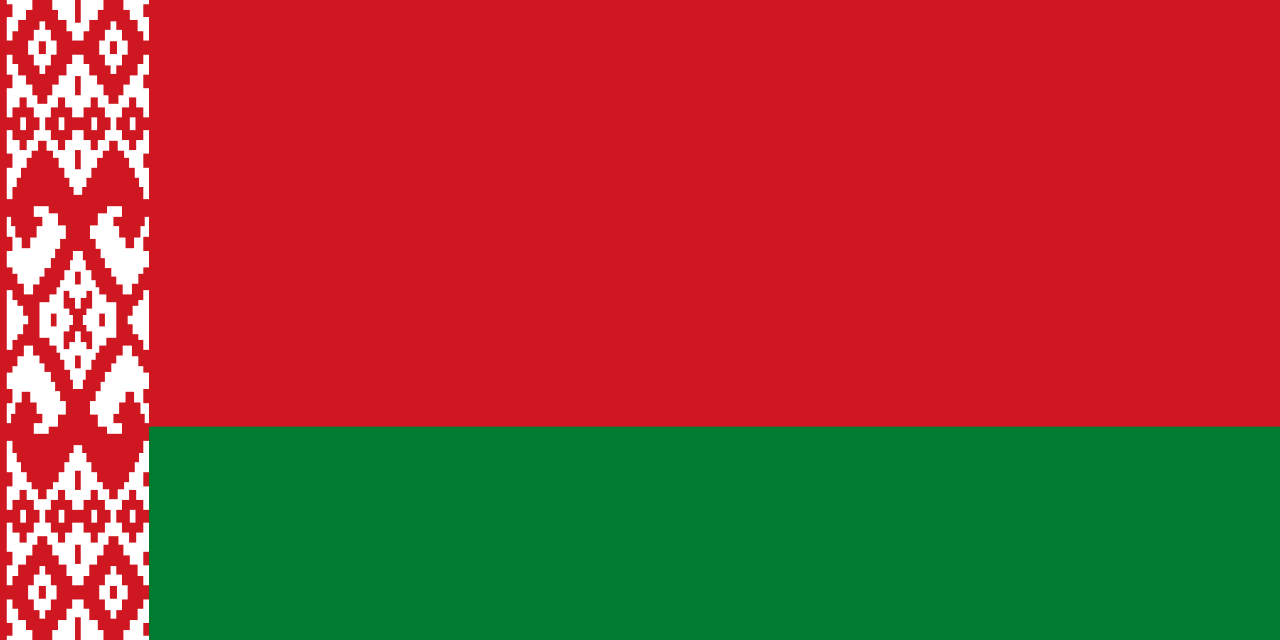
Belarus
Sign in to saveAlso known as White Russia, White Ruthenia, Republic of Belarus, by, Byeloruss, BLR, Bielorussia, Belorussia
Belarus, officially the Republic of Belarus, is a landlocked country in Eastern Europe. It is bordered by Russia to the east and northeast, Ukraine to the south, Poland to the west, and Lithuania and Latvia to the northwest. Belarus spans an area of with a population of . The country has a hemiboreal climate and is administratively divided into six regions. Minsk is the capital and largest city; it is administered separately as a city with special status.
Belarus is a landlocked country in Eastern Europe bordered by Russia, Ukraine, Poland, Lithuania, and Latvia, with its capital in Minsk. The country is administratively divided into six regions and has a hemiboreal climate.
AI-generated from the Wikipedia summary — may contain errors.
Weather now
7-day forecast
via Open-Meteo
Country
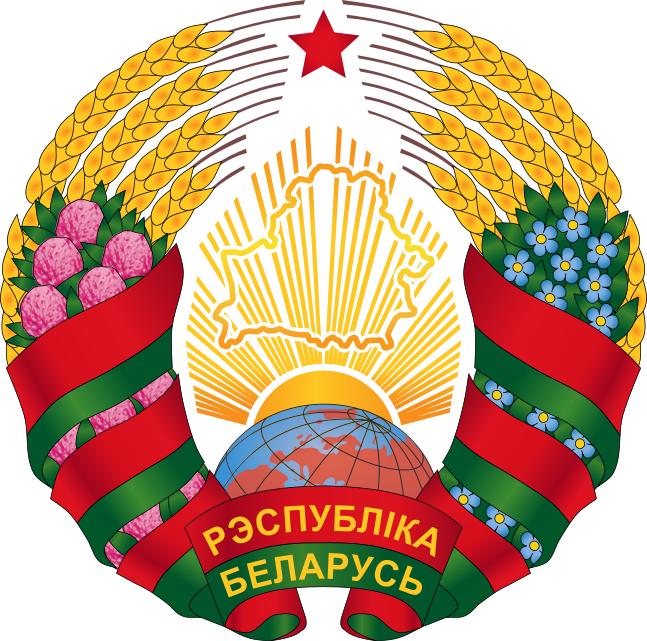
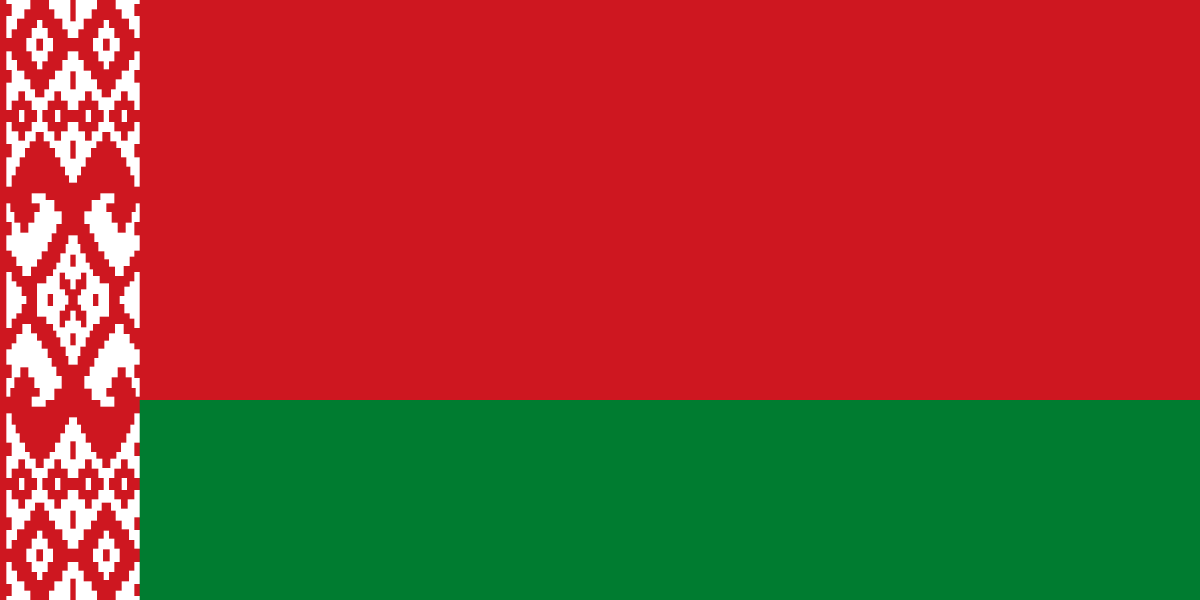
- Capital
- Minsk
- Population
- 9,109,280
- Region
- Europe · Eastern Europe
- Demonym
- Belarusian
- Currencies
- BYN (Br)
- Languages
- Belarusian, Russian
- Calling code
- +375
- Drives on
- Right
- Gini
- 25.3 (2019)
- FIFA code
- BLR
- TLD
- .by
- Timezones
- UTC+03:00
- Borders
- LVA, LTU, POL, RUS, UKR
via REST Countries
Indicators · World Bank
- GDP
- $76B(2024)
- Population
- 9,132,629(2024)
- Life expectancy
- 74.4 yrs(2024)
- Unemployment
- 3.4 %(2025)
- Urban population
- 79.2 %(2024)
- Internet users
- 94.3 %(2024)
- Forest area
- 43.4 %(2023)
- Renewable energy
- 8.2 %(2021)
via World Bank Open Data · CC BY 4.0
Place details
- Locality
- Блеўчыцкі сельскі Савет
- Region
- Мінская вобласць
- Country
- Беларусь
- Population
- 9,485,386
- Timezone
- Europe/Minsk
via OpenStreetMap · GeoNames
Wikipedia views (30d)
160,939 totalvia Wikimedia Pageviews API
Key facts
- Country.conventional_long_name
- Republic of Belarus
- Country.common_name
- Belarus
- Country.image_flag
- Flag of Belarus.svg
- Country.image_coat
- Coat of arms of Belarus (2020).svg
- Country.symbol_type
- Emblem
- Country.national_anthem
- "State Anthem of the Republic of Belarus"
- Country.capital
- Minsk
- Country.largest_city
- capital
- Country.languages2_type
- Widely used minority languages
- Country.religion_year
- 2020
- Country.demonym
- Belarusian
- Country.government_type
- Unitary semi-presidential republic under an authoritarian dictatorship
- Country.leader_title1
- President
- Country.leader_name1
- Alexander Lukashenko
- Country.leader_title2
- Prime Minister
- Country.leader_name2
- Alexander Turchin
- Country.legislature
- National Assembly
- Country.upper_house
- Council of the Republic
via Wikipedia infobox
Research
9,258 papers- Alcohol control policies and mortality trends in Belarus.ReviewDrug and alcohol review · 2020Grigoriev P, Bobrova ADOI: 10.1111/dar.13032
- Breastfeeding in Belarus.JAMA · 2001Lawrence RADOI: 10.1001/jama.285.4.463
- Belarus and drug-resistant tuberculosis.Bulletin of the World Health Organization · 2019DOI: 10.2471/BLT.19.021219
- Earthworms of Belarus (Annelida: Megadrili).Zootaxa · 2023Shekhovtsov SV, Derzhinsky YA, Ermolov SA et al.DOI: 10.11646/zootaxa.5255.1.9
- Epidemiology of childhood cancer in Belarus: review of data 1978-1994, and discussion of the new Belarusian Childhood Cancer Registry.ReviewStem cells (Dayton, Ohio) · 1997van Hoff J, Averkin YI, Hilchenko EI et al.DOI: 10.1002/stem.5530150731
- Several aspects of descriptive epidemiology of hematological malignancies in adult population of Ukraine, Belarus and Russian Federation after Chornobyl accident.ReviewExperimental oncology · 2016Guslitser N, Zavelevich MP, Koval SV et al.
- Outrage over Belarus Red Cross' deportation comments.Lancet (London, England) · 2023Holt EDOI: 10.1016/S0140-6736(23)00614-1
- Congenital malformations among newborns and developmental abnormalities among human embryos in Belarus after Chernobyl accident.ReviewCellular and molecular biology (Noisy-le-Grand, France) · 2002Feshchenko SP, Schröder HC, Müller WE et al.
via PubMed
Wikidata facts
- Instance of
- republic
- Named after
- White Ruthenia
- Official name
- Bieloruská republika
- Demonym
- Belarussinnen
- Participant in
- Russo-Ukrainian war (2022–present)
- Country
- Belarus
- Contains
- Minsk
- Continent
- Europe
- Capital
- Minsk
- Official language
- Russian
- Population
- 9491823
- Area
- 207596.76
- Head of government
- Alaksandar Turčyn
- Head of state
- Alexander Lukashenko
- Form of government
- presidential system
- Legislature
- National Assembly of the Republic of Belarus
- Anthem
- My Belarusy
- Shares border with
- European Union
- Highest point
- Dzyarzhynskaya Hara
- Official website
- www.belarus.by/cn
- Image
- Satellite image of Belarus in December 2002.jpg
- Life expectancy
- 73
- Nominal GDP
- 71857382745
- Unemployment rate
- 6
Show 81 more facts
- Calling code
- +375
- Licence plate code
- BLR
- Electrical plug type
- Schuko
- Mains voltage
- 220
- Motto
- Ospitalitate dincolo de granițe
- Flag
- flag of Belarus
- Coat of arms
- Pahonia
- topic's main Wikimedia portal
- Portal:Belarus
- Unicode character
- 🇧🇾
- category of associated people
- Category:People of Belarus
- trunk prefix
- 8
- geography of topic
- Geography of Belarus
- office held by head of government
- Prime Minister of Belarus
- Gini coefficient
- 24.4
- native label
- Беларусь
- public holiday
- Easter
- diplomatic relation
- North Korea
- inception
- 1991-09-19
- office held by head of state
- President of Belarus
- Commons gallery
- Беларусь
- history of topic
- history of Belarus
- replaces
- Soviet Union
- topic has template
- Template:First-level administrative divisions of Belarus
- separated from
- Soviet Union
- mobile country code
- 257
- total fertility rate
- 1.62
- maritime identification digits
- 206
- marriageable age
- 18
- topic's main category
- Category:Belarus
- central bank
- National Bank of the Republic of Belarus
- category for people buried here
- Category:Burials in Belarus
- age of majority
- 16
- railway traffic side
- right
- category for films shot at this location
- Category:Films shot in Belarus
- executive body
- Council of Ministers of the Republic of Belarus
- category for people who died here
- Category:Deaths in Belarus
- highest judicial authority
- Supreme Court of Belarus
- Commons category
- Belarus
- top-level Internet domain
- .бел
- category for people born here
- Category:Births in Belarus
- short name
- Беларусь
- number of out-of-school children
- 57823
- driving side
- right
- lowest point
- Neman
- IPA transcription
- bʲɛɫ̪äˈrus̪ʲ
- foreign direct investment net outflow
- 204800000
- described by source
- Brockhaus and Efron Encyclopedic Dictionary
- foreign direct investment net inflow
- 9904200000
- located in/on physical feature
- Eastern Europe
- minimum wage
- 330
- language used
- Belarusian
- literacy rate
- 100
- suicide rate
- 16.5
- GS1 country code
- 481
- culture
- culture of Belarus
- VAT rate
- 20
- BTI Status Index
- 4.61
- BTI Governance Index
- 2.78
- economy of topic
- economy of Belarus
- demographics of topic
- demographics of Belarus
- Democracy Index
- 2.59
- P6482
- Belarus
- maintained by WikiProject
- WikiProject Belarus
- official observer status in organization
- Shanghai Cooperation Organisation
- Human Development Index
- 0.808
- P11012
- Galileo Galilei
- hashtag
- Belarus
- on focus list of Wikimedia project
- Wikipedia:Vital articles/Level/4
- Happy Planet Index score
- 42.9
- Inequality-adjusted Human Development Index
- 0.765
- different from
- White movement
- P12749
- winter
- birth rate
- 9.165
- male population
- 4248965
- death rate
- 15.49
- rural population
- 1815531
- female population
- 4979107
- urban population
- 7412540
- water as percent of area
- 2.26
- water area
- 4702
Sources (15)
via Wikidata · CC0
Travel guide
Understand
thumb|300px|Independence Square in [[Minsk]]
Get in
thumb|375px|Visa free access anywhere for citizens of countries marked in green. Visa free entry for entry through Minsk Airport only for countries marked in ochre 300px|thumb|Church of the Transfiguration, Rakaŭ Although Belarus has an open border with Russia, third country nationals are not permitted to cross the border between Russia and Belarus overland; they are required to fly to travel directly between the two countries.
Get around
300px|thumb|Getting around [[Bobruisk in Belarus]]
With an area of , travelling around Belarus should not take a lot of time. A car ride to Brest from Minsk should take you about 4 hours, depending on traffic conditions.
See
300px|thumb|[[Brest (Belarus)|Brest fortress]]
The appeal of Belarus are little known, but the off the beaten track character of this unfamiliar country is exactly what makes it special to the people that visit. Much of the historic heritage was lost to World War II violence or to post-war communist planning, but there's more to see than one might expect at first glance. Take Minsk, the country's surprisingly modern and distinctively Eastern European capital, bustling with nightclubs and modern restaurants but simultaneously a monument of Communist architecture and city development, as it had to be completely reconstructed after the war. It's home to the fine Belarus State Museum, Independence Square (where democratic protests make world news every so many years) and the former KGB Headquarters but also the humbling Zaslavsky Jewish Monument. Far more western is the border city of Brest, where you'll find the 19th-century Brest Fortress, the site of a long and severe Operation Barbarossa battle and a monument of the Soviet resistance against the Germans.
There are four World Heritage Sites, although one, the Struve Geodetic Arc which provided the basis for the first meridian measurement, offers little more than an inscription to see. Of more interest for visitors are the late medieval Mir Castle Complex and Nesvizh Castle. They are the best of the country's castles, but a few more can be found if you're interested. For a glance of 19th-century life, visit the Dudutki Open A…
Do
Watch football: 16 teams play in the Belarusian Premier League, with four based in Minsk. The national team play at Dinamo Stadium in Minsk city centre, which is also the home ground of FC Minsk. The playing season is April-Nov. The Premier League gained attention in 2020 when it continued through the Covid pandemic, so it attracted TV spectators and betting from a global audience whose local games were halted.
Eat
thumb|300px|Draniki (potato pancakes)
In a nutshell: potatoes, pork, beef, bread.
If you are looking for a national gourmet meal, then you are in the right place. Most of the products and ingredients are organic, and radiation levels are constantly checked in the food to avoid contamination.
Take fresh bison, and if you do not have any, you can use elk instead. From an 18th-century Belarusian cookbook
Modern Belarusian cookery is based on old national traditions, which have undergone a long historical evolution, with similarities to the Russian cuisine. But the main methods of traditional Belarusian cuisine are carefully maintained by the people.
Dishes made with potatoes, which are called "the second bread", are common in Belarus. The Belarusians bring fame to their beloved potato in their verses, songs and dances. There are special potato cafes in the country where you can try various potato dishes. Many salads include potatoes; they are served together with mushrooms and/or meat; different pirazhki (patties) and baked puddings are made from it. The most popular among the Belarusians is traditional draniki (known as "latkes" to North Americans, but eaten only with sour cream, never apple sauce), thick pancakes prepared from shredded potatoes. The wide spread of potato dishes in Belarusian cuisine can be explained by natural climatic conditions of Belarus which are propitious for growing highly starched and tasty sorts of potatoes.
Meat and meat products, especially po…
Drink
thumb|"Belaya Rus" vodka
Typical non-alcoholic drinks include kefir, which is a sort of sour milk, similar to yogurt, kvas and kompot.
Vodka (harelka), bitter herbal nastoikas (especially Belavezhskaja) and sweet balsams are the most common alcoholic drinks.
Krambambula is a traditional medieval alcoholic drink which you can buy in most stores or order in a restaurant. It's a pretty strong drink but its taste is much softer than vodka.
Medovukha (or myadukha) is a honey-based alcoholic beverage very similar to mead.
Sbiten is a combination of kvass, another common soft alcohol drink, with honey.
Berezavik or biarozavy sok is a birch tree sap which is collected in March from small holes in birch tree trunks, with no harm to the plants. There are several variations of this very refreshing alcohol-free drink, which is a good thirst-quencher in hot weather.
Sleep
Don't leave valuable items, such as computers, mobile phones, or wallets/cash in hotel rooms as there have been reports of thefts by housekeepers.
Stay safe
thumb|The old Belarusian national flag, which is widely used by the opposition
Belarus is generally a safe country, largely because crime is punished severely by the government. Street-level crime is rare and usually does not affect tourists. You should still apply common sense and be vigilant of your surroundings.
Stay healthy
Medical care is generally poor and is well below western standards. Furthermore, the system is generally inaccessible to those who aren't proficient in Russian and/or Belarusian. Even if you have travel health insurance it might not be valid in Belarus.
Ambulances are poorly equipped and unreliable; a wait time of 30 minutes or more is not unusual. The fastest way to secure Western European-level care is medical evacuation to the European Union.
Tuberculosis (TB) is an increasingly serious health concern in Belarus. Consider consulting with a doctor about getting vaccinated before traveling to Belarus.
The impact of the Chernobyl disaster on the food chain is an ongoing study. Food inspectors check food not only for bacterial contamination but also its radiation levels. Most food is considered safe, except if sourced from the banned regions within 50 km of the Chernobyl plant or the second hotspot around the intersection of the Russian, Ukrainian and Belarusian borders.
Tap water is not safe for drinking. Buy bottled water.
Travel guide from Wikivoyage (CC BY-SA 4.0)
~40 min read
Encyclopedic overview
40 sectionsContents
- Etymology
- History
- Early history
- Kievan Rus'
- Polish–Lithuanian Commonwealth
- Russian Empire
- Early states and interwar period
- World War II
- Post-war
- Independence
- Lukashenko era
- Geography
- Government and politics
- Elections
- Local government
- Administrative divisions
- Foreign relations
- Military
- Human rights and corruption
- Economy
- Trade
- Employment
- Currency
- Free economic zones
- Telecommunications
- Demographics
- Languages
- Religion
- Culture
- Arts and literature
- Dress
- Cuisine
- Sport
- World Heritage Sites
- See also
- Notes
- References
- Bibliography
- Further reading
- External links
Belarus, officially the Republic of Belarus, is a landlocked country in Eastern Europe. It is bordered by Russia to the east and northeast, Ukraine to the south, Poland to the west, and Lithuania and Latvia to the northwest. Belarus spans an area of 207,600 square kilometres (80,200 sq mi) with a population of 9.1 million. The country has a hemiboreal climate and is administratively divided into six regions. Minsk is the capital and largest city; it is administered separately as a city with special status.
For most of the medieval period, the lands of modern-day Belarus were ruled by independent city-states such as the Principality of Polotsk. Around 1300 these lands came fully under the Grand Duchy of Lithuania and subsequently by the Polish–Lithuanian Commonwealth; this period lasted for 500 years until the 1792–1795 partitions of Poland-Lithuania placed Belarus within the Russian Empire for the first time. In the aftermath of the Russian Revolution in 1917, different states arose competing for legitimacy amid the Civil War, ultimately ending in the rise of the Byelorussian SSR, which became a founding constituent republic of the Soviet Union in 1922. After the Polish-Soviet War (1918–1921), Belarus lost almost half of its territory to Poland. Much of the borders of Belarus took their modern shape in 1939, when some lands of the Second Polish Republic were reintegrated into it after the Soviet invasion of Poland, and were finalised after World War II. During World War II, military operations devastated Belarus, which lost about a quarter of its population and half of its economic resources. In 1945, the Byelorussian SSR became a founding member of the United Nations, along with the Soviet Union. The republic was home to a widespread and diverse anti-Nazi insurgent movement which dominated politics until well into the 1970s, overseeing Belarus's transformation from an agrarian to an industrial economy.
Excerpted from Wikipedia’s “Belarus” article, available under the CC BY-SA 4.0 licence.
Gallery (639)
On the map
60 mapped locations
Available in 287 languages
- Español
- Français
- Deutsch
- 中文
- 日本語
- Русский
- Português
- Italiano
- العربية
- हिन्दी
- Abkhazian
- abstract
- Achinese
- Adyghe
- Afrikaans
- Akan
- Albanian
- Albanian
Show 268 more
- Amharic
- ami
- Angika
- Aragonese
- Aramaic
- Armenian
- Arpitan
- Assamese
- Asturian
- Avaric
- Awadhi
- Aymara
- azb
- Azerbaijani
- Bahasa Indonesia
- Balinese
- Bangla
- Banjar
- Bashkir
- Basque
- bat_smg
- Bavarian
- be_x_old
- Belarusian
- Betawi
- Bhojpuri
- Bikol
- Bishnupriya
- Bislama
- blk
- Bosnian
- Breton
- Bulgarian
- Buriat
- Burmese
- Catalan
- cbk_zam
- cdo
- Cebuano
- Central Kurdish
- Chechen
- Cherokee
- Church Slavic
- Chuvash
- Cornish
- Corsican
- Crimean Tatar
- Croatian
- Czech
- dag
- Danish
- Dinka
- Divehi
- dty
- Dzongkha
- Egyptian Arabic
- eml
- Erzya
- Esperanto
- Estonian
- Ewe
- Extremaduran
- Faroese
- Fiji Hindi
- Filipino
- Finnish
- fiu_vro
- Friulian
- Fula
- Gagauz
- Galician
- Ganda
- gcr
- Georgian
- Gilaki
- Goan Konkani
- Gothic
- Greek
- Guarani
- Gujarati
- Haitian Creole
- Hakka Chinese
- Hausa
- Hawaiian
- Hebrew
- Hungarian
- hyw
- Iban
- Icelandic
- Ido
- Igbo
- Iloko
- Inari Sami
- Interlingua
- Interlingue
- Irish
- Jamaican Creole English
- Javanese
- Kabardian
- Kabyle
- Kannada
- Kara-Kalpak
- Karachay-Balkar
- Kashmiri
- Kashubian
- Kazakh
- kbp
- Khmer
- Kinyarwanda
- Komi
- Komi-Permyak
- Kongo
- Kotava
- Kurdish
- Kyrgyz
- Ladino
- Lao
- Latgalian
- Latin
- Latvian
- Lezghian
- Ligurian
- Limburgish
- Lingala
- Lingua Franca Nova
- Lithuanian
- lld
- Lojban
- Lombard
- Low German
- Lower Sorbian
- Luxembourgish
- Macedonian
- Madurese
- Maithili
- Malagasy
- Malay
- Malayalam
- Maltese
- Manipuri
- Manx
- Māori
- map_bms
- Marathi
- Mari
- Mazanderani
- Minangkabau
- Mingrelian
- Mirandese
- Moksha
- Mongolian
- Moroccan Arabic
- Navajo
- nds_nl
- Neapolitan
- Nederlands
- Nepali
- Newari
- Northern Frisian
- Northern Sami
- Northern Sotho
- Norwegian
- Norwegian Nynorsk
- Novial
- Obolo
- Occitan
- Odia
- Old English
- olo
- Oromo
- Ossetic
- Pampanga
- Pangasinan
- Papiamento
- Pashto
- Picard
- Piedmontese
- Polski
- Pontic
- Punjabi
- Quechua
- roa_rup
- roa_tara
- Romanian
- Romansh
- Rusyn
- Samoan
- Sango
- Sanskrit
- Santali
- Sardinian
- Saterland Frisian
- Scots
- Scottish Gaelic
- Serbian
- Serbian (Latin)
- Shan
- Shona
- Sicilian
- Silesian
- simple
- Sindhi
- Sinhala
- skr
- Slovak
- Slovenian
- Somali
- Southern Sotho
- Sranan Tongo
- Standard Moroccan Tamazight
- Sundanese
- Svenska
- Swahili
- Swati
- syl
- szy
- Tachelhit
- Tahitian
- Tajik
- Talysh
- Tamil
- Taroko
- Tatar
- tay
- Telugu
- Tetum
- Tibetan
- Tiếng Việt
- Tok Pisin
- Toki Pona
- Tongan
- Tsonga
- Tumbuka
- Türkçe
- Turkmen
- Tyap
- Udmurt
- Ukrainian
- Upper Sorbian
- Urdu
- Uyghur
- Uzbek
- Venetian
- Veps
- Volapük
- Walloon
- Waray
- Welsh
- West Flemish
- Western Frisian
- Western Mari
- Western Panjabi
- Wolof
- Wu Chinese
- Xhosa
- Yakut
- Yiddish
- Yoruba
- Zaza
- Zeelandic
- zh_classical
- zh_min_nan
- zh_yue
- Zhuang
- Zulu
- فارسی
- ไทย
- 한국어
via Wikidata sitelinks · CC0