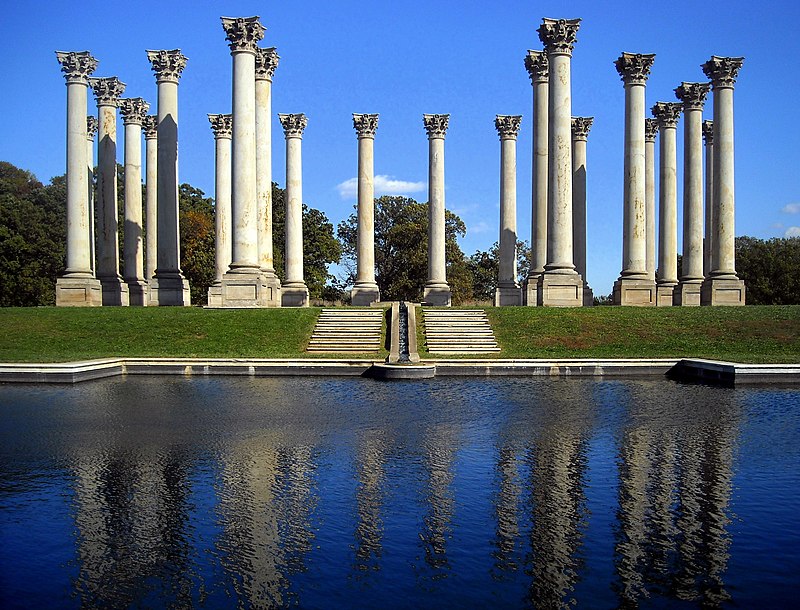
File:National_Capitol_Columns_-_Washington,_D.C..jpg · Wikimedia Commons · See Wikimedia Commons
column
Sign in to saveAlso known as Y-column, Y-shaped column, structural column, column drum, architectural column, pillar
thumb|right|upright=1|National Capitol Columns at the [[United States National Arboretum in Washington, D.C.]] thumb|right|upright=1|Columns of the Parliament House, Helsinki|Parliament House in [[Helsinki, Finland]] thumb|right|upright=1|Column of the Gordon Monument in Waterloo. A column or pillar in architecture and structural engineering is a structural element that transmits, through compression, the weight of the structure above to other structural elements below. In other words, a column is a compression member. The term column applies especially to a large round support (the shaft of t
A column is a vertical structural element in buildings that supports the weight of the structure above it by transmitting that weight downward through compression. Columns are important because they allow architects and engineers to design buildings with open interior spaces while safely distributing heavy loads to the foundation below.
AI-generated from the Wikipedia summary — may contain errors.
Wikidata facts
- Subclass of
- architectural element
- Part of
- building
- Has part
- capital
- Image
- Denderah cour.jpg
Show 8 more facts
- OpenStreetMap tag
- man_made=column
- Commons category
- Columns
- Commons gallery
- Column
- different from
- memorial column
- has characteristic
- shape
- P8168
- Ғ
- on focus list of Wikimedia project
- Wikipedia:Vital articles/Level/4
- name in kana
- はしら
Sources (3)
via Wikidata · CC0
~29 min read
Encyclopedic overview
29 sectionsContents
- History
- Antiquity
- Egyptian
- Greek and Roman
- Persian
- South Asia
- Middle Ages
- Mesoamerica
- Renaissance and later styles
- Structure
- Nomenclature
- Equilibrium, instability, and loads
- Extensions
- Foundations
- Orders
- Doric order
- Tuscan order
- Ionic order
- Corinthian order
- Composite order
- Solomonic
- Caryatid
- Engaged columns
- Pillar tombs
- Gallery
- See also
- References
- Sources
- External links
thumb|right|upright=1|National Capitol Columns at the [[United States National Arboretum in Washington, D.C.]] thumb|right|upright=1|Columns of the Parliament House, Helsinki|Parliament House in [[Helsinki, Finland]] thumb|right|upright=1|Column of the Gordon Monument in Waterloo. A column or pillar in architecture and structural engineering is a structural element that transmits, through compression, the weight of the structure above to other structural elements below. In other words, a column is a compression member. The term column applies especially to a large round support (the shaft of the column) with a capital and a base or pedestal, which is made of stone, or appearing to be so. A small wooden or metal support is typically called a post. Supports with a rectangular or other non-round section are usually called piers. Throughout architectural history, especially in Classical and Rennaisance styles, the column has been central to building design.
For the purpose of wind or earthquake engineering, columns may be designed to resist lateral forces. Other compression members are often termed "columns" because of the similar stress conditions. Columns are frequently used to support beams or arches on which the upper parts of walls or ceilings rest. In architecture, "column" refers to such a structural element that also has certain proportional and decorative features. These columns are available in a broad selection of styles and designs in round tapered, round straight, or square shaft styles. A column might also be a decorative element not needed for structural purposes; many columns are engaged, that is to say form part of a wall. A long sequence of columns joined by an entablature is known as a colonnade. In Classical architecture, columns have historically had a few different "orders", notably the Doric, Ionic, Corinthian, Tuscan, Composite, and Solomonic.
Excerpted from Wikipedia’s “column” article, available under the CC BY-SA 4.0 licence.
Gallery (26)
Available in 88 languages
- Español
- Français
- Deutsch
- 中文
- 日本語
- Русский
- Português
- Italiano
- العربية
- हिन्दी
- Albanian
- Aragonese
- Azerbaijani
- Bahasa Indonesia
- Bangla
- Basque
- be_x_old
- Belarusian
Show 69 more
- Bhojpuri
- Bikol
- Bosnian
- Breton
- Bulgarian
- Catalan
- Central Kurdish
- Croatian
- Czech
- Danish
- Esperanto
- Estonian
- Filipino
- Finnish
- Galician
- Greek
- Hebrew
- Hungarian
- Irish
- Kannada
- Kazakh
- Kyrgyz
- Latin
- Latvian
- Limburgish
- Lingua Franca Nova
- Lithuanian
- Macedonian
- Malay
- Malayalam
- Mazanderani
- Nederlands
- Nepali
- Newari
- Norwegian
- Norwegian Nynorsk
- nrm
- Occitan
- Polski
- Quechua
- Romanian
- Scots
- Serbian
- Serbian (Latin)
- Shona
- Sicilian
- simple
- Sindhi
- Slovak
- Slovenian
- Sundanese
- Svenska
- Swahili
- Tajik
- Tamil
- Telugu
- Tiếng Việt
- Türkçe
- Ukrainian
- Urdu
- Uzbek
- West Flemish
- Western Panjabi
- Wu Chinese
- Yakut
- zh_yue
- فارسی
- ไทย
- 한국어
via Wikidata sitelinks · CC0