Encyclopedia of Life · EOL (see source)
Crambe
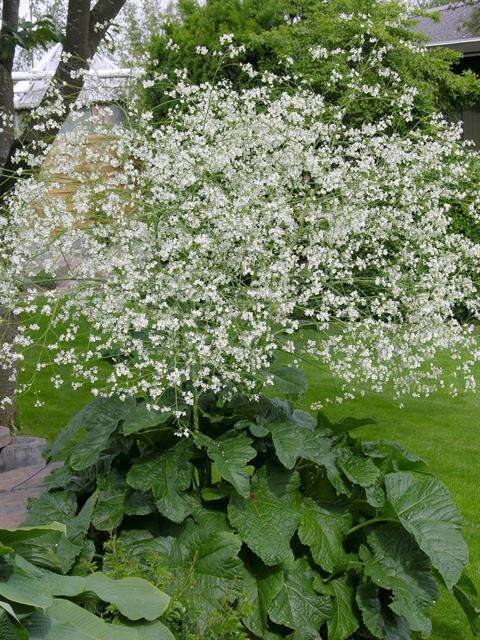
Sign in to saveCrambe is a genus of annual and perennial flowering plants in the family Brassicaceae, native to a variety of habitats in Europe, Turkey, southwest and central Asia and eastern Africa. They carry dense racemes of tiny white or yellow flowers on (mostly leafless) stems above the basal leaves. Crambe hispanica subsp. abyssinica, formerly known as Crambe abyssinica, is grown for the oil from the seeds that has characteristics similar to whale oil.
Species
Genus
- PhylumPorifera
- ClassDemospongiae
- OrderPoecilosclerida
- FamilyCrambeidae
Meerkohl (Crambe) ist eine Pflanzengattung in der Familie der Kreuzblütler (Brassicaceae). Die 34 bis 37 Arten sind von Mitteleuropa bis Westasien sowie Nordafrika und auf Kanarischen Inseln verbreitet; das Zentrum der Artenvielfalt ist der Mittelmeerraum. Einige Arten wie der Echte Meerkohl wurden früher an der Nord- und Ostseeküste wild gesammelt und vor allem als Futterpflanze verwendet. Die Krambe wird als Nachwachsender Rohstoff vor allem als Ölpflanze für technische Öle und Wachse genutzt. Mittlerweile steht Meerkohl in Deutschland jedoch unter Naturschutz. Als Halophyt, die an die erhöhten Salzgehalte an ihren Naturstandorten angepasst ist, besiedelt der Meerkohl vor allem salzhaltige Böden in kargen Küstengebieten und hat dort kaum Konkurrenz durch andere Pflanzen.[1] Inhaltsverzeichnis 1 Beschreibung 1.1 Vegetative Merkmale 1.2 Generative Merkmale 2 Vorkommen 3 Systematik und Verbreitung 4 Nutzung 5 Quellen 5.1 Einzelnachweise 6 Weblinks Beschreibung Illustration des Tatarischen Meerkohl (Crambe tataria) Vegetative Merkmale Der Meerkohl wächst als überwinternd grüne, ausdauernde krautige Pflanze, die eine Wuchshöhen von 20 bis 50, selten bis zu 75 Zentimetern erreicht. Es
via · Kew POWO
Museum specimens
- Specimen records
- 183
- With media
- 162
- Family
- Brassicaceae
- Collections
- MICH, MO
- Recorded in
- Russia, Canary Islands, Jordan, Algeria, Turkey, Ethiopia, Turkmenistan, Armenia
Research
333 papers- Biotechnological approach for improvement of Crambe species as valuable oilseed plants for industrial purposes.RSC advances · 2022
- Batzella, Crambe and Monanchora: Highly Prolific Marine Sponge Genera Yielding Compounds with Potential Applications for Cancer and Other Therapeutic Areas.Nutrients · 2018
- Crambe hispanica Subsp. abyssinica Diacylglycerol Acyltransferase Specificities Towards Diacylglycerols and Acyl-CoA Reveal Combinatorial Effects That Greatly Affect Enzymatic Activity and Specificity.Frontiers in plant science · 2019
- Detoxifying crambe meal by ammoniation.Nutrition reviews · 1967
- Chemical Investigation of the Mediterranean Sponge Crambe crambe by UHPLC-HRMS/MS via Manual and Computational Dereplication Approaches.Marine drugs · 2024
via PubMed
Wikidata facts
- Instance of
- taxon
- Parent taxon
- Brassiceae
- Image
- Seakale.JPG
Show 8 more facts
- taxon rank
- genus
- taxon name
- Crambe
- Commons category
- Crambe (Brassicaceae)
- topic's main category
- Category:Crambe (Brassicaceae)
- taxon common name
- 两行荠属
- has fruit type
- silique
- homonymous taxon
- Crambe
via Wikidata · CC0
~2 min read
Encyclopedic overview
3 sectionsContents
- Species
- References
- External links
Crambe is a genus of annual and perennial flowering plants in the family Brassicaceae, native to a variety of habitats in Europe, Turkey, southwest and central Asia and eastern Africa. They carry dense racemes of tiny white or yellow flowers on (mostly leafless) stems above the basal leaves. Crambe hispanica subsp. abyssinica, formerly known as Crambe abyssinica, is grown for the oil from the seeds that has characteristics similar to whale oil.
The word "crambe" derives, via the Latin crambe, from the Greek κράμβη, a kind of cabbage.
Excerpted from Wikipedia’s “Crambe” article, available under the CC BY-SA 4.0 licence.