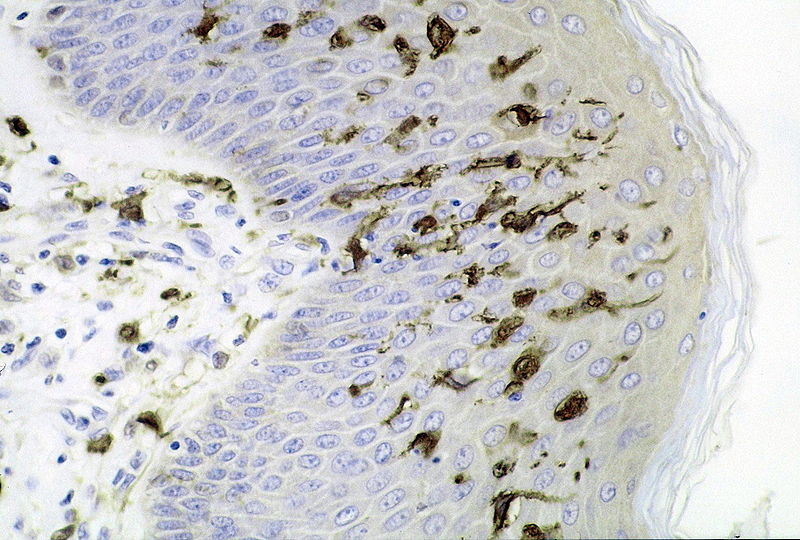
File:Dendritic_cells.jpg · Wikimedia Commons · See Wikimedia Commons
dendritic cell
Sign in to saveAlso known as dendritic cells, immune dendritic cells, DC
specialized cells of the hematopoietic system with branch-like extensions
Key facts
- System
- Immune system
- Latin
- cellula dendritiformis
- Mesh
- D003713
- Th
- H1.00.01.0.00038
via Wikipedia infobox
Research
150,122 papersvia PubMed
Wikidata facts
Show 2 more facts
- Commons category
- Dendritic cells
- different from
- dendrite
via Wikidata · CC0
~16 min read
Encyclopedic overview
A dendritic cell (DC) is an antigen-presenting cell (also known as an accessory cell) of the mammalian immune system. A dendritic cell's function is to process antigen material and present it on the cell surface to the T cells of the immune system. They act as messengers between the innate and adaptive immune systems.
Dendritic cells are present in tissues that are in contact with the body's external environment, such as the skin, and the inner lining of the nose, lungs, stomach and intestines. They can also be found in an immature and mature state in the blood. Once activated, they migrate to the lymph nodes, where they interact with T cells and B cells to initiate and shape the adaptive immune response. At certain development stages they grow branched projections, the dendrites, that give the cell its name (δένδρον or déndron being Greek for 'tree'). While similar in appearance to the dendrites of neurons, these are structures distinct from them. Immature dendritic cells are also called veiled cells, as they possess large cytoplasmic 'veils' rather than dendrites.
Excerpted from Wikipedia’s “dendritic cell” article, available under the CC BY-SA 4.0 licence.