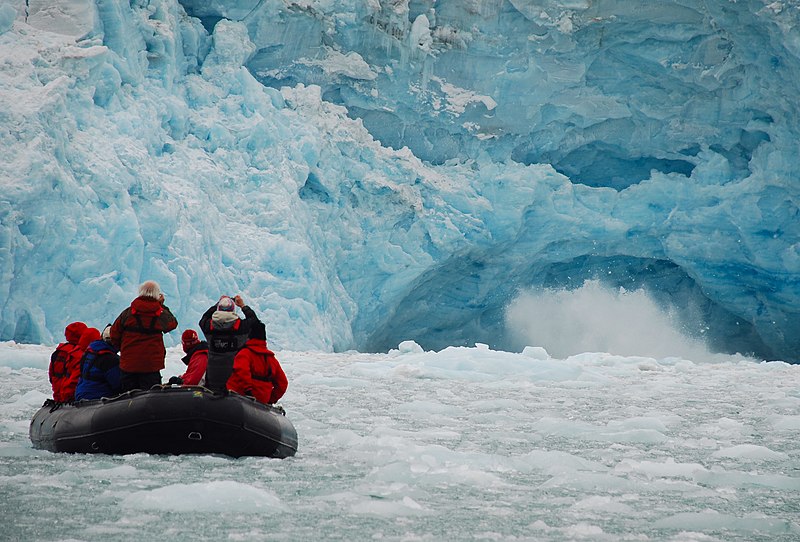
File:Ecotourism_Svalbard.JPG · Wikimedia Commons · See Wikimedia Commons
ecotourism
Sign in to saveAlso known as green tourism, environmental tourism, ecological tourism, natural environment tourism, conservation tourism, ecology tourism, ecosystem tourism, eco-friendly tourism
thumb|Ecotourism in Svalbard Ecotourism is a form of nature-oriented tourism intended to contribute to the conservation of the natural environment, generally defined as being minimally impactful, and including providing both contributions to conservation and environmental education. The definition sometimes also includes being financially beneficial to the host community or making conservation financially possible. There is a range of different definitions, and the correct definition of the term was an active subject of debate as of 2009. The term is also used more widely by many organizations
Ecotourism is nature-based tourism designed to minimize environmental damage while supporting conservation efforts and educating visitors about nature. It often aims to benefit local communities financially while making conservation economically sustainable, though experts have debated the precise definition of the term.
AI-generated from the Wikipedia summary — may contain errors.
In the Vinony graph
Vinony's link graph records 2,148 inbound references to ecotourism, and connects out to tourism, environmentalism and UN Tourism.
Vinony files it under Adventure travel, Ecological economics and Ecotourism.
Vinony links it to 66 Wikipedia language editions.
Wikidata facts
- Subclass of
- tourism
- Image
- Gruppenreise Kungsleden 2007.jpg
- Said to be same as
- nature tourism
Show 2 more facts
- Commons category
- Ecotourism
- topic's main category
- Category:Ecotourism
via Wikidata · CC0
~48 min read
Encyclopedic overview
37 sectionsContents
- Risks and benefits
- Ecological risk
- Risks to local communities
- Health risks
- Potential ecological benefits
- Direct benefits
- Indirect benefits
- Potential economic benefits
- Direct benefits
- Indirect benefits
- Potential socio-cultural benefits
- Direct and indirect benefits
- Terminology and history
- Related terms
- Sustainable tourism
- Improving sustainability
- Principles
- Regulation and accreditation
- Labels and certification
- Guidelines and education
- Small scale, slow growth, and local control
- Efforts to preserve ecosystems at risk
- Natural resource management
- Impact on indigenous people and indigenous land
- Criticism
- Definition
- Negative impact
- Direct environmental impacts
- Environmental hazards
- Who benefits?
- Eviction of Indigenous peoples
- Mismanagement by government
- Case studies
- See also
- References
- Further reading
- External links
thumb|Ecotourism in Svalbard Ecotourism is a form of nature-oriented tourism intended to contribute to the conservation of the natural environment, generally defined as being minimally impactful, and including providing both contributions to conservation and environmental education. The definition sometimes also includes being financially beneficial to the host community or making conservation financially possible. There is a range of different definitions, and the correct definition of the term was an active subject of debate as of 2009. The term is also used more widely by many organizations offering nature tourism, which do not focus on being beneficial to the environment.
Since the 1980s, ecotourism has been considered an important endeavor by environmentalists for conservation reasons. Organizations focusing on ecotourism often make direct or indirect contributions to conservation or employ practices or technology that reduce impacts on the environment. However (according to Buckley), very few organizations make a net-positive impact on the environment overall. Ecotourism has also been criticized for often using the same infrastructure and practices of regular tourism under a different name. Like most long-distance travel, ecotourism often depends on air transportation, which contributes to climate change.
Excerpted from Wikipedia’s “ecotourism” article, available under the CC BY-SA 4.0 licence.
Gallery (19)
Available in 66 languages
- Español
- Français
- Deutsch
- 中文
- 日本語
- Русский
- Português
- Italiano
- العربية
- हिन्दी
- Afrikaans
- Albanian
- Armenian
- Assamese
- Azerbaijani
- Bahasa Indonesia
- Basque
- Bhojpuri
Show 47 more
- Bosnian
- Bulgarian
- Catalan
- Croatian
- Czech
- Danish
- Dzongkha
- Esperanto
- Estonian
- Filipino
- Finnish
- Georgian
- Greek
- Hebrew
- Hungarian
- Icelandic
- Kazakh
- Kyrgyz
- Latin
- Latvian
- Lithuanian
- Malay
- Malayalam
- Mingrelian
- Nederlands
- Norwegian
- Norwegian Nynorsk
- Polski
- Romanian
- Sardinian
- Serbian
- Serbian (Latin)
- simple
- Slovenian
- Svenska
- Tajik
- Tamil
- Tiếng Việt
- Türkçe
- Ukrainian
- Urdu
- Uzbek
- Wu Chinese
- zh_yue
- فارسی
- ไทย
- 한국어
via Wikidata sitelinks · CC0