File:Roma_flag.svg · Wikimedia Commons · See Wikimedia Commons
flag of the Romani people
Also known as Romani flag, the Romani people flag, Romani people flag
flag
Key facts
- Other names
- O styago le romengo , O romanko flako
- Use
- Ethnic flag
- Adopted
- 1971, 1978
- Designed by
- Gheorghe A. Lăzăreanu-Lăzurică ( purported ), World Romani Congress , Weer Rajendra Rishi
via Wikipedia infobox
Wikidata facts
- Image
- Romernas flagga.png
Show 2 more facts
- inception
- 1971-00-00
- Commons category
- Flag of the Romani people
Sources (1)
via Wikidata · CC0
~40 min read
Article
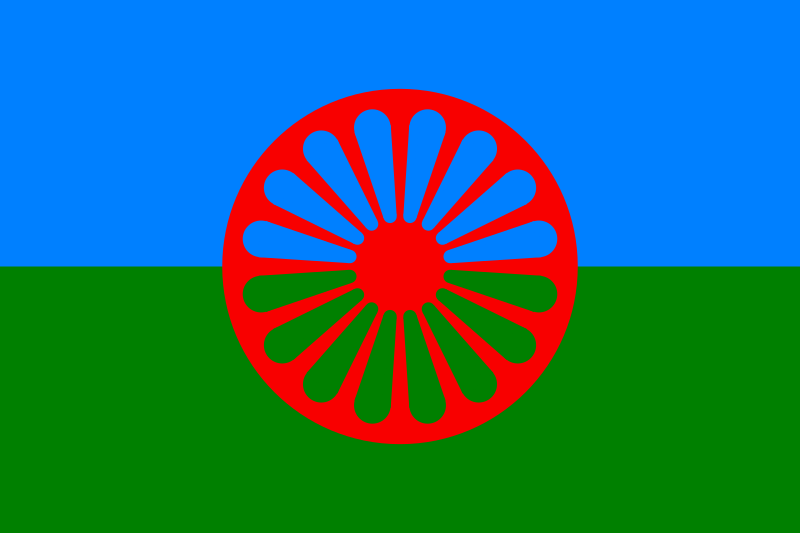
The Romani flag (Romani: O styago le romengo or O romanko flako) is the international ethnic flag of the Romani people, historically known as Gypsies. They constitute a stateless minority concentrated in Europe, but are also dispersed across parts of other continents. The flag was approved by the representatives of various Romani communities at the first and second World Romani Congresses (WRC), in 1971 and 1978. It consists of a background of blue and green, representing the heavens and earth, respectively; it also contains a 16-spoke red dharmachakra, or cartwheel, in the center. The latter element stands for the itinerant tradition of the Romani people and is also an homage to the flag of India, added to the flag by scholar Weer Rajendra Rishi. It superseded a number of tribal emblems and banners, several of which evoked claims of Romani descent from the Ancient Egyptians.
Older Romani symbolism comprises insignia reflecting occupational and tribal divisions, as well totems and pictograms. In some cases, Romani "Kings" and "Princes" were also integrated within the European heraldic tradition with coats of arms of their own. As a result of this synthesis, "Egyptians" became visually associated with heraldic animals, including the adder and, in the 19th century, the hedgehog. Around 1890, affiliates of the Gypsy Lore Society had deduced that a tricolor of red-yellow-black was preferred by the Spanish Romanies, and embraced it as a generic Romani symbol. In the Balkans at large, corporate representation was granted to the Gypsy esnaf—which preceded the creation of modern professional unions, all of which had their own seals or flags. The first stages of identity politics in the 20th century saw the emergence of Romani political groups, but their designs remained attached to those of more dominant cultural nationalisms in their respective country. Into the interwar era, the various and competing Romani flags were mostly based on Romanian, Polish, communist, or Islamic symbolism.