ftira
Sign in to saveAlso known as Il-Ftira, culinary art and culture of flattened sourdough bread in Malta
Ftira (plural: ftajjar) is a ring-shaped, leavened, Maltese bread, usually eaten with fillings such as sardines, tuna, potato, fresh tomato, onion, capers and olives. Regional variations include Gozo ftira, which is served more like a pizza than a sandwich. Gozitan ftira is served open with thinly sliced potato over the crust, or folded over like a calzone.
Key facts
- Food.country
- Malta
- Food.type
- Bread
- Food.name
- Maltese ftira
- Food.image
- File:Ftira with Tuna in Marsaxlokk 02.jpg
- Food.variations
- Gozitan open ftira
via Wikipedia infobox
Described at
Il-Ftira, culinary art and culture of flattened sourdough bread in Malta - UNESCO Intangible Cultural Heritage
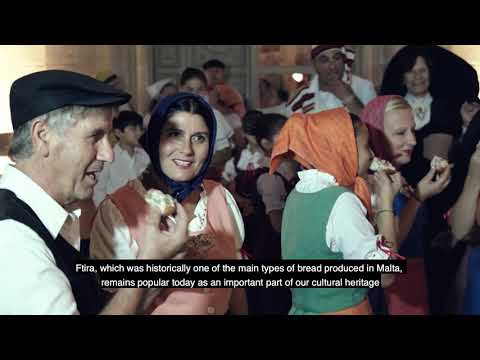
ich.unesco.org →Il-Ftira, culinary art and culture of flattened sourdough bread in Malta, is a key part of the cultural heritage of the inhabitants of the Maltese archipelago. Ftira has a thick crust and light internal texture, characterized by large, irregular holes (an open crumb). It is flatter than other Maltese breads and has a hotter baking temperature. The halved loaf is filled with Mediterranean-type ingredients such as olive oil and tomato, tuna, capers and olives. Seasonal variants and inventive twists can also be added. With a name derived from Arabic (fatir, meaning unleavened bread), ftira culture reflects the continuity of intercultural exchange in Malta’s history. Although other kinds of Maltese bread can be made with a mechanized process, skilled bakers are still needed to shape ftira by hand. In the bakery, apprentices learn by watching and doing, and various training programmes also exist. The skills of choosing compatible ingredients and filling ftira are passed down informally in homes, as well as through other channels such as social media and cooking blogs. Eating ftira as a filled snack or appetiser fosters a shared identity in Malta, bringing people together. A wide variety of people, including marginalized groups, can enter the baking profession as apprentices, and Ftira Days in schools help inform students about healthy eating. 1. Social practices, rituals and festive events (584) 2. Traditional craftsmanship (460)
Excerpt from a page describing this subject · 8,472 chars · not written by Vinony
Wikidata facts
- Subclass of
- sourdough bread
- Country
- Malta
- Country of origin
- Malta
- Image
- Malta ftira.JPG
Show 2 more facts
- native label
- ftira
Sources (3)
via Wikidata · CC0
~1 min read
Encyclopedic overview
3 sectionsContents
- Intangible cultural heritage
- See also
- References
Ftira (plural: ftajjar) is a ring-shaped, leavened, Maltese bread, usually eaten with fillings such as sardines, tuna, potato, fresh tomato, onion, capers and olives. Regional variations include Gozo ftira, which is served more like a pizza than a sandwich. Gozitan ftira is served open with thinly sliced potato over the crust, or folded over like a calzone.
==Intangible cultural heritage== Following the Maltese Parliament's unanimous approval to ratify UNESCO's Convention for the Safeguarding of the Intangible Cultural Heritage, in 2018 Malta's Culture Directorate launched a petition to include the Maltese Ftira as part of UNESCO's Intangible Cultural Heritage (ICH) list. According to a local expert, 'The Making of the Ftira Maltija' dates back to the Sixteenth Century. Following a strong public call, the Government of Malta announced that it would be submitting the culinary art and culture of the Maltese ftira to UNESCO for consideration as intangible cultural heritage. In 2020, "Il-Ftira, culinary art and culture of flattened sourdough bread in Malta" was added to UNESCO's Intangible Cultural Heritage List. ==See also== Maltese cuisine List of Maltese dishes
Excerpted from Wikipedia’s “ftira” article, available under the CC BY-SA 4.0 licence.