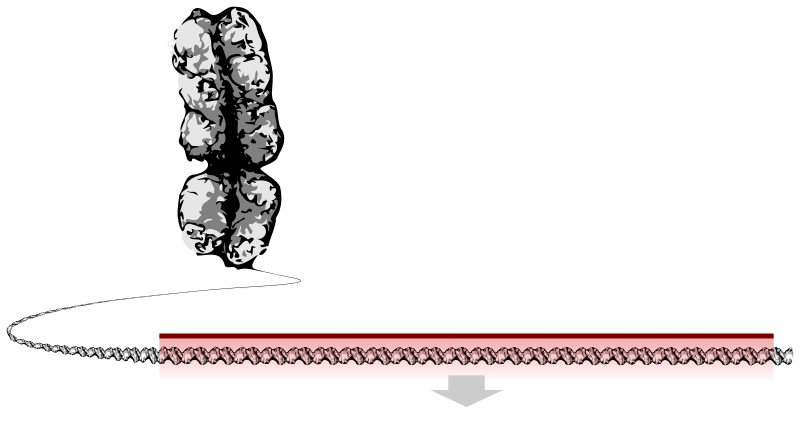
File:Chromosome_DNA_Gene_unannotated.svg · Wikimedia Commons · See Wikimedia Commons
gene
Sign in to saveAlso known as genes
In biology, the word gene has two meanings. The Mendelian gene is a basic unit of heredity. The molecular gene is a sequence of nucleotides in DNA that is transcribed to produce RNA. There are two types of molecular genes: protein-coding genes and non-coding genes. During gene expression (the synthesis of RNA or protein from a gene), DNA is first copied into RNA. RNA can be directly functional or be the intermediate template for the synthesis of a protein.
A gene is a unit of heredity that contains the instructions for traits passed from parents to offspring, and at the molecular level, it's a specific sequence of DNA that gets copied into RNA. Genes matter because they direct the production of RNA and proteins that control how our bodies develop and function.
AI-generated from the Wikipedia summary — may contain errors.
Research
3,791,759 papers- Resurrection from lethal knockouts: Bypass of gene essentiality.ReviewBiochemical and biophysical research communications · 2020Du LLDOI: 10.1016/j.bbrc.2020.05.207
- Gene-for-gene complementarity in plant-pathogen interactions.ReviewAnnual review of genetics · 1990Keen NTDOI: 10.1146/annurev.ge.24.120190.002311
- Gene expression studies of reference genes for quantitative real-time PCR: an overview in insects.ReviewBiotechnology letters · 2018Shakeel M, Rodriguez A, Tahir UB et al.DOI: 10.1007/s10529-017-2465-4
- Essentiality-specific pathogenicity prioritization gene score to improve filtering of disease sequence data.ReviewBriefings in bioinformatics · 2021Alyousfi D, Baralle D, Collins ADOI: 10.1093/bib/bbaa029
- Machine learning approach to gene essentiality prediction: a review.ReviewBriefings in bioinformatics · 2021Aromolaran O, Aromolaran D, Isewon I et al.DOI: 10.1093/bib/bbab128
- [Gene expression in brain ischemia].ReviewBrain and nerve = Shinkei kenkyu no shinpo · 2008Yagita Y, Sakoda S, Kitagawa K
- Gene Switching and Essentiality Testing.Methods in molecular biology (Clifton, N.J.) · 2021Brown ACDOI: 10.1007/978-1-0716-1460-0_13
- Gene therapy for lung cancer: practice and promise.ReviewAnnali italiani di chirurgia · 2004Vattemi E, Claudio PP
via PubMed
Wikidata facts
- Subclass of
- biomolecular structure
- Part of
- gene cluster
- Image
- Gene structure eukaryote 2 annotated.svg
Show 9 more facts
- topic's main category
- Category:Genes
- Commons category
- Genes
- equivalent class
- schema.org/Gene
- exact match
- purl.obolibrary.org/obo/SO_0000704
- model item
- acetylcholinesterase
- Stack Exchange tag
- bioinformatics.stackexchange.com/tags/gene
- different from
- genome
- subject has role
- heredity
- on focus list of Wikimedia project
- Wikipedia:Vital articles/Level/4
Sources (6)
via Wikidata · CC0
~42 min read
Encyclopedic overview
31 sectionsContents
- Definitions
- History
- Discovery of discrete inherited units
- Discovery of DNA
- Modern synthesis and its successors
- Molecular basis
- DNA
- Chromosomes
- Structure
- Complexity
- Gene expression
- Genetic code
- Transcription
- Translation
- Regulation
- RNA genes
- Inheritance
- Mendelian inheritance
- DNA replication and cell division
- Molecular inheritance
- Genome
- Number of genes
- Essential genes
- Genetic and genomic nomenclature
- Genetic engineering
- See also
- References
- Citations
- Sources
- Further reading
- External links
In biology, the word gene has two meanings. The Mendelian gene is a basic unit of heredity. The molecular gene is a sequence of nucleotides in DNA that is transcribed to produce RNA. There are two types of molecular genes: protein-coding genes and non-coding genes. During gene expression (the synthesis of RNA or protein from a gene), DNA is first copied into RNA. RNA can be directly functional or be the intermediate template for the synthesis of a protein.
The transmission of genes to an organism's offspring is the basis of the inheritance of phenotypic traits from one generation to the next. These genes make up different DNA sequences, together called a genotype, that is specific to every given individual, within the gene pool of the population of a given species. The genotype, along with environmental and developmental factors, ultimately determines the phenotype of the individual.
Excerpted from Wikipedia’s “gene” article, available under the CC BY-SA 4.0 licence.
Gallery (22)
Available in 126 languages
- Español
- Français
- Deutsch
- 中文
- 日本語
- Русский
- Português
- Italiano
- العربية
- हिन्दी
- Afrikaans
- Albanian
- Albanian
- Amharic
- Armenian
- Asturian
- Azerbaijani
- Bahasa Indonesia
Show 107 more
- Bangla
- Bashkir
- Basque
- be_x_old
- Belarusian
- blk
- Bosnian
- Bulgarian
- Burmese
- Catalan
- cdo
- Central Kurdish
- Chuvash
- Croatian
- Czech
- Danish
- Egyptian Arabic
- Esperanto
- Estonian
- Filipino
- Finnish
- Galician
- gcr
- Georgian
- Gorontalo
- Greek
- Haitian Creole
- Hebrew
- Hungarian
- Icelandic
- Ido
- Ingush
- Interlingua
- Irish
- Jamaican Creole English
- Javanese
- Kannada
- Kazakh
- Kikuyu
- Kurdish
- Kyrgyz
- Lao
- Latin
- Latvian
- Lithuanian
- lld
- Macedonian
- Malagasy
- Malay
- Malayalam
- Mingrelian
- Mongolian
- Nederlands
- Nepali
- Newari
- Northern Frisian
- Northern Sami
- Norwegian
- Norwegian Nynorsk
- Occitan
- Oromo
- Papiamento
- Pashto
- Polski
- Punjabi
- Quechua
- rki
- Romanian
- Scots
- Serbian
- Serbian (Latin)
- Shona
- Sicilian
- simple
- Sindhi
- Sinhala
- Slovak
- Slovenian
- Somali
- Sundanese
- Svenska
- Swahili
- Tajik
- Tamil
- Tatar
- Telugu
- Tiếng Việt
- Türkçe
- Ukrainian
- Urdu
- Uzbek
- Waray
- Welsh
- Western Frisian
- Western Panjabi
- Wu Chinese
- Xhosa
- Yakut
- Yiddish
- zh_classical
- zh_min_nan
- zh_yue
- Zhuang
- Zulu
- فارسی
- ไทย
- 한국어
via Wikidata sitelinks · CC0