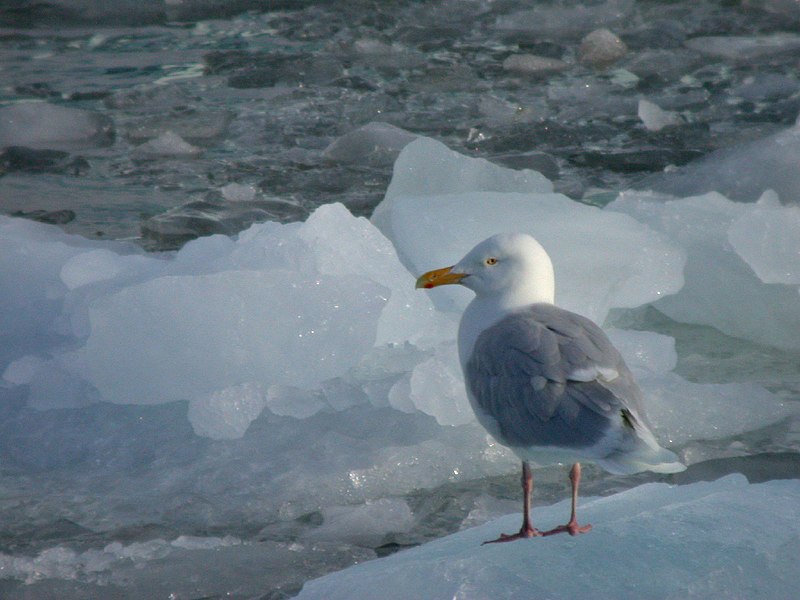
File:Glacous_Gull_on_ice.jpg · Wikimedia Commons · See Wikimedia Commons
OverviewAI-generated
The Glaucous Gull, scientifically named *Larus hyperboreus*, is a species of bird within the family Laridae. It belongs to the order Charadriiformes, class Aves, and phylum Chordata. The species is classified under the genus *Larus* and was described by Gunnerus in 1767. Its taxonomic status is accepted.
This marine bird has a wingspan of 158 and a mass of 1.576. It is also referred to by the common names Hvítmáfur, Polarmåke, and Gråmåge. The IUCN Red List assessed the species as Least Concern in 2018. The taxon range is listed as Africa.
Synthesized by Vinony from 24 facts across 4 sources: Wikidata, WoRMS, IUCN Red List, Vinony graph. Generated from structured data (not the Wikipedia text) and checked against those facts — may still contain errors.
In the Vinony graph
Vinony's link graph records 307 inbound references to Glaucous Gull, and connects out to subspecies, Europe and Iceland.
Vinony files it under Birds described in 1767, Birds of the Arctic and Holarctic birds.
Vinony links it to 55 Wikipedia language editions.
Species
Least Concernglaucous gull
Species
- PhylumChordata
- ClassAves
- OrderCharadriiformes
- FamilyLaridae
via IUCN
Wikidata facts
Show 9 more facts
- taxon rank
- species
- IUCN conservation status
- Least Concern
- taxon name
- Larus hyperboreus
- Commons category
- Larus hyperboreus
- Commons gallery
- Larus hyperboreus
- wingspan
- 158
- short name
- L. hyperboreus
- taxon common name
- gaivota-hiperbórea
- taxon range
- Africa
Sources (8)
via Wikidata · CC0
~4 min read
Encyclopedic overview
The glaucous gull (Larus hyperboreus) is a large gull, the second-largest gull in the world. The genus name is from Latin larus, which appears to have referred to a gull or other large seabird. The specific name hyperboreus is Latin for "northern" from the Ancient Greek Huperboreoi people from the far north "Glaucous" is from Latin glaucus and denotes the grey colour of the gull. An older English name for this species is burgomaster.
Distribution
Excerpted from Wikipedia’s “Glaucous Gull” article, available under the CC BY-SA 4.0 licence.
Gallery (10)
Available in 55 languages
- Español
- Français
- Deutsch
- 中文
- 日本語
- Русский
- Português
- Italiano
- العربية
- Asturian
- Basque
- Breton
- Bulgarian
- Catalan
- Cebuano
- Croatian
- Czech
- Danish
Show 36 more
- Egyptian Arabic
- Esperanto
- Estonian
- Faroese
- Finnish
- Galician
- Georgian
- Hebrew
- Hungarian
- Icelandic
- Inupiaq
- Irish
- Kazakh
- Latvian
- Lithuanian
- Mongolian
- Navajo
- Nederlands
- Northern Frisian
- Northern Sami
- Norwegian
- Norwegian Nynorsk
- Piedmontese
- Polski
- Romanian
- Scots
- Slovak
- Svenska
- Tiếng Việt
- Türkçe
- Ukrainian
- Waray
- Welsh
- Western Frisian
- فارسی
- 한국어
via Wikidata sitelinks · CC0