File:Glycolysis_metabolic_pathway_3.svg · Wikimedia Commons · See Wikimedia Commons
glycolytic process
Sign in to saveAlso known as GO:0006096, glycolysis
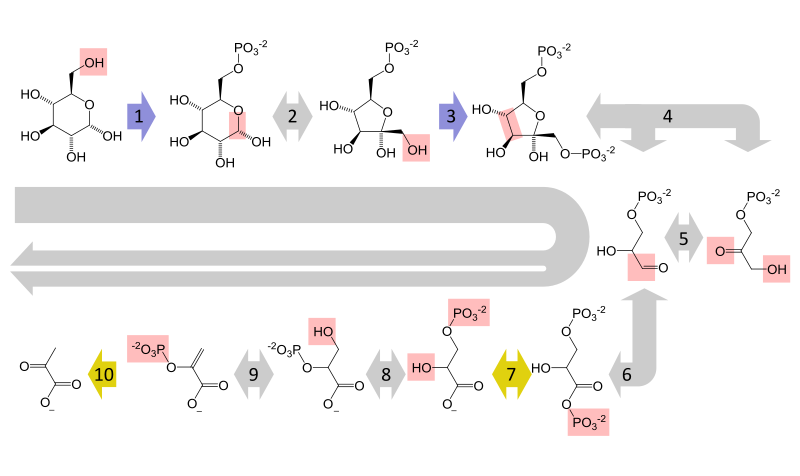
thumb|400px|class=skin-invert-image|Summary of aerobic respirationGlycolysis is the metabolic pathway that converts glucose () into pyruvate and, in most organisms, occurs in the liquid part of cells (the cytosol). The free energy released in this process is used to form the high-energy molecules adenosine triphosphate (ATP) and reduced nicotinamide adenine dinucleotide (NADH). Glycolysis is a sequence of ten reactions catalyzed by enzymes. thumb|375x375px|Summary of the 10 reactions of the glycolysis pathway
Glycolysis is a cellular process that breaks down glucose into pyruvate through ten enzyme-catalyzed reactions, primarily occurring in the cytosol (the liquid part of cells). This process matters because it releases energy that cells capture and store in high-energy molecules called ATP and NADH, which fuel essential cellular functions.
AI-generated from the Wikipedia summary — may contain errors.
Research
66,605 papers- The glycolytic process in endothelial cells and its implications.ReviewActa pharmacologica Sinica · 2022Leung SWS, Shi YDOI: 10.1038/s41401-021-00647-y
- Target modulation of glycolytic pathways as a new strategy for the treatment of neuroinflammatory diseases.ReviewAgeing research reviews · 2024Wang H, Liu S, Sun Y et al.DOI: 10.1016/j.arr.2024.102472
- Role of PFKFB3-driven glycolysis in vessel sprouting.Cell · 2013De Bock K, Georgiadou M, Schoors S et al.DOI: 10.1016/j.cell.2013.06.037
- Senescent melanocytes driven by glycolytic changes are characterized by melanosome transport dysfunction.Theranostics · 2023Park YJ, Kim JC, Kim Y et al.DOI: 10.7150/thno.84912
- Tumor glycolysis as a target for cancer therapy: progress and prospects.ReviewMolecular cancer · 2013Ganapathy-Kanniappan S, Geschwind JFDOI: 10.1186/1476-4598-12-152
- Disruption of the eEF1A1/ARID3A/PKC-δ Complex by Neferine Inhibits Macrophage Glycolytic Reprogramming in Atherosclerosis.Advanced science (Weinheim, Baden-Wurttemberg, Germany) · 2025Xie B, Tian LW, Liu C et al.DOI: 10.1002/advs.202416158
- Histone lactylation mediated by Fam172a in POMC neurons regulates energy balance.Nature communications · 2024Chen Z, Wan B, Zhang H et al.DOI: 10.1038/s41467-024-54488-4
- Tumor glycolysis, an essential sweet tooth of tumor cells.ReviewSeminars in cancer biology · 2022Paul S, Ghosh S, Kumar SDOI: 10.1016/j.semcancer.2022.09.007
via PubMed
Wikidata facts
- Instance of
- biological process
- Image
- GlycolysiscompleteLabelled.png
Show 4 more facts
- topic's main category
- Category:Glycolysis
- Commons category
- Glycolysis
- exact match
- purl.obolibrary.org/obo/GO_0006096
- on focus list of Wikimedia project
- Wikipedia:Vital articles/Level/4
Sources (3)
via Wikidata · CC0
~48 min read
Encyclopedic overview
29 sectionsContents
- Overview
- History
- Sequence of reactions
- Summary of reactions
- Biochemical logic
- Free energy changes
- Regulation
- Regulation by insulin in animals
- Regulated Enzymes in Glycolysis
- Hexokinase and glucokinase
- Phosphofructokinase
- Pyruvate kinase
- Post-glycolysis processes
- Anoxic regeneration of NAD<sup>+</sup>
- Aerobic regeneration of NAD<sup>+</sup> and further catabolism of pyruvate
- Conversion of carbohydrates into fatty acids and cholesterol
- Conversion of pyruvate into oxaloacetate for the citric acid cycle
- Intermediates for other pathways
- Glycolysis in disease
- Diabetes
- Genetic diseases
- Cancer
- Interactive pathway map
- Alternative nomenclature
- Structure of glycolysis components in Fischer projections and polygonal model
- Structure of glycolysis components in skeletal diagram and conservation-of-matter model
- See also
- References
- External links
thumb|400px|class=skin-invert-image|Summary of aerobic respirationGlycolysis is the metabolic pathway that converts glucose () into pyruvate and, in most organisms, occurs in the liquid part of cells (the cytosol). The free energy released in this process is used to form the high-energy molecules adenosine triphosphate (ATP) and reduced nicotinamide adenine dinucleotide (NADH). Glycolysis is a sequence of ten reactions catalyzed by enzymes. thumb|375x375px|Summary of the 10 reactions of the glycolysis pathway
The wide occurrence of glycolysis in other species indicates that it is an ancient metabolic pathway. Indeed, the reactions that make up glycolysis and its parallel pathway, the pentose phosphate pathway, can occur in the oxygen-free conditions of the Archean oceans, also in the absence of enzymes, catalyzed by metal ions, meaning this is a plausible prebiotic pathway for abiogenesis.
Excerpted from Wikipedia’s “glycolytic process” article, available under the CC BY-SA 4.0 licence.
Gallery (32)
Available in 74 languages
- Español
- Français
- Deutsch
- 中文
- 日本語
- Русский
- Português
- Italiano
- العربية
- हिन्दी
- Armenian
- Asturian
- Azerbaijani
- Bahasa Indonesia
- Bangla
- Basque
- be_x_old
- Belarusian
Show 55 more
- Bosnian
- Bulgarian
- Catalan
- Central Kurdish
- Croatian
- Czech
- Danish
- Esperanto
- Estonian
- Filipino
- Finnish
- Galician
- Georgian
- Greek
- Haitian Creole
- Hebrew
- Hungarian
- Javanese
- Kazakh
- Kurdish
- Kyrgyz
- Latin
- Latvian
- Lithuanian
- Luxembourgish
- Macedonian
- Malay
- Malayalam
- Nederlands
- Norwegian
- Norwegian Nynorsk
- Oromo
- Pashto
- Polski
- Romanian
- Serbian
- Serbian (Latin)
- simple
- Slovak
- Slovenian
- Sundanese
- Svenska
- Tajik
- Tamil
- Tiếng Việt
- Türkçe
- Ukrainian
- Uzbek
- Wu Chinese
- zh_min_nan
- zh_yue
- Zulu
- فارسی
- ไทย
- 한국어
via Wikidata sitelinks · CC0