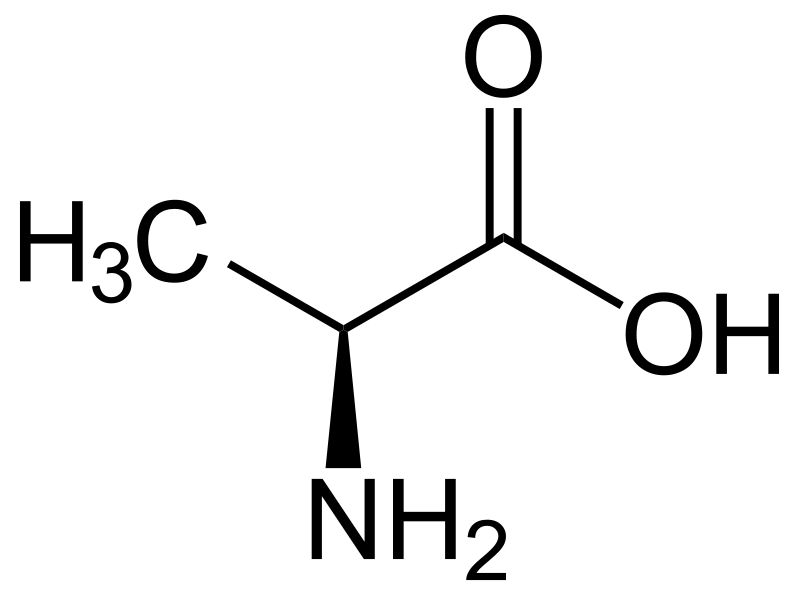
File:L-Alanin_-_L-Alanine.svg · Wikimedia Commons · See Wikimedia Commons
L-alanine
Sign in to saveAlso known as L-Ala, L-alpha-Alanine, L-α-alanine, (2S)-2-aminopropanoic acid, (S)-alanine, (S)-2-aminopropanoic acid, alanine, L-2-aminopropionic acid
thumb|Spin view of ball-stick model Alanine (symbol Ala or A), or α-alanine, is an α-amino acid that is used in the biosynthesis of proteins. It contains an amine group and a carboxylic acid group, both attached to the central carbon atom which also carries a methyl group side chain. Consequently it is classified as a non-polar, aliphatic α-amino acid. Under biological conditions, it exists in its zwitterionic form with its amine group protonated (as ) and its carboxyl group deprotonated (as ). It is non-essential to humans as it can be synthesized metabolically and does not need to be present
OverviewAI-generated
L-alanine, also identified as (2S)-2-aminopropanoic acid, is a chemical compound with the formula C₃H₇NO₂. It has a mass of 89.048 and a melting point of 314.5. The compound features a pKa of 2.61 and a charge of 0. Its structural properties include two hydrogen bond donors and three hydrogen bond acceptors, with a topological polar surface area of 63.3 and an xlogp value of -3.
The substance is represented by the canonical SMILES string CC(C(=O)O)N and the isomeric SMILES C[C@H](N)C(O)=O. It is cataloged in the NCI Thesaurus under the ID C29605 and has a PubChem CID of 5950. A search for L-alanine in PubMed yields 152,975 results. Additionally, the subject is referenced by 1,542 other encyclopedia articles.
Synthesized by Vinony from 22 facts across 4 sources: Wikidata, PubChem, PubMed, Vinony graph. Generated from structured data (not the Wikipedia text) and checked against those facts — may still contain errors.
Chemical data
- Formula
- C3H7NO2
- Molecular weight
- 89.09 g/mol
- IUPAC name
- (2S)-2-aminopropanoic acid
- SMILES
- C[C@@H](C(=O)O)N
- InChIKey
- QNAYBMKLOCPYGJ-REOHCLBHSA-N
- XLogP
- -3
- Polar surface area
- 63.3 Ų
- H-bond donors
- 2
- H-bond acceptors
- 3
- Formal charge
- 0
via PubChem
Drug data · ChEMBL
- Max clinical phase
- Phase 3
- Molecule type
- Small molecule
- Indications
- coronary artery disease, malignant glioma, asthma, Cognitive impairment
via ChEMBL · EBI
Research
152,975 papers- Metabolic engineering of microorganisms for L-alanine production.ReviewJournal of industrial microbiology & biotechnology · 2022Liu P, Xu H, Zhang XDOI: 10.1093/jimb/kuab057
- Exogenous L-Alanine promotes phagocytosis of multidrug-resistant bacterial pathogens.EMBO reports · 2023Jiang M, Chen XH, Li H et al.DOI: 10.15252/embr.201949561
- l-Alanine Exporter AlaE Functions as One of the d-Alanine Exporters in Escherichia coli.International journal of molecular sciences · 2023Katsube S, Sakai K, Ando T et al.DOI: 10.3390/ijms241210242
- The effect of L-alanine on sleep through taste properties in Drosophila melanogaster.Neuroscience research · 2025Garibağaoğlu R, Kobayashi R, Hanashiro V et al.DOI: 10.1016/j.neures.2025.104924
- L-Alanine promotes anti-infectious properties of Bacillus subtilis S-2 spores via the germination receptor gerAA.Probiotics and antimicrobial proteins · 2024Lu S, Liao X, Lu W et al.DOI: 10.1007/s12602-023-10121-2
- Enzymatic determination of d-alanine with l-alanine dehydrogenase and alanine racemase.Bioscience, biotechnology, and biochemistry · 2021Ashida H, Sawa Y, Yoshimura TDOI: 10.1093/bbb/zbab148
- L-alanine supplementation improves blood glucose level and biochemical indices in alloxan-induced diabetic rats.Journal of food biochemistry · 2021Dandare SU, Ezeonwumelu IJ, Shinkafi TS et al.DOI: 10.1111/jfbc.13590
- Studies on beta-(pyrazolyl-n)-L-alanine.The Journal of biological chemistry · 1963TAKESHITA M, NISHIZUKA Y, HAYAISHI O
via PubMed
Wikidata facts
- Part of
- zein
- Has part
- carbon
- Mass
- 89.048
- Has use
- flavoring substance
Show 9 more facts
- pKa
- 2.61
- chemical formula
- C₃H₇NO₂
- found in taxon
- Caenorhabditis elegans
- Commons category
- L-Alanine
- canonical SMILES
- CC(C(=O)O)N
- melting point
- 314.5
- NCI Thesaurus ID
- C29605
- isomeric SMILES
- C[C@H](N)C(O)=O
- subject has role
- metabolite
Sources (3)
via Wikidata · CC0
~9 min read
Encyclopedic overview
13 sectionsContents
- History and etymology
- Structure
- Sources
- Biosynthesis
- Chemical synthesis
- Degradation
- Alanine world hypothesis
- Physiological function
- Glucose–alanine cycle
- Link to diabetes
- Chemical properties
- Free radical
- References
thumb|Spin view of ball-stick model Alanine (symbol Ala or A), or α-alanine, is an α-amino acid that is used in the biosynthesis of proteins. It contains an amine group and a carboxylic acid group, both attached to the central carbon atom which also carries a methyl group side chain. Consequently it is classified as a non-polar, aliphatic α-amino acid. Under biological conditions, it exists in its zwitterionic form with its amine group protonated (as ) and its carboxyl group deprotonated (as ). It is non-essential to humans as it can be synthesized metabolically and does not need to be present in the diet. It is encoded by all codons starting with GC (GCU, GCC, GCA, and GCG).
The L-isomer of alanine (left-handed) is the one that is incorporated into proteins. L-alanine is second only to L-leucine in rate of occurrence, accounting for 7.8% of the primary structure in a sample of 1,150 proteins. The right-handed form, D-alanine, occurs in peptides in some bacterial cell walls (in peptidoglycan) and in some peptide antibiotics, and occurs in the tissues of many crustaceans and molluscs as an osmolyte.
Excerpted from Wikipedia’s “L-alanine” article, available under the CC BY-SA 4.0 licence.
Gallery (16)
Available in 73 languages
- Español
- Français
- Deutsch
- 中文
- 日本語
- Русский
- Português
- Italiano
- العربية
- Afrikaans
- Armenian
- azb
- Azerbaijani
- Bahasa Indonesia
- Bangla
- Basque
- Belarusian
- Bosnian
Show 54 more
- Bulgarian
- Catalan
- Croatian
- Czech
- Danish
- Esperanto
- Estonian
- Filipino
- Finnish
- Galician
- Georgian
- Greek
- Hebrew
- Hungarian
- Kazakh
- Kurdish
- Latin
- Latvian
- Lithuanian
- Luxembourgish
- Macedonian
- Malay
- Mongolian
- Nederlands
- Norwegian
- Norwegian Nynorsk
- Occitan
- Pashto
- Polski
- Romanian
- Serbian
- Serbian (Latin)
- Sicilian
- simple
- Slovak
- Slovenian
- Sundanese
- Svenska
- Tajik
- Tamil
- Tibetan
- Tiếng Việt
- Türkçe
- Ukrainian
- Urdu
- Uzbek
- Waray
- Wu Chinese
- Yoruba
- zh_min_nan
- zh_yue
- فارسی
- ไทย
- 한국어
via Wikidata sitelinks · CC0