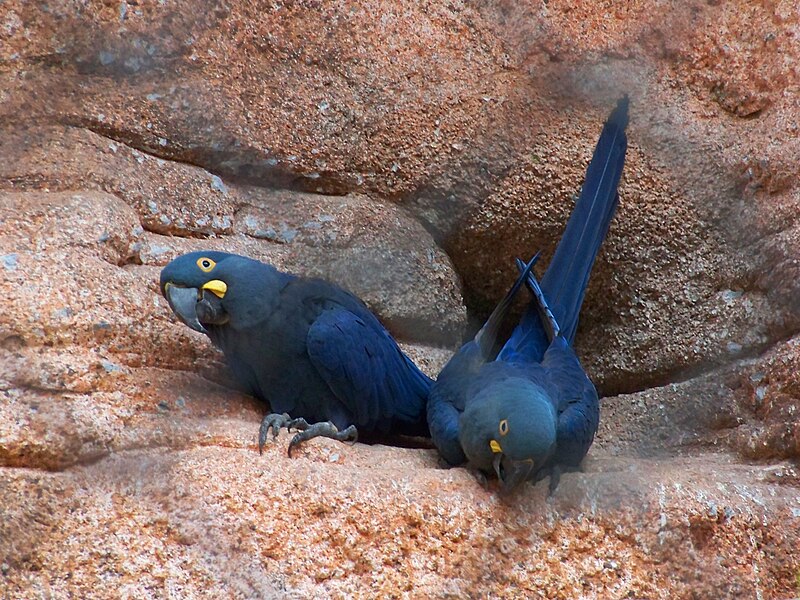
File:Anodorhynchus_leari_-Rio_de_Janeiro_Zoo,_Brazil-8a.jpg · Wikimedia Commons · See Wikimedia Commons
Lear's Macaw
Sign in to saveAlso known as Anodorhynchus leari, Indigo Macaw
large all-blue Brazilian parrot
Species
EndangeredMaximum longevity: 38.3 years (captivity) Observations: One specimen lived 38.3 years in captivity (Brouwer et al. 2000).
via IUCN
Wikidata facts
- Instance of
- taxon
- Parent taxon
- Anodorhynchus
- Image
- Anodorhynchus leari -Rio de Janeiro Zoo, Brazil-8a.jpg
Show 11 more facts
- taxon rank
- species
- IUCN conservation status
- Endangered status
- taxon name
- Anodorhynchus leari
- Commons category
- Anodorhynchus leari
- Commons gallery
- Anodorhynchus leari
- taxon common name
- arara-azul-pequena
- endemic to
- Brazil
- litter size
- 2
- CITES Appendix
- Appendix I of CITES
- taxon range
- South America
- diel cycle
- diurnality
via Wikidata · CC0
~19 min read
Encyclopedic overview
Lear's macaw (Anodorhynchus leari), also known as the indigo macaw, is a large all-blue Brazilian parrot, a member of a large group of neotropical parrots known as macaws. It was first described by Charles Lucien Bonaparte in 1856. Lear's macaw is 70–75 cm (27+1⁄2–29+1⁄2 in) long and weighs around 950 g (2 lb 2 oz). It is coloured almost completely blue, with a yellow patch of skin at the base of the heavy, black bill.
Although there are records of the macaw from Britain from the early 1830s, this bird was only generally recognised as an independent species in the late 1970s. It is rare with a highly restricted native range, which was only discovered in 1978, although intensive conservation efforts have increased the world population about thirtyfold in the first two decades of the 21st century. It inhabits a dry desert-like shrubby environment known as caatinga, and roosts and nests in cavities in sandstone cliffs. It mostly feeds on the nuts of the palm species Syagrus coronata, as well as raiding maize from local farmers. Its ecology also appears linked to cattle ranching.
Excerpted from Wikipedia’s “Lear's Macaw” article, available under the CC BY-SA 4.0 licence.