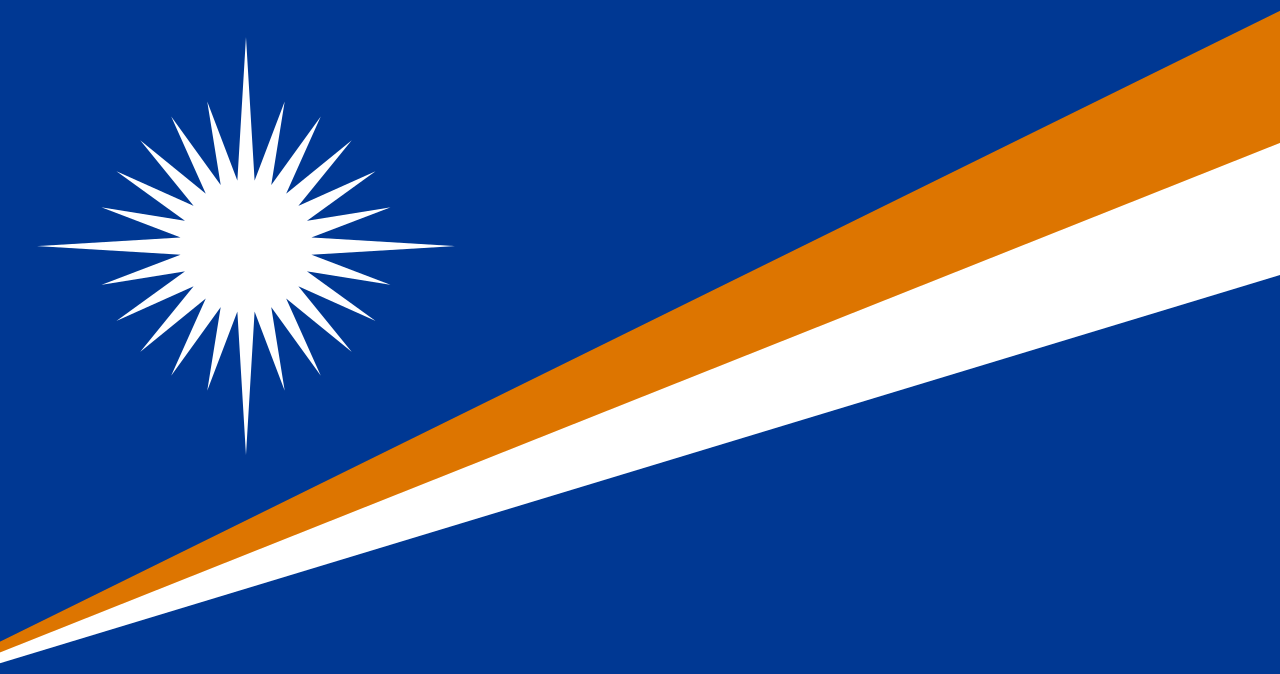
Marshall Islands
Sign in to saveAlso known as Republic of the Marshall Islands, mh
The Marshall Islands, officially the Republic of the Marshall Islands, is an archipelagic country in Oceania. The sovereign state lies west of the International Date Line and north of the equator in the Micronesia region of the Northwestern Pacific Ocean.
OverviewAI-generated
The Marshall Islands, officially the Republic of the Marshall Islands, is an island country and sovereign state located in Insular Oceania. It is situated in the subregion of Micronesia. The capital is Majuro, and the highest point is Likiep Atoll. The nation contains administrative entities such as Ailinginae Atoll, Ailinglaplap Atoll, Ailuk Atoll, and Arno Atoll. It has at various times been a United Nations trust territory.
English language and Marshallese are the official languages. The currency is the United States dollar, and the top-level Internet domain is .mh. The anthem is Forever Marshall Islands. The country is a member of the United Nations, International Bank for Reconstruction and Development, International Development Association, and International Finance Corporation. It is named after John Marshall.
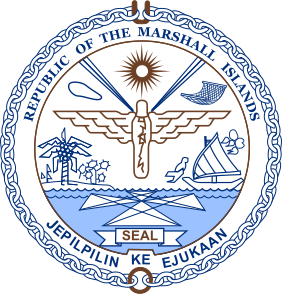
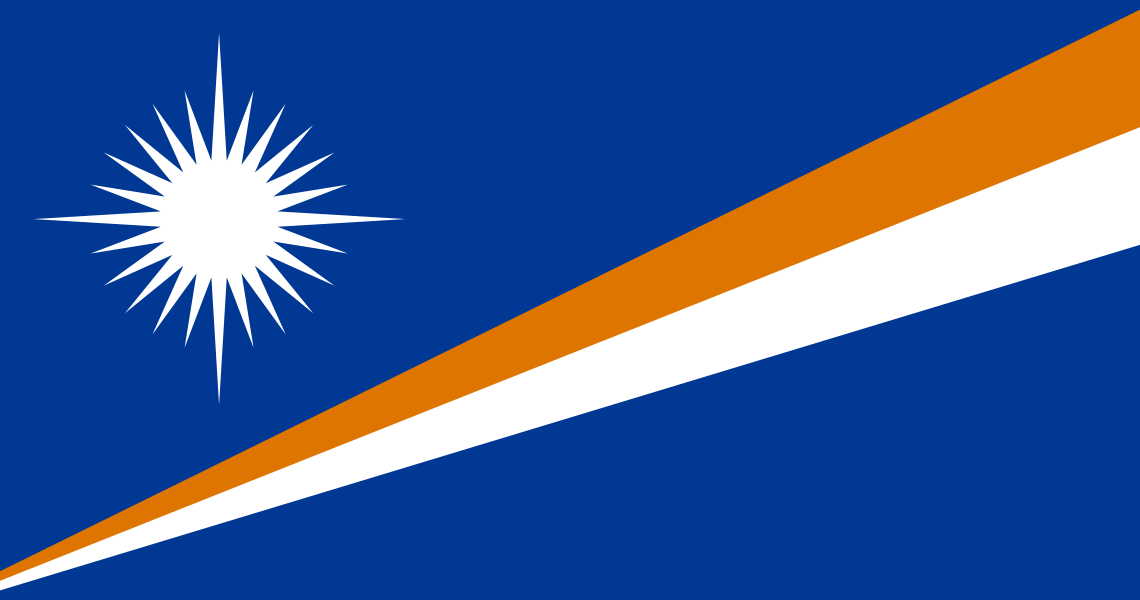
The population is listed as 54366, 42418, and 37548 in different records. The area is 181. The time zone is UTC+12:00. The telephone country code is 692. The flag is the flag of the Marshall Islands, and the coat of arms is the Seal of the Marshall Islands. The head of state includes Christopher Loeak, Casten Nemra, and Hilda Heine.
Synthesized by Vinony from 70 facts across 9 sources: Wikidata, Open Meteo, Openweathermap, World Bank, OpenStreetMap, Firecrawl, REST Countries, Vinony graph, Geo. Generated from structured data (not the Wikipedia text) and checked against those facts — may still contain errors.
In the Vinony graph
Marshall Islands appears in Vinony's Countries collection — one of 215 entries.
Within Vinony's link graph, Marshall Islands is referenced by 5,778 other articles, and connects out to Hawaii, Guam and Niue.
The entry is geolocated on the map in city, across 2 mapped points.
It is catalogued under topics including 1986 establishments in Oceania, Archipelagoes of the Pacific Ocean and Associated states of the United States.
Weather now
cached 2h ago7-day forecast
via Open-Meteo
Country
- Capital
- Majuro
- Population
- 42,418
- Region
- Oceania · Micronesia
- Demonym
- Marshallese
- Currencies
- USD ($)
- Languages
- English, Marshallese
- Calling code
- +692
- Drives on
- Right
- TLD
- .mh
- Timezones
- UTC+12:00
via REST Countries
Indicators · World Bank
- GDP
- $290.1M(2024)
- Population
- 37,548(2024)
- Life expectancy
- 67.1 yrs(2024)
- Urban population
- 78.7 %(2024)
- Internet users
- 65.9 %(2024)
- Forest area
- 52.2 %(2023)
- Renewable energy
- 12.2 %(2022)
via World Bank Open Data · CC BY 4.0
Wikipedia views (30d)
62,682 totalvia Wikimedia Pageviews API
Official website

The Embassy of the Republic of the Marshall Islands, Washington D.C. | Discover More Today
Marshall Island Embassy, Marshall Island Embassy
rmiembassyus.org →H.E. Charles R. Paul is the fifth Ambassador Extraordinary and Plenipotentiary of Republic of the Marshall Islands to the United States. He held the same position from 2011 to 2015, making him also the third RMI Ambassador to the US. During the intervening time between his first appointment and his re-appointment in September 2023, Ambassador Paul served as an Advisor to the Executive Director at the World Bank Group from June 2015 to June 2017. Afterwards, Ambassador Paul co-founded a real estate financial company in 2017. Prior to his first appointment, Ambassador Paul served the RMI Government in various capacities including Deputy Chief of Mission for the RMI Embassy to the United States of America; Economic, Performance and Budgeting Coordinator for the Economic Policy, Planning and Statistics Office under the Office of the President; among others. Ambassador Paul holds a Masters of Science in Finance, and a Graduate Certificate in Financial Management from Johns Hopkins University, as well as a Bachelor of Arts in Economics from Washington College, Maryland. Ambassador Paul was born and raised on Ebeye, Kwajalein Atoll, and was one of the first students to participate in the United States Army Kwajalein Atoll “Rikatak” Program. He enjoys watching historical documentaries, sports, and cooking.
Read more on their site →Excerpt from the official site · 3,164 chars · not written by Vinony
Wikidata facts
- Instance of
- country
- Named after
- John Marshall
- Official name
- Aolepān Aorōkin M̧ajeļ
- Demonym
- Marshallovka
- Country
- Marshall Islands
- Contains
- Jabat Island
- Continent
- Oceania
- Capital
- Majuro
- Official language
- Marshallese
- Population
- 54366
- Area
- 181.43
- Body of water
- Pacific Ocean
- Head of government
- Hilda Heine
- Head of state
- Hilda Heine
- Legislature
- Legislature of the Marshall Islands
- Anthem
- Forever Marshall Islands
- Shares border with
- Nauru
- Highest point
- Likiep Atoll
- Image
- Marshall Islands - Location Map (2013) - MHL - UNOCHA.svg
- Life expectancy
- 65
- Nominal GDP
- 279667900
- Calling code
- +692
Show 55 more facts
- Motto
- Cyflawniad trwy ymdrech ar y cyd
- Coat of arms
- Seal of the Marshall Islands
- top-level Internet domain
- .mh
- Commons category
- Marshall Islands
- topic's main category
- Category:Marshall Islands
- category of associated people
- Category:Marshallese people
- office held by head of government
- President of the Marshall Islands
- office held by head of state
- President of the Marshall Islands
- IPA transcription
- ˈmɑːʂɑlœɪənə
- Commons gallery
- Ṃajeḷ / Marshall Islands
- lowest point
- Pacific Ocean
- mobile country code
- 551
- geography of topic
- geography of the Marshall Islands
- emergency phone number
- 911
- driving side
- right
- topic's main Wikimedia portal
- Marshall Islands portal
- short name
- MH
- diplomatic relation
- China
- language used
- Marshallese
- number of out-of-school children
- 3624
- has characteristic
- free country
- located in/on physical feature
- Micronesia
- total fertility rate
- 4.05
- maritime identification digits
- 538
- history of topic
- history of the Marshall Islands
- category for people who died here
- Category:Deaths in the Marshall Islands
- inception
- 1986-10-21
- category for people born here
- Q32372270
- water as percent of area
- 0
- foundational text
- Constitution of the Marshall Islands
- Unicode character
- 🇲🇭
- maximum temperature record
- 35.6
- native label
- Aolepān Aorōkin M̧ajeļ
- minimum temperature record
- 20
- economy of topic
- economy of the Marshall Islands
- demographics of topic
- demographics of the Marshall Islands
- has seal, badge, or sigil
- Seal of the Marshall Islands
- compulsory education (maximum age)
- 14
- topic has template
- Template:Marshall Islands
- related category
- Category:Marshall Islands-related lists
- Human Development Index
- 0.639
- P11012
- Jérôme Neuville
- hashtag
- MarshallIslands
- on focus list of Wikimedia project
- Wikipedia:Vital articles/Level/4
- Gini coefficient
- 35.5
- P12749
- Hesse
- birth rate
- 18.524
- male population
- 21223
- death rate
- 7.919
- rural population
- 8929
- female population
- 20346
- urban population
- 32640
Sources (15)
via Wikidata · CC0
Travel guide
Understand
After almost four decades under US administration as the easternmost part of the UN Trust Territory of the Pacific Islands, the Marshall Islands attained independence in 1986 under a Compact of Free Association. Compensation claims continue as a result of US nuclear testing on some of the atolls between 1947 and 1962, which displaced some Marshallese citizens and exposed them to deadly radiation. The Marshall Islands have been home to the US Army Post Kwajalein (USAKA) since 1964. A number of islands are off-limits to tourism (and even to locals) due to US military presence or the residue of nuclear testing.
Get in
thumb|375px|A map showing the visa requirements of Marshall Islands, with countries in blue having visa-free access, countries in gold having visa on arrival
See
thumb|A Laura beach
Watch the sunset from your beachchair in one of the luxurious resorts or make your way to one of the more deserted beaches for a day of almost Robinson Crusoe-like tranquillity. On the far west side of the Majuro-atoll, the quiet beaches of Laura are a fine choice. If you've had enough of sun and sand, head to the capital Majuro for some shopping.
Head to the Longar area on Arno, where young women were once taught the tips and tricks for a happy sexual life in so-called love schools. This is a perfect place for deep-sea fishing too. In Uliga you'll find the Alele Museum and Public Library. Although small, it has some nice artefacts of the nation's culture on display. Note the stick charts, used by the indigenous people to help remember the complex wave patterns between the many atolls.
Eat
There are many types of different fruits that are available in the different seasons. There are also farms that produce vegetable or raise pigs. Most, if not all, the produce are: breadfruit, pandanus, coconut, corn, tomato, sweet potato, cassava, papaya, pumpkin, "nin" (noni), lime, pigs and chicken. In addition to these, there are stands that sell fruit and traditional food along the road from Ajeltake to Laura.
The Marshall Islands was once known as the world's "fishiest" place, meaning that there was an over-abundance of species of fish that dwell in Marshallese waters. However, there is great uncertainty as to whether this is still true due to concern over overfishing and destruction of natural habitat by ships' anchors, harmful chemicals & climate change.
There are several restaurants that serve international food. The Marshall Islands Resort's (MIR) Enra Restaurant, Yummy BBQ, Jitak Take-Out, DAR Restaurant, and Robert Reimers Enterprises' (RRE) Tide Table are among the most well known.
Non-Marshallese owned restaurants include Monica's (Chinese), La Bojie's (Filipino), China Restaurant (Chinese), Special Restaurant (Chinese), Won Hai Shen (Chinese), The Stone House (Japanese), Jay's Restaurant (Indian), Island Star Restaurant (Chinese), Eastern Restaurant, and Aliang Restaurant (Chinese).
Stay safe
Beware of storm surges or high tides. Flooding is common due to rising sea level.
Stay healthy
Tap water is not drinkable. It's recommended to use bottled water even for brushing your teeth.
Connect
Mobile phone service is available from the National Telecommunications Authority. Visitors with a foreign SIM card may receive a SMS offering a local number for use with their foreign SIM card. You just need to top up the account to activate the service. Follow the instructions in the SMS. It may take a few attempts to make it work.
NTA offer internet through a chain of wifi hotspots. There are 3 ways to connect: Buy a card which will give time limited connection - $5 for 50 minutes. Buy a fixed amount of data online. the service will be offered when connecting to one of the NTA-UniFi hotspots. $10 give 100MB. Credit cards or Paypal are accepted. Register for a months access at the NTA office. This costs $35 per month, plus $5 setup charge. The MAC address of your device will be programmed into the NTA system, giving access to just that device. It might take a few attempts to get this to work.
Internet speeds can be quite good, but the system is not wholly reliable.
Post is provided by the United States Postal Service.
Travel guide from Wikivoyage (CC BY-SA 4.0)
~40 min read
Encyclopedic overview
The Marshall Islands, officially the Republic of the Marshall Islands, is an archipelagic country in Oceania. The sovereign state lies west of the International Date Line and north of the equator in the Micronesia region of the Northwestern Pacific Ocean.
The territory consists of 29 coral atolls and five main islands as well as 1,220 other very small ones, divided across two island chains: Ratak in the east and Ralik in the west. 98.62% of its territory is water, the largest proportion of water to land of any sovereign state. The country shares maritime boundaries with Wake Island to the north, Kiribati to the southeast, Nauru to the south, and the Federated States of Micronesia to the west. The capital and largest city is Majuro, home to approximately half of the country's population. The Marshall Islands are one of only four atoll-based nations in the entire world, along with Kiribati, The Maldives, and Tuvalu.
Excerpted from Wikipedia’s “Marshall Islands” article, available under the CC BY-SA 4.0 licence.
Gallery (17)
On the map
2 mapped locations
Available in 200 languages
- Español
- Français
- Deutsch
- 中文
- 日本語
- Русский
- Português
- Italiano
- العربية
- हिन्दी
- Abkhazian
- Achinese
- Afrikaans
- Albanian
- Albanian
- Amharic
- ami
- Angika
Show 181 more
- Aragonese
- Armenian
- Arpitan
- Asturian
- azb
- Azerbaijani
- Bahasa Indonesia
- Balinese
- Bangla
- Bashkir
- Basque
- bat_smg
- be_x_old
- Belarusian
- Betawi
- Bhojpuri
- Bikol
- Bishnupriya
- Bislama
- Bosnian
- Breton
- Bulgarian
- Buriat
- Burmese
- Catalan
- cbk_zam
- cdo
- Cebuano
- Central Kurdish
- Chechen
- Cheyenne
- Cornish
- Corsican
- Crimean Tatar
- Croatian
- Czech
- dag
- Danish
- Divehi
- dty
- Egyptian Arabic
- Esperanto
- Estonian
- Extremaduran
- Faroese
- Fiji Hindi
- Filipino
- Finnish
- fiu_vro
- Gagauz
- Galician
- gcr
- Georgian
- Gilaki
- Goan Konkani
- Greek
- Guarani
- Haitian Creole
- Hakka Chinese
- Hausa
- Hebrew
- Hungarian
- Icelandic
- Ido
- Iloko
- Inari Sami
- Interlingue
- Inupiaq
- Irish
- Jamaican Creole English
- Javanese
- Kannada
- Kara-Kalpak
- Karachay-Balkar
- Kazakh
- Kinyarwanda
- Kotava
- Kurdish
- Kyrgyz
- Ladino
- Latin
- Latvian
- Ligurian
- Limburgish
- Lingua Franca Nova
- Lithuanian
- lld
- Lombard
- Low German
- Luxembourgish
- Macedonian
- Malagasy
- Malay
- Malayalam
- Maltese
- Manipuri
- Manx
- Māori
- Marathi
- Marshallese
- Mazanderani
- Minangkabau
- Mingrelian
- Mongolian
- Moroccan Arabic
- Nederlands
- Nepali
- Northern Frisian
- Northern Sami
- Norwegian
- Norwegian Nynorsk
- Occitan
- olo
- Ossetic
- Pampanga
- Papiamento
- Pashto
- Polski
- Punjabi
- Quechua
- Romanian
- Samoan
- Sanskrit
- Santali
- Sardinian
- Scots
- Scottish Gaelic
- Serbian
- Serbian (Latin)
- Shan
- Shona
- Sicilian
- Silesian
- simple
- Sindhi
- Sinhala
- Slovak
- Slovenian
- Somali
- Sundanese
- Svenska
- Swahili
- szy
- Tahitian
- Tajik
- Tamil
- Tatar
- Telugu
- Tibetan
- Tiếng Việt
- Tok Pisin
- Toki Pona
- Tongan
- Türkçe
- Turkmen
- Udmurt
- Ukrainian
- Upper Sorbian
- Urdu
- Uyghur
- Uzbek
- Venetian
- Veps
- Volapük
- Waray
- Welsh
- Western Frisian
- Western Panjabi
- Wolof
- Wu Chinese
- Yakut
- Yoruba
- Zaza
- Zeelandic
- zh_classical
- zh_min_nan
- zh_yue
- Zhuang
- فارسی
- ไทย
- 한국어
via Wikidata sitelinks · CC0