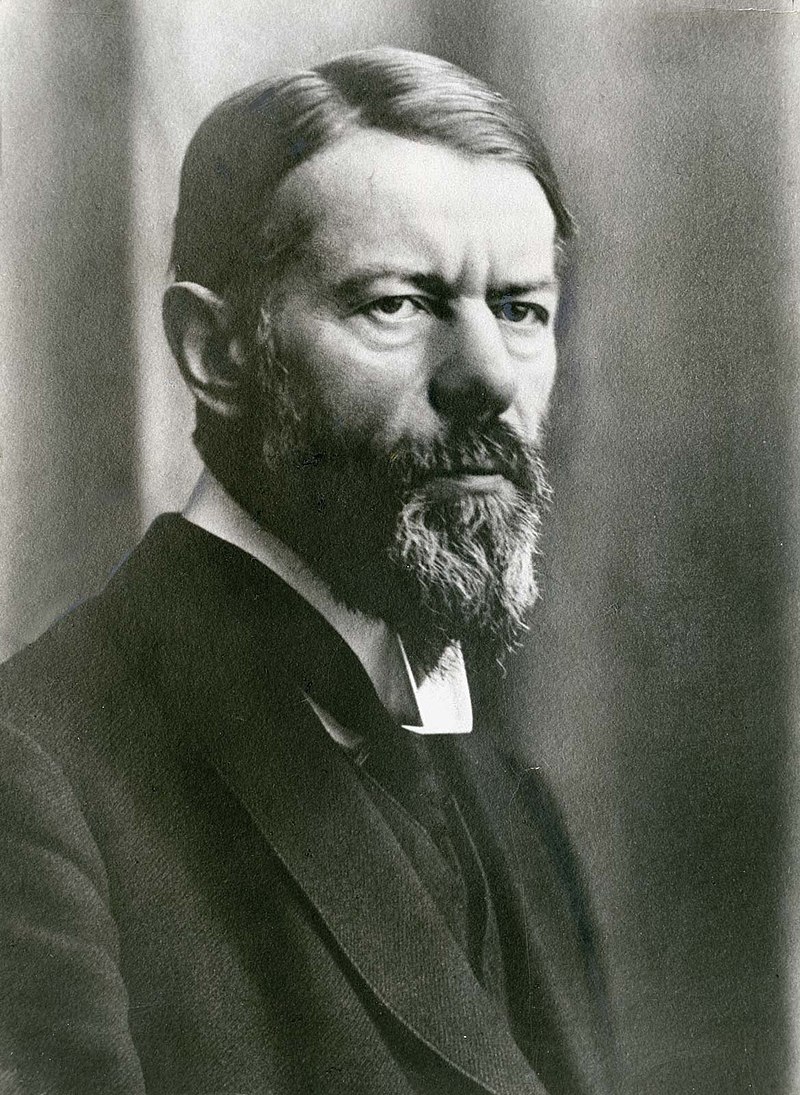
File:Max_Weber,_1918.jpg · Wikimedia Commons · See Wikimedia Commons
Max Weber
Sign in to saveGerman sociologist, philosopher, and political economist (1864–1920)
Max Weber was a German sociologist, philosopher, and political economist (1864–1920) who fundamentally shaped how we understand society, economics, and history. His ideas about bureaucracy, capitalism, and the relationship between religion and economic systems remain central to sociology and continue to influence how scholars analyze institutions and social change today.
AI-generated from the Wikipedia summary — may contain errors.
Wikidata facts
- Instance of
- human
- Given name
- Emil
- Family name
- Weber
- Gender
- male
- Citizenship
- Germany
- Place of birth
- Erfurt
- Place of death
- Munich
- Spouse
- Marianne Weber
- Occupation
- historian
- Educated at
- University of Strasbourg
- Employer
- University of Vienna
- Political party
- German Democratic Party
- Languages spoken
- Russian
- Religion
- agnosticism
- Notable work
- Economy and Society
- Doctoral advisor
- August Meitzen
- Field of work
- sociology of organisations
- Hair colour
- black hair
- Image
- Max Weber in 1918.png
- Work location
- Vienna
Show 21 more facts
- P8168
- Szwarunki
- Commons category
- Max Weber
- medical condition
- 1918–1920 flu pandemic
- date of birth
- 1864-04-21
- date of death
- 1920-06-14
- topic's main category
- Category:Max Weber
- cause of death
- 1918–1920 flu pandemic
- Commons Creator page
- Max Weber
- manner of death
- natural causes
- Commons gallery
- Max Weber
- student
- Harold Garfinkel
- birth name
- Maximilian Carl Emil Weber
- ethnic group
- Germans
- name in native language
- Max Weber
- on focus list of Wikimedia project
- Wikipedia:Vital articles/Level/4
- writing language
- German
- different from
- Max Weber
- unmarried partner
- Else von Richthofen
- handedness
- right-handedness
- archives at
- Bavarian State Library
- described at URL
- lod.gesis.org/thesoz/concept_10062015
Sources (15)
via Wikidata · CC0
~40 min read
Encyclopedic overview
Maximilian Carl Emil Weber (/ˈveɪbər/; German: [ˈveːbɐ] ; 21 April 1864 – 14 June 1920) was a German sociologist, historian, jurist, and political economist who was one of the central figures in the development of sociology and the social sciences more generally. His ideas continue to influence social theory and research.
Born in Erfurt in 1864, Weber studied law and history in Berlin, Göttingen, and Heidelberg. After earning his doctorate in law in 1889 and habilitation in 1891, he taught in Berlin, Freiburg, and Heidelberg. He married his cousin Marianne Schnitger two years later. In 1897, he had a breakdown after his father died following an argument. Weber ceased teaching and travelled until the early 1900s. He recovered and wrote The Protestant Ethic and the Spirit of Capitalism. During the First World War, he initially supported Germany's war effort but became critical of it and supported democratisation. He also gave the lectures "Science as a Vocation" and "Politics as a Vocation". After the war, Weber co-founded the German Democratic Party, unsuccessfully ran for office, and advised the drafting of the Weimar Constitution. Meanwhile, he resumed teaching in Vienna and Munich. He died of pneumonia in 1920 at the age of 56, possibly as a result of the post-war Spanish flu pandemic. A book, Economy and Society, was left unfinished.
Excerpted from Wikipedia’s “Max Weber” article, available under the CC BY-SA 4.0 licence.
Gallery (12)
Available in 140 languages
- Español
- Français
- Deutsch
- 中文
- 日本語
- Русский
- Português
- Italiano
- العربية
- हिन्दी
- Afrikaans
- Albanian
- Albanian
- Amharic
- Aragonese
- Armenian
- Assamese
- Asturian
Show 121 more
- azb
- Azerbaijani
- Bahasa Indonesia
- Bangla
- Banjar
- Bashkir
- Basque
- bat_smg
- be_x_old
- Belarusian
- Betawi
- Bosnian
- Breton
- btm
- Bulgarian
- Buriat
- Catalan
- Central Kurdish
- Chechen
- Chuvash
- Cornish
- Croatian
- Czech
- Danish
- Egyptian Arabic
- Erzya
- Esperanto
- Estonian
- Extremaduran
- Fiji Hindi
- Filipino
- Finnish
- Galician
- Gan Chinese
- gcr
- Georgian
- Greek
- Guarani
- Haitian Creole
- Hausa
- Hebrew
- Hungarian
- Icelandic
- Ido
- Iloko
- Interlingua
- Jamaican Creole English
- Kannada
- Kanuri
- Kazakh
- kbp
- Kurdish
- Kyrgyz
- Latin
- Latvian
- Limburgish
- Lithuanian
- Lombard
- Low German
- Luxembourgish
- Macedonian
- Madurese
- Malagasy
- Malay
- Malayalam
- Marathi
- Mingrelian
- Mongolian
- Moroccan Arabic
- Nederlands
- Nepali
- Norwegian
- Norwegian Nynorsk
- Novial
- Occitan
- Odia
- Pashto
- Piedmontese
- Polski
- Punjabi
- Quechua
- Romanian
- Rusyn
- Santali
- Scots
- Serbian
- Serbian (Latin)
- Sicilian
- simple
- Sindhi
- Sinhala
- Slovak
- Slovenian
- Svenska
- Swahili
- Tajik
- Tamil
- Tatar
- Tiếng Việt
- Türkçe
- Ukrainian
- Urdu
- Uzbek
- Venetian
- Veps
- Volapük
- Waray
- Welsh
- Western Frisian
- Western Panjabi
- Wu Chinese
- Yakut
- Yiddish
- Yoruba
- Zaza
- zh_classical
- zh_min_nan
- zh_yue
- فارسی
- ไทย
- 한국어
via Wikidata sitelinks · CC0