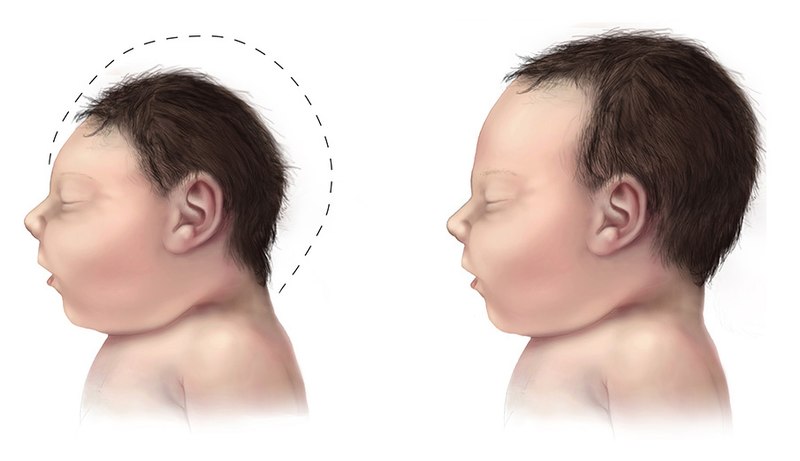
File:Microcephaly-comparison-500px.jpg · Wikimedia Commons · See Wikimedia Commons
microcephaly
Sign in to saveAlso known as Microcephalus, microencephaly
thumb|A mother holding her son who was born with microcephaly due to vertically transmitted infection with [[Zika virus]] Microcephaly (from Neo-Latin microcephalia, from Ancient Greek μικρός mikrós "small" and κεφαλή kephalé "head") is a medical condition involving a smaller-than-normal head. Microcephaly may be present at birth or it may develop in the first few years of life. Brain development is often affected; people with this disorder often have an intellectual disability, poor motor function, poor speech, abnormal facial features, seizures and dwarfism.
Key facts
- Medical condition (new).name
- Microcephaly
- Medical condition (new).image
- Microcephaly-comparison-500px.jpg
- Medical condition (new).caption
- A baby with microcephaly (left) compared to a baby with a typical head size
- Medical condition (new).field
- Medical genetics, Psychiatry, Neurology
- Medical condition (new).symptoms
- Abnormally small head and brain, neurological impairments
- Medical condition (new).complications
- Neurological impairments
- Medical condition (new).onset
- Congenital
- Medical condition (new).duration
- Lifelong
- Medical condition (new).causes
- Usually genetic or toxin exposure during pregnancy
- Medical condition (new).prevention
- Avoiding alcohol consumption while pregnant
- Medical condition (new).frequency
- 2–12 per 10,000 births
via Wikipedia infobox
Research
14,635 papersvia PubMed
Wikidata facts
- Subclass of
- disease
- Image
- Microcephaly-comparison-500px.jpg
Show 9 more facts
- health specialty
- medical genetics
- exact match
- purl.obolibrary.org/obo/HP_0000252
- NCI Thesaurus ID
- C85874
- Commons category
- Microcephaly
- ICPC 2 ID
- N85
- anatomical location
- brain
- on focus list of Wikimedia project
- WikiProject Medicine
- ICD-9-CM
- 742.1
- hashtag
- microcephaly
via Wikidata · CC0
~14 min read
Encyclopedic overview
16 sectionsContents
- Signs and symptoms
- Causes
- Congenital
- Postnatal onset
- Arbovirus
- Microlissencephaly
- Historical causes of microcephaly
- Other relations
- Pathophysiology
- Treatment
- History
- Notable cases
- Fictional characters with microcephaly
- See also
- References
- External links
thumb|A mother holding her son who was born with microcephaly due to vertically transmitted infection with [[Zika virus]] Microcephaly (from Neo-Latin microcephalia, from Ancient Greek μικρός mikrós "small" and κεφαλή kephalé "head") is a medical condition involving a smaller-than-normal head. Microcephaly may be present at birth or it may develop in the first few years of life. Brain development is often affected; people with this disorder often have an intellectual disability, poor motor function, poor speech, abnormal facial features, seizures and dwarfism.
The disorder is caused by a disruption to the genetic processes that form the brain early in pregnancy, though the cause is not identified in most cases. Many genetic syndromes can result in microcephaly, including chromosomal and single-gene conditions, though almost always in combination with other symptoms. Mutations that result solely in microcephaly (primary microcephaly) exist but are less common. External toxins to the embryo, such as alcohol during pregnancy or vertically transmitted infections, can also result in microcephaly. Microcephaly serves as an important neurological indication or warning sign, but no uniformity exists in its definition. It is usually defined as a head circumference (HC) more than two standard deviations below the mean for age and sex. Some academics advocate defining it as head circumference more than three standard deviations below the mean for the age and sex.
Excerpted from Wikipedia’s “microcephaly” article, available under the CC BY-SA 4.0 licence.