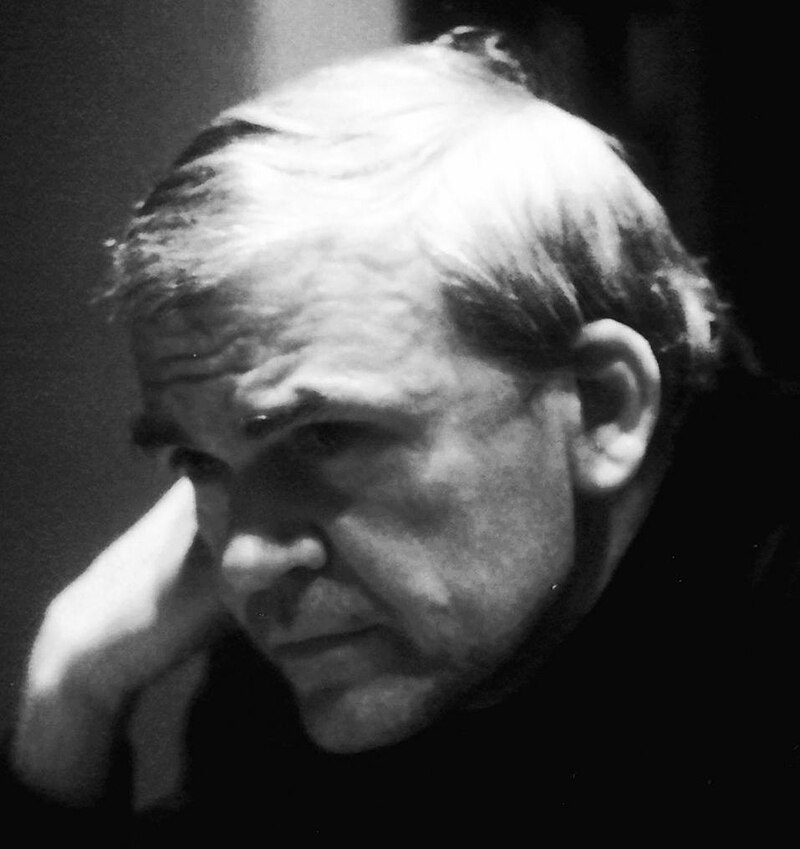
File:Milan_Kundera_redux.jpg · Wikimedia Commons · See Wikimedia Commons
Milan Kundera
Sign in to saveromancier, essayiste et dramaturge tchèque naturalisé français
OverviewAI-generated
Milan Kundera was a writer, screenwriter, translator, and novelist born on April 1, 1929, in Brno, Královo Pole. He held citizenship in France, the Czech Republic, and Czechoslovakia, and was stateless at various times. Kundera spoke and wrote in French and Czech, with Czech as his native language. He was educated at the Faculty of Arts, Charles University in Prague, and the Film and TV School of the Academy of Performing Arts in Prague. His professional career began in 1953, and he was employed by the School for Advanced Studies in the Social Sciences.
His notable works include The Joke, The Book of Laughter and Forgetting, The Unbearable Lightness of Being, and Immortality. Kundera received the Herder Prize, Prix mondial Cino Del Duca, Knight of the Legion of Honour, and Vilenica Prize. He was a member of the American Academy of Arts and Sciences, the American Academy of Arts and Letters, and the Communist Party of Czechoslovakia. He identified as an atheist and resided in Paris and Rennes.
Synthesized by Vinony from 42 facts across 8 sources: Wikidata, Crossref, Open Library, MusicBrainz, Last.fm, TMDb, Vinony collections, Vinony graph. Generated from structured data (not the Wikipedia text) and checked against those facts — may still contain errors.
Person · Open Library
- Born
- 1929-04-01
- Died
- 2023-07-11
- Works
- 195
Top works
- al-Ḥayāh hīya fī makān ākhar
- Burut
- ha-Hanaʾah sheba-iṭiyut
- Člověk zahrada širá
- Zahradou těch, které mám rád
via Open Library + Wikidata
Film & TV
Brno, Czechoslovakia
Milan Kundera (1 April 1929 – 11 July 2023) was a writer of Czech origin who lived in exile in France since 1975, where he became a naturalized citizen in 1981. He is best known as the author of The Unbearable Lightness of Being, The Book of Laughter and Forgetting, and The Joke. Kundera has written in both Czech and French. He revises the French translations of all his books; these therefore are…
Known for
- Milan Kundera: The Unbearable Weight of History — Self (archive footage)2023
- Milan Kundera: From the Joke to Insignificance — Self - Writer (voice) (archive footage)2021
- Apostrophes — Self1975
via TMDB
Wikidata facts
- Instance of
- human
- Given name
- Milan
- Gender
- male
- Citizenship
- statelessness
- Place of birth
- Brno
- Place of death
- Paris
- Father
- Ludvík Kundera
- Occupation
- short story writer
- Political party
- Communist Party of Czechoslovakia
- Languages spoken
- Czech
- Native language
- Czech
- Religion
- atheism
- Notable work
- The Farewell Waltz
- Field of work
- translation
- Instrument
- piano
- Image
- Milan Kundera redux.jpg
- Residence
- Rennes
Show 14 more facts
- Commons category
- Milan Kundera
- date of birth
- 1929-04-01
- topic's main category
- Category:Milan Kundera
- name in native language
- Milan Kundera
- IPA transcription
- ˈmɪlan ˈkundɛra
- start of work period
- 1953-00-00
- relative
- Ludvík Kundera
- writing language
- French
- date of death
- 2023-07-11
- end of work period
- 2023-00-00
- date of burial or cremation
- 2023-07-19
- P8168
- Natalia Rusakova
- P12674
- Georges Weill
- place of burial
- Brno
Sources (15)
via Wikidata · CC0
Article · Français
Milan Kundera [ˈmɪlan kunˈdɛra] , né le 1er avril 1929 à Brno, en Tchécoslovaquie (Moravie), est un écrivain tchèque naturalisé français. Ayant émigré en France en 1975, il a obtenu la nationalité française le 1er juillet 1981, peu de temps après l'élection de François Mitterrand. Milan Kundera a écrit ses premiers livres en tchèque, mais utilise exclusivement le français depuis 1993. Il reçoit le prix Médicis étranger en 1973 pour La vie est ailleurs, le prix Jérusalem en 1985, le prix Aujourd'hui en 1993 pour Les Testaments trahis, le prix Herder en 2000, le grand prix de littérature de l'Académie française pour l'ensemble de son œuvre en 2001, le prix mondial Cino Del Duca en 2009 et le prix de la BnF en 2012. Son nom a été plusieurs fois cité sur les listes du prix Nobel de littérature. Son œuvre est traduite dans plus d'une quarantaine de langues.
Abstract from DBpedia / Wikipedia · CC BY-SA
Gallery (3)
Available in 86 languages
- Español
- Français
- Deutsch
- 中文
- 日本語
- Русский
- Português
- Italiano
- العربية
- हिन्दी
- Afrikaans
- Albanian
- Aragonese
- Armenian
- azb
- Azerbaijani
- Bahasa Indonesia
- Bangla
Show 67 more
- Basque
- be_x_old
- Belarusian
- Bikol
- Bosnian
- Breton
- Bulgarian
- Catalan
- cdo
- Central Kurdish
- Croatian
- Czech
- Danish
- Egyptian Arabic
- Esperanto
- Estonian
- Filipino
- Finnish
- Galician
- Georgian
- Greek
- Hausa
- Hebrew
- Hungarian
- hyw
- Icelandic
- Ido
- Interlingue
- Irish
- Kurdish
- Kyrgyz
- Latin
- Latvian
- Limburgish
- Lithuanian
- Luxembourgish
- Macedonian
- Malayalam
- Mazanderani
- Mingrelian
- Nederlands
- Norwegian
- Occitan
- Pashto
- Piedmontese
- Polski
- Punjabi
- Romanian
- Serbian
- Serbian (Latin)
- simple
- Slovak
- Slovenian
- Svenska
- Swahili
- Tiếng Việt
- Türkçe
- Ukrainian
- Urdu
- Volapük
- Welsh
- Wu Chinese
- zh_min_nan
- zh_yue
- فارسی
- ไทย
- 한국어
via Wikidata sitelinks · CC0