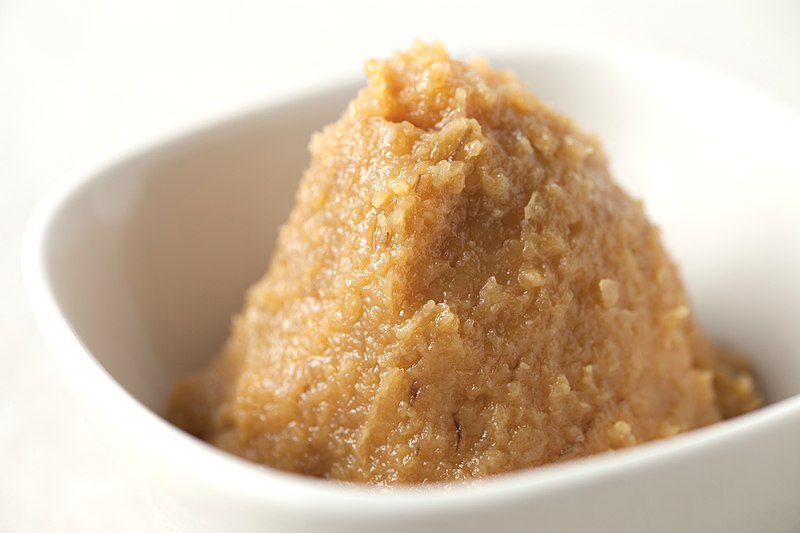
File:Miso_001.jpg · Wikimedia Commons · See Wikimedia Commons
miso
Sign in to saveAlso known as Soya paste, Soybean paste
is a traditional Japanese seasoning. It is a thick paste produced by fermenting soybeans with salt and kōji (the fungus Aspergillus oryzae), and sometimes rice, barley, seaweed, or other ingredients. It is used for sauces and spreads; pickling vegetables, fish, or meats; and mixing with dashi soup stock to serve as miso soup, a Japanese culinary staple food. Miso is high in protein and rich in minerals, and it played an important nutritional role in feudal Japan. Miso is widely used in both traditional and modern cooking in Japan, and as of 2018 had been gaining worldwide interest.
Miso is a thick Japanese paste made by fermenting soybeans with salt and a special fungus, sometimes combined with rice, barley, or seaweed. It's used in cooking for sauces, spreads, pickling, and soup, and it's valued for its high protein content and minerals, making it an important ingredient in Japanese cuisine that is now gaining interest globally.
AI-generated from the Wikipedia summary — may contain errors.
Key facts
- Food.name
- Miso
- Food.image
- Miso 001.jpg
- Food.image_size
- 300px
- Food.caption
- Miso
- Food.alternate_name
- Soybean paste,
- Food.place_of_origin
- Japan
- Food.associated_cuisine
- Japanese
- Food.creator
- <!-- or
- Food.creators
- -->
- Food.type
- Seasoning
- Food.main_ingredient
- Fermented soybeans, salt, kōji (Aspergillus oryzae)
via Wikipedia infobox
Nutrition · Open Food Facts
Typical values per 100 g · averaged across 72 products
- Energy
- 155 kcal
- Fat
- 4 g
- — of which saturates
- 0.5 g
- Carbohydrates
- 20.6 g
- — of which sugars
- 11.1 g
- Fibre
- 4.1 g
- Protein
- 9.1 g
- Salt
- 9.17 g
via Open Food Facts · ODbL
Wikidata facts
- Subclass of
- condiment
- Part of
- Japanese cuisine
- Country of origin
- Japan
- Material used
- soybean
- Image
- Miso 002.jpg
Show 6 more facts
- Commons category
- Miso
- cuisine
- Japanese cuisine
- native label
- 味噌
- partially coincident with
- doenjang
- exact match
- purl.obolibrary.org/obo/ENVO_00003898
- water footprint
- 572
via Wikidata · CC0
~15 min read
Encyclopedic overview
13 sectionsContents
- History
- Ingredients
- Types and flavor
- Chemical properties of flavor and aroma compounds
- Fermentation
- Creating koji
- Storage and preparation
- Usage
- Nutrition and health
- See also
- References
- Further reading
- External links
is a traditional Japanese seasoning. It is a thick paste produced by fermenting soybeans with salt and kōji (the fungus Aspergillus oryzae), and sometimes rice, barley, seaweed, or other ingredients. It is used for sauces and spreads; pickling vegetables, fish, or meats; and mixing with dashi soup stock to serve as miso soup, a Japanese culinary staple food. Miso is high in protein and rich in minerals, and it played an important nutritional role in feudal Japan. Miso is widely used in both traditional and modern cooking in Japan, and as of 2018 had been gaining worldwide interest.
Typically, miso is salty, but its flavor and aroma depend on the ingredients and fermentation process. Different varieties of miso have been variously described as salty, sweet, earthy, fruity, or savory.
Excerpted from Wikipedia’s “miso” article, available under the CC BY-SA 4.0 licence.