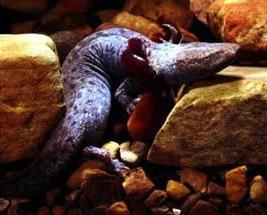
File:Necturus_maculosus_maculosus.jpg · Wikimedia Commons · See Wikimedia Commons
mudpuppy
Sign in to saveAlso known as Proteidae
The family Proteidae is a group of aquatic salamanders found today in the Balkan Peninsula and North America. The range of the genus Necturus (commonly known as waterdogs or mudpuppies) runs from southern central Canada, through the midwestern United States, east to North Carolina and south to Georgia and Mississippi. The range of the olm, the only extant member of the genus Proteus, is limited to the Western Balkans. The fossil record of the family extends back to the Late Cretaceous, with Paranecturus being known from the Maastrichtian of North America, and Bishara from the Santonian-Campani
OverviewAI-generated
The mudpuppy is a taxon classified within the family Proteidae. This family belongs to the order Caudata, which is part of the class Amphibia and the phylum Chordata. The parent taxon for this group is Salamandroidea. The family name Proteidae was established by Gray in 1825 and holds an accepted status in the World Register of Marine Species.
Organisms in this family inhabit freshwater environments. The term mudpuppy is associated with 923 records in the PubMed database. Additionally, the subject is referenced by 76 other encyclopedia articles.
Synthesized by Vinony from 17 facts across 4 sources: Wikidata, PubMed, WoRMS, Vinony graph. Generated from structured data (not the Wikipedia text) and checked against those facts — may still contain errors.
Species
Family
- PhylumChordata
- ClassAmphibia
- OrderCaudata
- FamilyProteidae
洞螈科是有尾目下的一個科,是一類水生的蠑螈,屬於兩棲類,分布於巴爾幹半島與北美洲。泥螈屬分布於加拿大中部至美國中西部,東至北卡羅萊納州,南可達喬治亞州與密西西比州[1]。洞螈屬現存僅洞螈一種,僅分布於巴爾幹半島西部。 目录 1 生物分類學 2 生活史 3 參見 4 參考文獻 生物分類學 洞螈科下包括兩個屬,分別是洞螈屬及泥螈屬,總共有7個物種。 泥螈屬 阿拉巴馬泥螈 (Necturus alabamensis) 海灣泥螈 (Necturus beyeri) 紐斯河泥螈 (Necturus lewisi) 紅河泥螈 (Necturus louisianensis) 斑泥螈 (Necturus maculosus) 小泥螈 (Necturus punctatus) 洞螈屬 洞螈 (Proteus anguinus) 生活史 和許多有尾目不同的是,洞螈科即使進到了成年也依然保有幼體時的外鰓,這項特徵被稱為幼態延續。洞螈科為完全水棲,雖然擁有肺,但很少用來進行呼吸作用[2]。洞螈科的鰓部外露,缺乏魚類的鰓蓋(英语:Operculum (fish))。鰓在低溫高含氧的水中緊貼身體並呈現鮮紅色,在溫暖缺氧的水中則會舒張開來增加接收氧的表面積。泥螈屬另外能透過皮膚吸收氧氣,有時也會直接呼吸空氣[2]。 另外洞螈科也缺乏眼瞼以及上頜骨。雌性會將卵產在原木或石頭上,而雄性則會保護這些卵5至9個星期好讓卵能順利地發育[3]。洞螈科的體長約在28~40厘米(11~16英寸)之間[4]。 泥螈屬,通常稱為「泥狗」或「水狗」,偏好棲息在淺湖與流速緩慢的溪流的石頭底下,但也曾經發現在90英尺(27米)的深水之中[5]。牠們的名字來自於被誤認為能夠發出類似犬的吠聲[4]。泥螈屬以小魚與無脊椎動物為食,包括螯蝦、蝸牛與蠕蟲[6]。泥螈在4到6年中完全成長並可存活超過20年。泥螈屬具有幼態延續的特性,由幼體發育至性成熟時期間,不會經歷變態。 參見 墨西哥鈍口螈 參考文獻 ^ Mudpuppies, Mudpuppy Pictures, Mudpuppy Facts. Animals.nationalgeographic.com. Retrieved on 2013-01-02. ^ 2.0 2.1 Harris, J.P., Jr. The natural history of Necturus: II.. Field and Laboratory. 1959, 27 (2): 71–77. ^ 自然與人文數位博物館:洞螈、泥狗和水狗(洞螈科) http://digimuse.nmns.edu.tw/Default.aspx?tabid=414&ObjectId=0b00000181e3fec3&Domin=z&Field=a1&ContentType=Exh
via
Research
923 papers- Galanin activates an inwardly rectifying potassium conductance and inhibits a voltage-dependent calcium conductance in mudpuppy parasympathetic neurons.Annals of the New York Academy of Sciences · 1998
- Yersinia ruckeri Isolated from Common Mudpuppy Necturus maculosus.Journal of aquatic animal health · 2019
- Mudpuppy retinal ganglion cell morphology revealed by an HRP impregnation technique which provides Golgi-like staining.The Journal of comparative neurology · 1988
- Nephroblastoma in a Common Mudpuppy Necturus maculosus simultaneously Present with a Mollicute Bacterium of the Genus Acholeplasma.Journal of aquatic animal health · 2021
- Gap Junctions Contribute to the Regulation of Walking-Like Activity in the Adult Mudpuppy (Necturus Maculatus).PloS one · 2016
via PubMed
Wikidata facts
Show 3 more facts
- Commons category
- Proteidae
- taxon name
- Proteidae
- taxon rank
- family
Sources (1)
via Wikidata · CC0
~5 min read
Encyclopedic overview
5 sectionsContents
- Taxonomy
- Life history
- See also
- References
- External links
The family Proteidae is a group of aquatic salamanders found today in the Balkan Peninsula and North America. The range of the genus Necturus (commonly known as waterdogs or mudpuppies) runs from southern central Canada, through the midwestern United States, east to North Carolina and south to Georgia and Mississippi. The range of the olm, the only extant member of the genus Proteus, is limited to the Western Balkans. The fossil record of the family extends back to the Late Cretaceous, with Paranecturus being known from the Maastrichtian of North America, and Bishara from the Santonian-Campanian of Central Asia.
== Taxonomy == Proteidae is divided into two extant genera, Necturus with five North American species, and Proteus with one extant European species, the olm. A number of extinct genera are known extending back to the end of the Late Cretaceous. Morphological analyses suggest that the oldest genus, Bishara, is a crown-group proteid more closely related to Proteus than to Necturus, suggesting an ancient divergence between the North American and Eurasian members of the family, dating to at least the Late Cretaceous.
Excerpted from Wikipedia’s “mudpuppy” article, available under the CC BY-SA 4.0 licence.