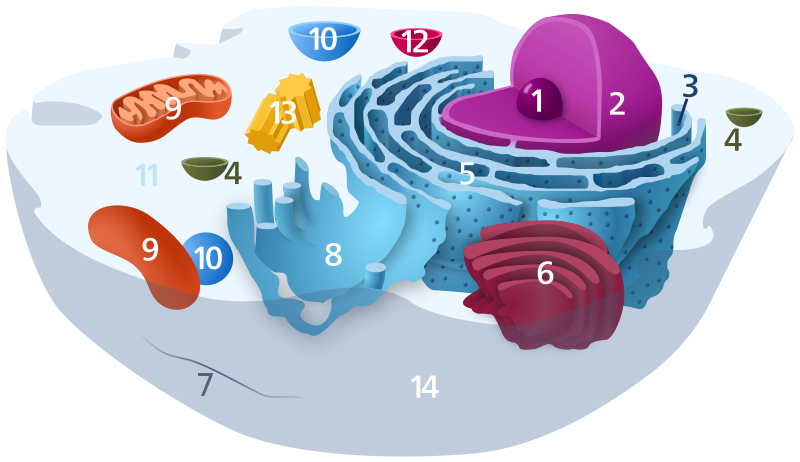
File:Animal_Cell.svg · Wikimedia Commons · See Wikimedia Commons
organelle
Sign in to saveAlso known as cell organelles, cell organelle, organelles
An organelle is a specialized subunit, within a biological cell, that has a specific function. The name organelle comes from the idea that these structures are parts of cells, as organs are to the body, hence organelle, the suffix -elle being a diminutive. Organelles are either separately enclosed within their own lipid bilayers (also called membrane-bound organelles) or are spatially distinct functional units without a surrounding lipid bilayer (non-membrane bounded organelles). Although most organelles are functional units within cells, some functional units that extend outside of cells are
An organelle is a specialized structure inside a cell that performs a specific job, similar to how organs work in your body. Organelles can either be enclosed in their own protective membrane or exist as distinct functional units without a surrounding membrane.
AI-generated from the Wikipedia summary — may contain errors.
Key facts
- Microanatomy.Name
- Organelle
- Microanatomy.Latin
- organella
- Microanatomy.PartOf
- Cell
via Wikipedia infobox
Research
633,872 papers- Organelle Zones.ReviewCell structure and function · 2019Sasaki K, Yoshida HDOI: 10.1247/csf.19010
- Organelle-Targeting Nanoparticles.ReviewAdvanced science (Weinheim, Baden-Wurttemberg, Germany) · 2025Soukar J, Peppas NA, Gaharwar AKDOI: 10.1002/advs.202411720
- Organelle zones in mitochondria.ReviewJournal of biochemistry · 2019Shimizu SDOI: 10.1093/jb/mvy068
- Organelle Interactions in Plant Cells.ReviewResults and problems in cell differentiation · 2024Hall MR, Kunjumon TK, Ghosh PP et al.DOI: 10.1007/978-3-031-62036-2_3
- Organelle aging: Lessons from model organisms.ReviewJournal of genetics and genomics = Yi chuan xue bao · 2019Bouska M, Huang K, Kang P et al.DOI: 10.1016/j.jgg.2019.03.011
- ER-organelle contacts: A signaling hub for neurological diseases.ReviewPharmacological research · 2024Wang Y, Yang JDOI: 10.1016/j.phrs.2024.107149
- Organelle-Targeted Photosensitizers for Precision Photodynamic Therapy.ReviewACS applied materials & interfaces · 2021Wang R, Li X, Yoon JDOI: 10.1021/acsami.1c02019
- Organelle-targeted photothermal agents for cancer therapy.ReviewChemical communications (Cambridge, England) · 2021Hwang E, Jung HSDOI: 10.1039/d1cc02168k
via PubMed
Wikidata facts
Show 6 more facts
- Commons category
- Organelles
- topic's main category
- Category:Organelles
- described by source
- Armenian Soviet Encyclopedia
- exact match
- purl.obolibrary.org/obo/GO_0043226
- topic has template
- Template:Organelle diagram
- theorized by
- Karl Möbius
Sources (2)
via Wikidata · CC0
~15 min read
Encyclopedic overview
7 sectionsContents
- History and terminology
- Types
- Eukaryotic organelles
- Prokaryotic organelles
- See also
- References
- External links
An organelle is a specialized subunit, within a biological cell, that has a specific function. The name organelle comes from the idea that these structures are parts of cells, as organs are to the body, hence organelle, the suffix -elle being a diminutive. Organelles are either separately enclosed within their own lipid bilayers (also called membrane-bound organelles) or are spatially distinct functional units without a surrounding lipid bilayer (non-membrane bounded organelles). Although most organelles are functional units within cells, some functional units that extend outside of cells are often termed organelles, such as cilia, the flagellum and archaellum, and the trichocyst (these could be referred to as membrane bound in the sense that they are attached to (or bound to) the membrane).
Organelles are identified by microscopy, and can also be purified by cell fractionation. There are many types of organelles, particularly in eukaryotic cells. They include structures that make up the endomembrane system (such as the nuclear envelope, endoplasmic reticulum, and Golgi apparatus), and other structures such as mitochondria and plastids. While prokaryotes do not possess eukaryotic organelles, some do contain protein-shelled bacterial microcompartments, which are thought to act as primitive prokaryotic organelles; and there is also evidence of other membrane-bounded structures. Also, the prokaryotic flagellum which protrudes outside the cell, and its motor, as well as the largely extracellular pilus, are often spoken of as organelles.
Excerpted from Wikipedia’s “organelle” article, available under the CC BY-SA 4.0 licence.
Gallery (10)
Available in 88 languages
- Español
- Français
- Deutsch
- 中文
- 日本語
- Русский
- Português
- Italiano
- العربية
- हिन्दी
- Armenian
- Azerbaijani
- Bahasa Indonesia
- Bangla
- Basque
- Belarusian
- Bosnian
- Breton
Show 69 more
- Bulgarian
- Catalan
- Central Kurdish
- Chechen
- Chuvash
- Croatian
- Czech
- Danish
- Esperanto
- Estonian
- Filipino
- Finnish
- Galician
- Georgian
- Greek
- Haitian Creole
- Hebrew
- Hungarian
- Icelandic
- Javanese
- Kazakh
- Kurdish
- Kyrgyz
- Latin
- Latvian
- Lombard
- Low German
- Luxembourgish
- Macedonian
- Malay
- Malayalam
- Manx
- Mazanderani
- Mongolian
- Nederlands
- Norwegian
- Norwegian Nynorsk
- Occitan
- Odia
- Oromo
- Polski
- Punjabi
- Quechua
- Romanian
- Rusyn
- Serbian
- Serbian (Latin)
- simple
- Sinhala
- Slovak
- Slovenian
- Sundanese
- Svenska
- Tamil
- Tiếng Việt
- Türkçe
- Turkmen
- Ukrainian
- Urdu
- Uzbek
- Welsh
- Western Panjabi
- Wu Chinese
- zh_min_nan
- zh_yue
- Zulu
- فارسی
- ไทย
- 한국어
via Wikidata sitelinks · CC0