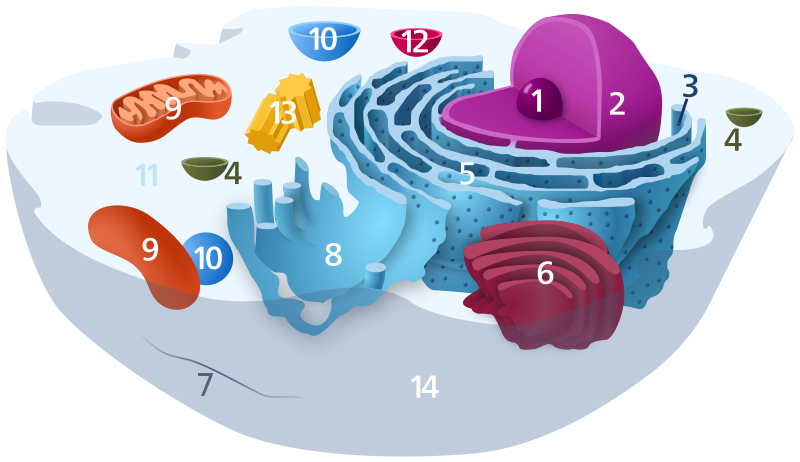
File:Animal_Cell.svg · Wikimedia Commons · See Wikimedia Commons
cytoskeleton
Sign in to saveAlso known as CSK, GO:0005856
thumb|right|300px|The cytoskeleton consists of (a) microtubules, (b) microfilaments, and (c) intermediate filaments.
The cytoskeleton is a network of protein structures inside cells made up of microtubules, microfilaments, and intermediate filaments that gives cells their shape and organization. It matters because these structures help cells maintain their form and enable internal movement and transport within the cell.
AI-generated from the Wikipedia summary — may contain errors.
Research
150,106 papers- Overview of the Cytoskeleton from an Evolutionary Perspective.ReviewCold Spring Harbor perspectives in biology · 2018Pollard TD, Goldman RDDOI: 10.1101/cshperspect.a030288
- Roles of cytoskeleton in metastasis: from its mechanism to therapeutic strategies.ReviewExperimental & molecular medicine · 2026Lim S, Woo S, Lee KW et al.DOI: 10.1038/s12276-025-01608-9
- The Cytoskeleton and Its Roles in Self-Organization Phenomena: Insights from Xenopus Egg Extracts.ReviewCells · 2021Geisterfer ZM, Guilloux G, Gatlin JC et al.DOI: 10.3390/cells10092197
- Cytoskeleton of mollicutes.ReviewJournal of molecular microbiology and biotechnology · 2006Miyata M, Ogaki HDOI: 10.1159/000094059
- The cytoskeleton of trypanosomatid parasites.ReviewAnnual review of microbiology · 1999Gull KDOI: 10.1146/annurev.micro.53.1.629
- The cytoskeleton and neurite initiation.ReviewBioarchitecture · 2013Flynn KCDOI: 10.4161/bioa.26259
- The Role of Host Cytoskeleton in Flavivirus Infection.ReviewVirologica Sinica · 2019Zhang Y, Gao W, Li J et al.DOI: 10.1007/s12250-019-00086-4
- The evolution of the cytoskeleton.ReviewThe Journal of cell biology · 2011Wickstead B, Gull KDOI: 10.1083/jcb.201102065
via PubMed
Wikidata facts
- Part of
- cytoplasm
Show 3 more facts
- Commons category
- Cytoskeleton
- topic's main category
- Category:Cytoskeleton
- exact match
- purl.obolibrary.org/obo/GO_0005856
via Wikidata · CC0
~23 min read
Encyclopedic overview
20 sectionsContents
- History
- Eukaryotic cytoskeleton
- Microfilaments
- Intermediate filaments
- Microtubules
- Comparison
- Septins
- Spectrin
- Yeast cytoskeleton
- Prokaryotic cytoskeleton
- FtsZ
- MreB and ParM
- Crescentin
- The cytoskeleton and cell mechanics
- Long-range order
- Common features and differences between prokaryotes and eukaryotes
- Cytoplasmic streaming
- See also
- References
- External links
thumb|right|300px|The cytoskeleton consists of (a) microtubules, (b) microfilaments, and (c) intermediate filaments.
The cytoskeleton is a complex, dynamic network of interlinking protein filaments present in the cytoplasm of all cells, including those of bacteria and archaea. In eukaryotes, it extends from the cell nucleus to the cell membrane and is composed of similar proteins in the various organisms. It is composed of three main components: microfilaments, intermediate filaments, and microtubules, and these are all capable of rapid growth and/or disassembly depending on the cell's requirements.
Excerpted from Wikipedia’s “cytoskeleton” article, available under the CC BY-SA 4.0 licence.
Gallery (15)
Available in 68 languages
- Español
- Français
- Deutsch
- 中文
- 日本語
- Русский
- Português
- Italiano
- العربية
- हिन्दी
- Armenian
- Bahasa Indonesia
- Bangla
- Basque
- Bosnian
- Bulgarian
- Catalan
- Central Kurdish
Show 49 more
- Croatian
- Czech
- Danish
- Esperanto
- Estonian
- Filipino
- Finnish
- Galician
- Greek
- Hebrew
- Hungarian
- Icelandic
- Irish
- Kannada
- Kazakh
- Kurdish
- Latin
- Latvian
- Lingua Franca Nova
- Lithuanian
- Luxembourgish
- Macedonian
- Manx
- Nederlands
- Norwegian
- Norwegian Nynorsk
- Occitan
- Polski
- Romanian
- Serbian
- Serbian (Latin)
- simple
- Sindhi
- Sinhala
- Slovak
- Slovenian
- Svenska
- Tamil
- Tiếng Việt
- Türkçe
- Ukrainian
- Urdu
- Welsh
- Wu Chinese
- zh_yue
- Zulu
- فارسی
- ไทย
- 한국어
via Wikidata sitelinks · CC0