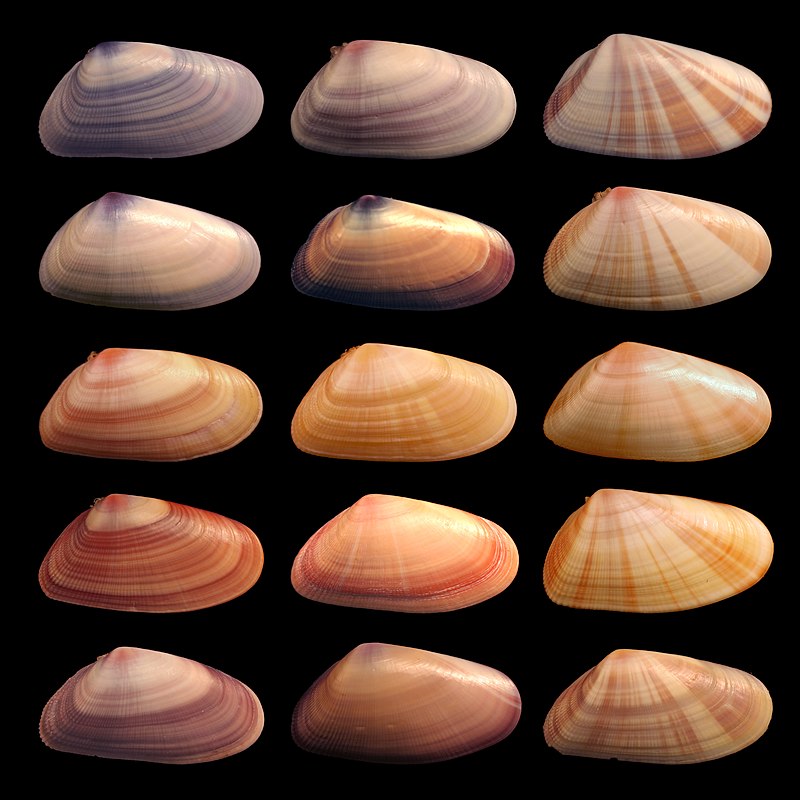
File:Coquina_variation3.jpg · Wikimedia Commons · See Wikimedia Commons
phenotype
Sign in to saveAlso known as phenotypical outcome
thumb|right|250px |The mollusc shell|shells of individuals within the [[bivalve mollusk species Donax variabilis show diverse coloration and patterning in their phenotypes.]] thumb|right |Here the relation between genotype and phenotype is illustrated, using a [[Punnett square, for the character of petal color in pea plants. The letters B and b represent genes for color, and the pictures show the resultant phenotypes. This shows how multiple genotypes (BB and Bb) may yield the same phenotype (purple petals).]]
A phenotype is the observable characteristics of an organism—like shell color and patterning in clams or petal color in plants—which result from both its genes and its environment. It matters because the same genetic makeup can produce different phenotypes, meaning that what we see in living things reflects a combination of inherited genes and other factors, not genes alone.
AI-generated from the Wikipedia summary — may contain errors.
Wikidata facts
- Subclass of
- quality
- Part of
- organism
- Has part
- phenotypic trait
Show 8 more facts
- exact match
- purl.obolibrary.org/obo/UPHENO_0001001
- Commons category
- Phenotypes
- opposite of
- genotype
- different from
- phoneme
- manifestation of
- environmental factor
- described by source
- Armenian Soviet Encyclopedia
- NCI Thesaurus ID
- C16977
- has cause
- genotype
via Wikidata · CC0
~17 min read
Encyclopedic overview
10 sectionsContents
- Definition
- Phenotypic variation
- The extended phenotype
- Genes and phenotypes
- Phenome and phenomics
- Large-scale phenotyping and genetic screens
- Evolutionary origin of phenotype
- See also
- References
- External links
thumb|right|250px |The mollusc shell|shells of individuals within the [[bivalve mollusk species Donax variabilis show diverse coloration and patterning in their phenotypes.]] thumb|right |Here the relation between genotype and phenotype is illustrated, using a [[Punnett square, for the character of petal color in pea plants. The letters B and b represent genes for color, and the pictures show the resultant phenotypes. This shows how multiple genotypes (BB and Bb) may yield the same phenotype (purple petals).]]
In genetics, the phenotype () is the set of observable characteristics or traits of an organism. The term covers all traits of an organism other than its genome, however transitory: the organism's morphology (physical form and structure), its developmental processes, its biochemical and physiological properties whether reversible or irreversible, and all its behavior, such as a peacock's display.
Excerpted from Wikipedia’s “phenotype” article, available under the CC BY-SA 4.0 licence.
Gallery (24)
Available in 77 languages
- Español
- Français
- Deutsch
- 中文
- 日本語
- Русский
- Português
- Italiano
- العربية
- Afrikaans
- Armenian
- Asturian
- Azerbaijani
- Bahasa Indonesia
- Bangla
- Basque
- Bosnian
- Bulgarian
Show 58 more
- Catalan
- Central Kurdish
- Chuvash
- Croatian
- Czech
- Danish
- Esperanto
- Estonian
- Filipino
- Finnish
- Galician
- Georgian
- Greek
- Haitian Creole
- Hebrew
- Hungarian
- Icelandic
- Ido
- Irish
- Kabyle
- Kara-Kalpak
- Kazakh
- Kurdish
- Kyrgyz
- Latvian
- Low German
- Luxembourgish
- Macedonian
- Malay
- Mongolian
- Nederlands
- Norwegian Nynorsk
- Occitan
- Pashto
- Polski
- Romanian
- Rusyn
- Saterland Frisian
- Scots
- Serbian
- Serbian (Latin)
- simple
- Slovak
- Slovenian
- Svenska
- Tajik
- Tamil
- Tiếng Việt
- Türkçe
- Ukrainian
- Urdu
- Uzbek
- Wu Chinese
- zh_min_nan
- zh_yue
- فارسی
- ไทย
- 한국어
via Wikidata sitelinks · CC0