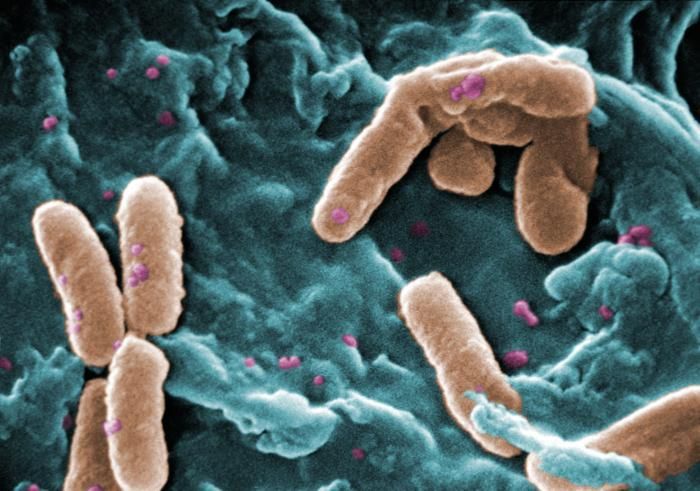
Encyclopedia of Life · EOL (see source)
Pseudomonadaceae
Sign in to saveThe Pseudomonadaceae are a family of bacteria which includes the genera Azomonas, Azorhizophilus, Azotobacter, Mesophilobacter, Pseudomonas (the type genus), and Rugamonas. The family Azotobacteraceae was recently reclassified into this family.
Species
FAMILY
- KingdomBacteria
- PhylumProteobacteria
- ClassGammaproteobacteria
- OrderPseudomonadales
- FamilyPseudomonadaceae
Die Pseudomonadaceae bilden eine Familie innerhalb der Gammaproteobakterien. Die Vertreter dieser Familie sind, wie alle Proteobakterien gramnegativ. Es handelt sich um aerobe Bakterien, sie benötigen Sauerstoff, um zu wachsen. Innerhalb dieser Familie ist die Gattung Pseudomonas sehr artenreich und enthält Bakterien von ökologischer und medizinischer Bedeutung. Arten wie Pseudomonas aeruginosa können für Menschen mit geschwächten Immunsystem gefährlich sein, Unterarten von Pseudomonas syringae verursachen die Tuberkelkrankheit beim Olivenbaum.
via GBIF
Research
92,045 papers- OsPHR2-mediated recruitment of Pseudomonadaceae enhances rice phosphorus uptake.Plant communications · 2024
- Siderophores of the Pseudomonadaceae sensu stricto (fluorescent and non-fluorescent Pseudomonas spp.).Fortschritte der Chemie organischer Naturstoffe = Progress in the chemistry of organic natural products. Progres dans la chimie des substances organiques naturelles · 2004
- D-glucarate catabolism by pseudomonadaceae and enterobacteriaceae.Nature · 1966
- Transition from Ginseng Root Rot Disease-Conducive Soil to -Suppressive Soil Mediated by Pseudomonadaceae.Microbiology spectrum · 2023
- Conserved Signal Transduction Mechanisms and Dark Recovery Kinetic Tuning in the Pseudomonadaceae Short Light, Oxygen, Voltage (LOV) Protein Family.Journal of molecular biology · 2024
via PubMed
Wikidata facts
- Instance of
- taxon
- Parent taxon
- Pseudomonadales
- Image
- Pseudomonas aeruginosa 01.jpg
Show 8 more facts
- Commons category
- Pseudomonadaceae
- taxon rank
- family
- taxon name
- Pseudomonadaceae
- topic's main category
- Category:Pseudomonadaceae
- taxon common name
- Pseudomonaadid
- Gram staining
- gram-negative bacteria
- taxonomic type
- Pseudomonas
Sources (2)
via Wikidata · CC0
~2 min read
Encyclopedic overview
3 sectionsContents
- History
- Distinguishing characteristics
- References
The Pseudomonadaceae are a family of bacteria which includes the genera Azomonas, Azorhizophilus, Azotobacter, Mesophilobacter, Pseudomonas (the type genus), and Rugamonas. The family Azotobacteraceae was recently reclassified into this family.
==History== Pseudomonad literally means false unit, being derived from the Greek pseudo ( – false) and monas (μονος – a single unit). The term "monad" was used in the early history of microbiology to denote single-celled organisms. Because of their widespread occurrence in nature, the pseudomonads were observed early in the history of microbiology. The generic name Pseudomonas created for these organisms was defined in rather vague terms in 1894 as a genus of Gram-negative, rod-shaped, and polar-flagellated bacteria. Soon afterwards, a large number of species was assigned to the genus. Pseudomonads were isolated from many natural niches. New methodology and the inclusion of approaches based on the studies of conservative macromolecules have reclassified many species.
Excerpted from Wikipedia’s “Pseudomonadaceae” article, available under the CC BY-SA 4.0 licence.