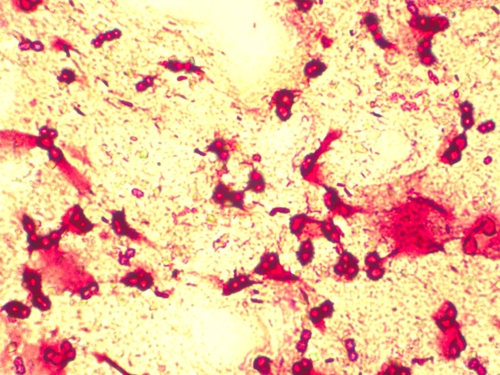
(c) Мирослав Харьков, some rights reserved (CC BY-NC), uploaded by Мирослав Харьков · cc-by-nc
Azotobacter
Sign in to savethumb|Azotobacter beijerinckii on agar plate
Species
GENUS
- KingdomBacteria
- PhylumProteobacteria
- ClassGammaproteobacteria
- OrderPseudomonadales
- FamilyPseudomonadaceae
via GBIF
Research
4,135 papers- Azotobacter keratitis.Archives of ophthalmology (Chicago, Ill. : 1960) · 1981
- Azotobacter fluorescence.Journal of bacteriology · 1955
- Impact of Azotobacter exopolysaccharides on sustainable agriculture.Applied microbiology and biotechnology · 2012
- Respiratory protection of nitrogenase in Azotobacter species: is a widely held hypothesis unequivocally supported by experimental evidence?FEMS microbiology reviews · 2000
- Azotobacters as biofertilizer.Advances in applied microbiology · 2019
via PubMed
Wikidata facts
- Instance of
- taxon
- Parent taxon
- Pseudomonadaceae
- Image
- Azotobacter cells.jpg
Show 7 more facts
- taxon rank
- genus
- taxon name
- Azotobacter
- Commons category
- Azotobacter
- taxon common name
- Asotobakter
- Gram staining
- gram-negative bacteria
- LPSN URL
- lpsn.dsmz.de/genus/azotobacter
- taxonomic type
- Azotobacter chroococcum
Sources (2)
via Wikidata · CC0
~13 min read
Encyclopedic overview
15 sectionsContents
- Biological characteristics
- Morphology
- Cysts
- Germination of cysts
- Physiological properties
- Pigments
- Genome
- Distribution
- Nitrogen fixation
- Nitrogenase
- Importance
- Applications
- Taxonomy
- References
- External links
thumb|Azotobacter beijerinckii on agar plate
Azotobacter is a genus of usually motile, oval or spherical bacteria that form thick-walled cysts (and also has hard crust) and may produce large quantities of capsular slime. They are aerobic, free-living soil microbes that play an important role in the nitrogen cycle in nature, binding atmospheric nitrogen, which is inaccessible to plants, and releasing it in the form of ammonium ions into the soil (nitrogen fixation). In addition to being a model organism for studying diazotrophs, it is used by humans for the production of biofertilizers, food additives, and some biopolymers. The first representative of the genus, Azotobacter chroococcum, was discovered and described in 1901 by Dutch microbiologist and botanist Martinus Beijerinck. Azotobacter species are Gram-negative bacteria found in neutral and alkaline soils, in water, and in association with some plants.
Excerpted from Wikipedia’s “Azotobacter” article, available under the CC BY-SA 4.0 licence.