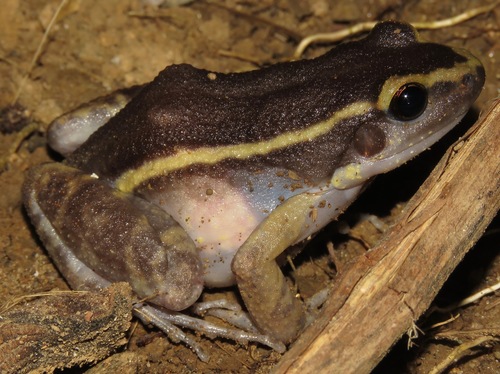
(c) Rich Hoyer, some rights reserved (CC BY-NC-SA), uploaded by Rich Hoyer · cc-by-nc-sa
Sapito Listado
Sign in to saveAlso known as Lithodytes lineatus
Lithodytes is a genus of frogs in the family of Leptodactylidae. It is monotypic, being represented by the single species, Lithodytes lineatus, also commonly known as the gold-striped frog or painted antnest frog. It is found in tropical South America where it lives in humid forests among the leaf litter. These frogs build foam nests at the edge of temporary pools, and the tadpoles develop within these. The frogs also associate with certain leafcutter ants (Atta cephalotes) and breed inside their nests without being attacked by the ants.
In the Vinony graph
Vinony's link graph records 11 inbound references to Sapito Listado, and connects out to Least Concern, Leptodactylidae and Brazil.
It sits within the topics Amphibians of Bolivia, Amphibians of Colombia and Amphibians of Ecuador.
Vinony links it to 12 Wikipedia language editions.
Species
Least ConcernPainted Antnest Frog
species
via IUCN
Wikidata facts
- Instance of
- taxon
- Image
- Lithodytes lineatus01.jpg
Show 9 more facts
- taxon rank
- species
- IUCN conservation status
- Least Concern
- taxon name
- Lithodytes lineatus
- Commons category
- Leptodactylus lineatus
- taxon common name
- Sapito Listado
- taxon range
- Venezuela
- diel cycle
- cathemeral
- short name
- L. lineatus
- external data available at URL
- www.gbif.org/dataset/7eabb3cb-039d-4906-b7a4-6de4d0d47294
via Wikidata · CC0
~16 min read
Encyclopedic overview
19 sectionsContents
- Description
- Tadpoles
- Distribution and habitat
- Conservation
- Phylogeny
- Close relatives
- Distinct Features
- Ecology and Mutualism
- Parental Care
- Social Behavior
- Reproductive Behavior
- Defensive Behavior
- Foraging Behavior
- Mimicry
- Batesian mimicry
- Müllerian mimicry
- Use in Research
- References
- External links
Lithodytes is a genus of frogs in the family of Leptodactylidae. It is monotypic, being represented by the single species, Lithodytes lineatus, also commonly known as the gold-striped frog or painted antnest frog. It is found in tropical South America where it lives in humid forests among the leaf litter. These frogs build foam nests at the edge of temporary pools, and the tadpoles develop within these. The frogs also associate with certain leafcutter ants (Atta cephalotes) and breed inside their nests without being attacked by the ants.
==Description== left|thumb|Amapá, [[Brazil]] left|thumb|Maranhão, [[Brazil]] The female Lithodytes lineatus grows to a length ranging from , and the male is slightly smaller. It has a slender body and blunt snout. The overall color is black apart from a pair of yellow lateral stripes running from the snout to the groin, where there is a red or orange patch. The limbs are brown banded with black.
Excerpted from Wikipedia’s “Sapito Listado” article, available under the CC BY-SA 4.0 licence.