File:3D_Spherical.svg · Wikimedia Commons · See Wikimedia Commons
spherical coordinate system
Sign in to savecoordinate system based around angle and distance from the origin
A spherical coordinate system specifies any point in space using angles and its distance from a central point, rather than measuring horizontal and vertical distances like we do on a flat grid. This approach is especially useful for describing locations on spheres (like Earth or the night sky) and for solving problems involving circular motion or radiation spreading outward from a source.
AI-generated from the Wikipedia summary — may contain errors.
Wikidata facts
- Subclass of
- orthogonal coordinate system
- Image
- Spherical Coordinates (Colatitude, Longitude) (b).svg
Show 2 more facts
- maintained by WikiProject
- WikiProject Mathematics
- Commons category
- Spherical coordinates
Sources (3)
via Wikidata · CC0
~40 min read
Encyclopedic overview
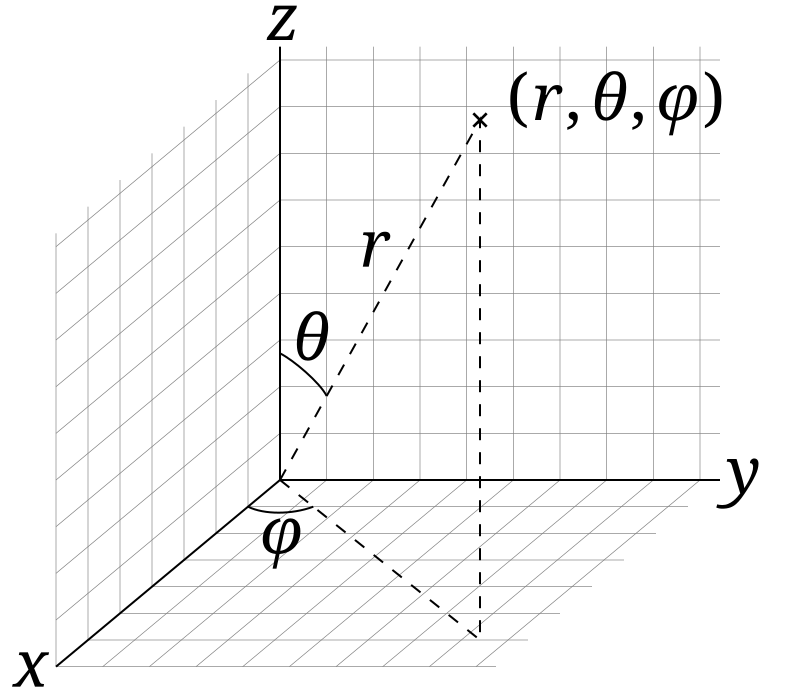
The physics convention. Spherical coordinates (r, θ, φ) as commonly used: (ISO 80000-2:2019): radial distance r (slant distance to origin), polar angle θ (theta) (angle with respect to positive polar axis), and azimuthal angle φ (phi) (angle of rotation from the initial meridian plane). This is the convention followed in this article.
In mathematics, a spherical coordinate system specifies a given point in three-dimensional space by using a distance and two angles as its three coordinates. These are
Excerpted from Wikipedia’s “spherical coordinate system” article, available under the CC BY-SA 4.0 licence.