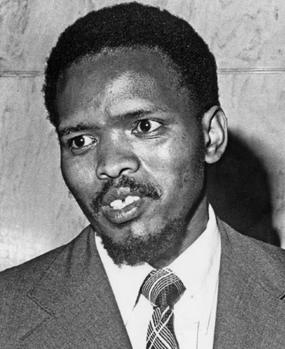
File:Steve_Biko_Photograph.jpg · Wikimedia Commons · See Wikimedia Commons
Steve Biko
Sign in to saveAlso known as Bantu Stephen Biko, Stephen Biko, Stephen Bantu Biko, Biko, Frank Talk
South African anti-apartheid activist (1946–1977)
OverviewAI-generated
Steve Biko was a South African trade unionist, politician, and writer born in 1946. He was a member of the South African Students' Organization and worked in the field of apartheid. Biko was educated at the University of Natal and spoke Afrikaans, Xhosa, and English. He also used the pseudonym Frank Talk.
He died by homicide in Pretoria in 1977 and is buried in Qonce. His archives are held at the Schomburg Center for Research in Black Culture. Biko is present in the works *Cry Freedom* and *Biko*. His notable writings include *I write what I like*, *The quest for a true humanity*, *Siyah Bilinci*, and *Black viewpoint*. He also authored *Geregtelike nadoodse ondersoek na die dood van Stephen Bantu Biko gehou in die sinagoge, Pretoria*.
Synthesized by Vinony from 25 facts across 3 sources: Wikidata, Open Library, Firecrawl. Generated from structured data (not the Wikipedia text) and checked against those facts — may still contain errors.
In the Vinony graph
Vinony's link graph records 747 inbound references to Steve Biko, and connects out to decolonization, Qonce and fetters.
Vinony files it under 1946 births, 1977 deaths and 1977 in South Africa.
Vinony links it to 73 Wikipedia language editions.
Person · Open Library
- Born
- 1946
- Died
- 1977
- Works
- 11
Top works
- "The quest for a true humanity"
- Geregtelike nadoodse ondersoek na die dood van Stephen Bantu Biko gehou in die sinagoge, Pretoria
- Siyah Bilinci
- I write what I like
- Black viewpoint
via Open Library + Wikidata
Wikidata facts
- Instance of
- human
- Given name
- Stephen
- Gender
- male
- Citizenship
- South Africa
- Place of birth
- Tarkastad
- Place of death
- Pretoria
- Occupation
- writer
- Educated at
- University of Natal
- Languages spoken
- English language
- Field of work
- apartheid
- Official website
- www.sbf.org.za/home
- Image
- Steve Biko on Flyer for Steve Biko Memorial at the Carver Cultural Center.jpg
Show 10 more facts
- Commons category
- Steve Biko
- date of birth
- 1946-12-18
- date of death
- 1977-09-12
- manner of death
- homicide
- pseudonym
- Frank Talk
- present in work
- Biko
- name in native language
- Steve Biko
- place of burial
- Qonce
- maintained by WikiProject
- WikiProject Biography
via Wikidata · CC0
~40 min read
Encyclopedic overview
Bantu Stephen Biko OMSG (18 December 1946 – 12 September 1977) was a South African anti-apartheid activist. Ideologically an African nationalist and African socialist, he was at the forefront of a grassroots anti-apartheid campaign known as the Black Consciousness Movement during the late 1960s and 1970s. His ideas were articulated in a series of articles published under the pseudonym Frank Talk.
Raised in a poor Xhosa family, Biko grew up in Ginsberg township in the Eastern Cape. In 1966, he began studying medicine at the University of Natal, where he joined the National Union of South African Students (NUSAS). Strongly opposed to the apartheid system of racial segregation and white-minority rule in South Africa, Biko was frustrated that NUSAS and other anti-apartheid groups were dominated by white liberals, rather than by the blacks who were most affected by apartheid. He believed that well-intentioned white liberals failed to comprehend the black experience and often acted in a paternalistic manner. He developed the view that to avoid white domination, black people had to organise independently, and to this end he became a leading figure in the creation of the South African Students' Organisation (SASO) in 1968. Membership was open only to "Blacks", a term that Biko used in reference not just to Bantu-speaking Africans but also to Coloureds and Indians. He was careful to keep his movement independent of white liberals, but opposed anti-white hatred and had white friends. The white-minority National Party government were initially supportive, seeing SASO's creation as a victory for apartheid's ethos of racial separatism.
Excerpted from Wikipedia’s “Steve Biko” article, available under the CC BY-SA 4.0 licence.
Gallery (7)
Available in 73 languages
- Español
- Français
- Deutsch
- 中文
- 日本語
- Русский
- Português
- Italiano
- العربية
- Afrikaans
- Armenian
- Asturian
- Bahasa Indonesia
- Bangla
- Basque
- Breton
- Catalan
- Central Kurdish
Show 54 more
- Croatian
- Czech
- Danish
- Egyptian Arabic
- Esperanto
- Estonian
- Finnish
- Galician
- Georgian
- gpe
- Greek
- Hausa
- Hebrew
- Hungarian
- Kazakh
- kbp
- Kikuyu
- Latin
- Latvian
- Lithuanian
- Luxembourgish
- Malagasy
- Malay
- Malayalam
- Nederlands
- Northern Sotho
- Norwegian
- Polski
- Punjabi
- Romanian
- Serbian
- Serbian (Latin)
- simple
- Slovak
- Slovenian
- Svenska
- Swahili
- Swati
- Tamil
- Telugu
- Tiếng Việt
- Tsonga
- Türkçe
- Ukrainian
- Venda
- Welsh
- Western Panjabi
- Wu Chinese
- Xhosa
- Yoruba
- zh_yue
- Zulu
- فارسی
- 한국어
via Wikidata sitelinks · CC0