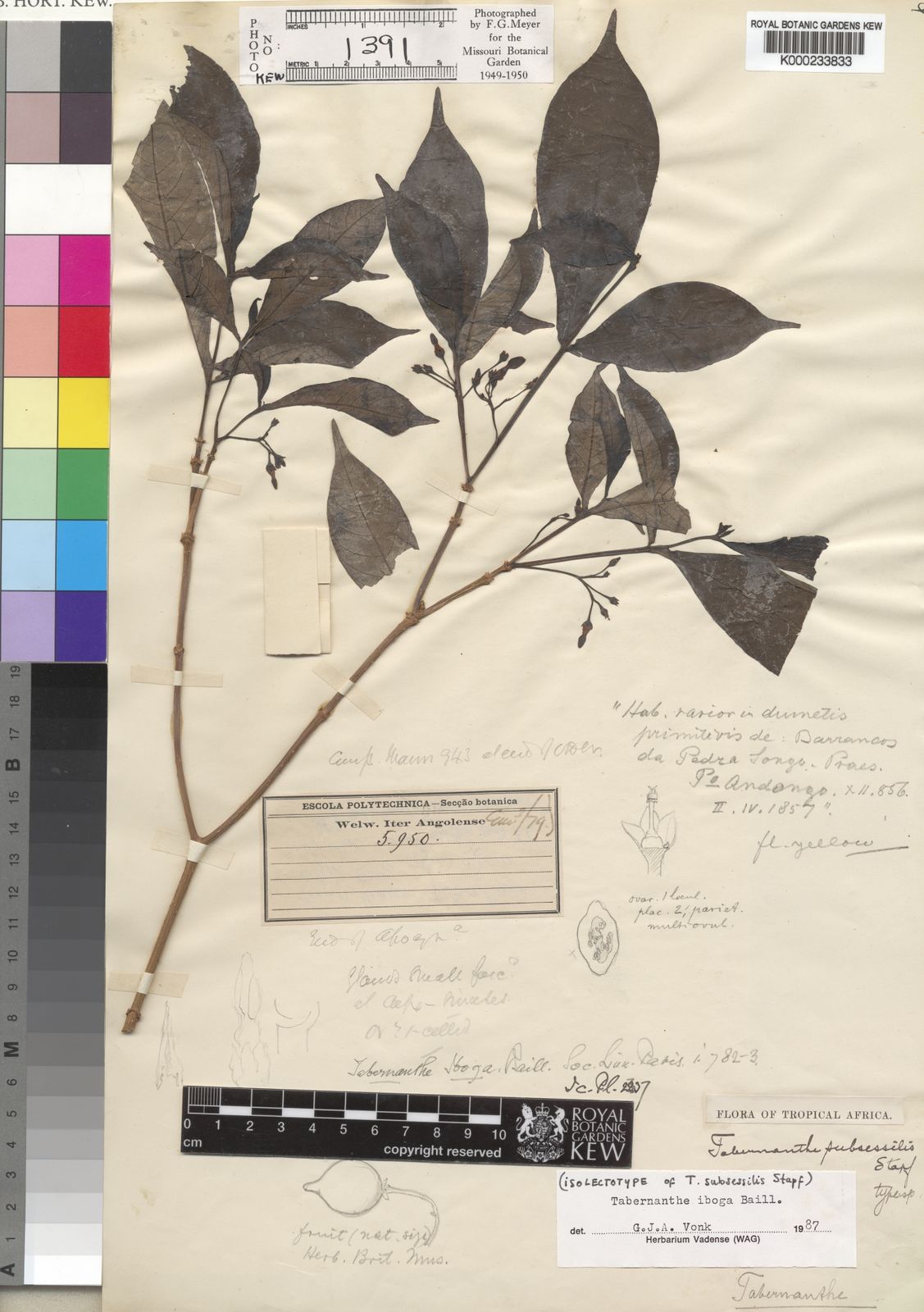
Tabernanthe iboga · Kew POWO · Kew Plants of the World Online
Species
Least ConcernSPECIES
- KingdomPlantae
- PhylumTracheophyta
- ClassMagnoliopsida
- OrderGentianales
- FamilyApocynaceae
Common Name: bacca
via GBIF · IUCN · Kew POWO
Museum specimens
- Specimen records
- 514
- With media
- 561
- Family
- Apocynaceae
- Collections
- US, CM
- Recorded in
- Gabon, Tanzania, Angola, Congo (Kinshasa), Netherlands, Equatorial Guinea, Ivory Coast, Cameroon
Wikidata facts
- Instance of
- taxon
- Subclass of
- useful plant
- Parent taxon
- Tabernanthe
- Image
- Iboga.jpg
- Has use
- medicinal plant
Show 11 more facts
- taxon rank
- species
- taxon name
- Tabernanthe iboga
- Commons category
- Tabernanthe iboga
- Commons gallery
- Tabernanthe iboga
- taxon common name
- 伊波卡
- IUCN conservation status
- Least Concern
- this taxon is source of
- ibogaine
- short name
- T. iboga
- taxon range
- Gabon
- external data available at URL
- www.gbif.org/dataset/31dc1507-a6e1-4233-a8df-c7a78596a7e4
Sources (2)
via Wikidata · CC0
~11 min read
Encyclopedic overview
Tabernanthe iboga (iboga) is an evergreen rainforest shrub native to Central Africa. A member of the Apocynaceae family indigenous to Gabon, the Democratic Republic of Congo, and the Republic of Congo, it is cultivated across Central Africa for use in traditional medicine and rituals.
T. iboga can grow up to 10 meters tall and contains psychoactive indole alkaloids, especially ibogaine, concentrated in its root bark, which produces strong neurological effects. It is used in both low doses as a stimulant and in high doses to induce intense dreamlike and hallucinatory states during rituals.
Excerpted from Wikipedia’s “Tabernanthe iboga” article, available under the CC BY-SA 4.0 licence.