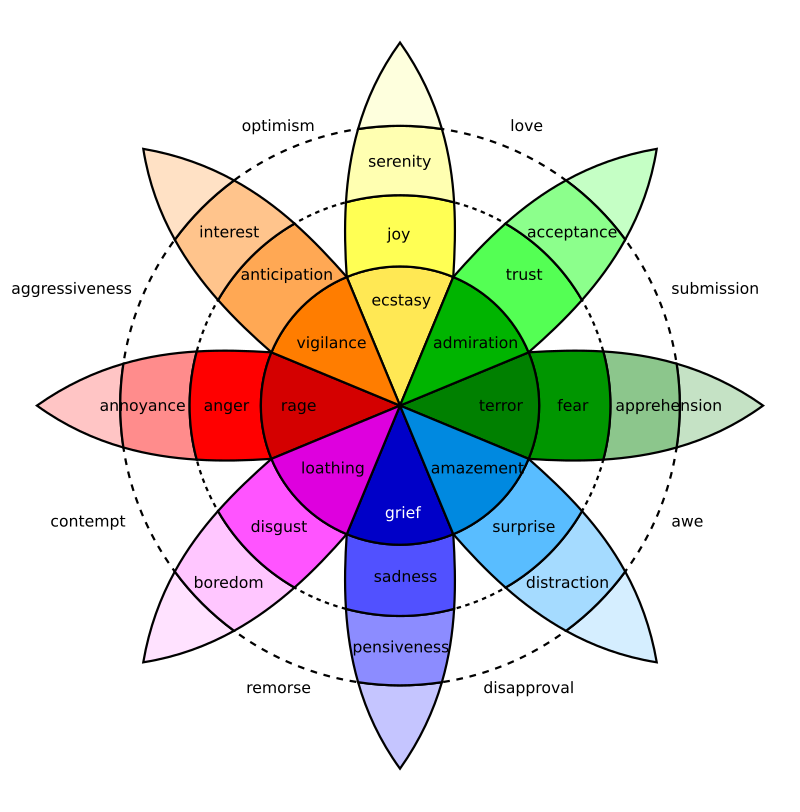
File:Plutchik-wheel.svg · Wikimedia Commons · See Wikimedia Commons
euphoria
Sign in to saveAlso known as happiness, pleasure, contentment
Euphoria ( ) is the experience (or affect) of pleasure or excitement and intense feelings of well-being and happiness. Certain natural rewards and social activities, such as aerobic exercise, laughter, listening to or making music and dancing, can induce a state of euphoria. Euphoria is also a symptom of certain neurological or neuropsychiatric disorders, such as mania. Romantic love and components of the human sexual response cycle are also associated with the induction of euphoria. Certain drugs, many of which are addictive, can cause euphoria, which at least partially motivates their recrea
Euphoria is an intense state of pleasure, excitement, and well-being that can be triggered by natural activities like exercise and music, social experiences like dancing and laughter, or romantic and sexual feelings. Understanding euphoria matters because it occurs both as a normal human experience and as a symptom of certain medical conditions or drug use, making it relevant to health, neuroscience, and addiction research.
AI-generated from the Wikipedia summary — may contain errors.
Research
2,983 papers- Ablation by lightning bolts: euphoria after EU-PORIA?Europace : European pacing, arrhythmias, and cardiac electrophysiology : journal of the working groups on cardiac pacing, arrhythmias, and cardiac cellular electrophysiology of the European Society of Cardiology · 2023Boersma L, Di Biase L, Tzeis SDOI: 10.1093/europace/euad218
- Postnatal euphoria: are 'the highs' an indicator of bipolarity?ReviewBipolar disorders · 2005Heron J, Craddock N, Jones IDOI: 10.1111/j.1399-5618.2005.00185.x
- Pediatric Mania: The Controversy between Euphoria and Irritability.ReviewCurrent neuropharmacology · 2017Serra G, Uchida M, Battaglia C et al.DOI: 10.2174/1570159X14666160607100403
- Changing definitions of euphoria in multiple sclerosis: A short report.ReviewMultiple sclerosis (Houndmills, Basingstoke, England) · 2015Duncan A, Malcolm-Smith S, Ameen O et al.DOI: 10.1177/1352458514549400
- [Euphoria].Il Policlinico. Sezione pratica · 1959
- [Euphoria].L' Evolution psychiatrique · 1958HENNE M
- [Euphoria].L' Infirmiere · 1969Bottequin A
- Exercise-induced euphoria and anxiolysis do not depend on endogenous opioids in humans.Psychoneuroendocrinology · 2021Siebers M, Biedermann SV, Bindila L et al.DOI: 10.1016/j.psyneuen.2021.105173
via PubMed
Wikidata facts
- Instance of
- biological process
- Subclass of
- condition
- Image
- Supreme happiness.jpg
- Said to be same as
- joy
Show 4 more facts
- opposite of
- dysphoria
- described by source
- Granat Encyclopedic Dictionary
- different from
- Euphoria
- NCI Thesaurus ID
- C34598
Sources (3)
via Wikidata · CC0
~13 min read
Encyclopedic overview
25 sectionsContents
- History {{anchor|History of the term}}
- Neuropsychology {{anchor|Neural substrates}}
- Types
- Exercise-induced
- Music-induced {{Anchor|Music euphoria}}
- Sex-induced
- Drug-induced{{anchor|Euphoriant|Euphoriants}}
- Stimulants
- Depressants
- Opioids
- Cannabinoids
- Inhalants
- Psychedelics
- Glucocorticoids
- List of euphoriants by mechanism of action
- Fasting–induced
- Neuropsychiatric
- Mania
- Epilepsy
- Migraine
- Multiple sclerosis
- Gender euphoria
- See also
- References
- External links
Euphoria ( ) is the experience (or affect) of pleasure or excitement and intense feelings of well-being and happiness. Certain natural rewards and social activities, such as aerobic exercise, laughter, listening to or making music and dancing, can induce a state of euphoria. Euphoria is also a symptom of certain neurological or neuropsychiatric disorders, such as mania. Romantic love and components of the human sexual response cycle are also associated with the induction of euphoria. Certain drugs, many of which are addictive, can cause euphoria, which at least partially motivates their recreational use.
Hedonic hotspots – i.e., the pleasure centers of the brain – are functionally linked. Activation of one hotspot results in the recruitment of the others. Inhibition of one hotspot results in the blunting of the effects of activating another hotspot. Therefore, the simultaneous activation of every hedonic hotspot within the reward system is believed to be necessary for generating the sensation of an intense euphoria.
Excerpted from Wikipedia’s “euphoria” article, available under the CC BY-SA 4.0 licence.