File:Three-body_Problem_Animation_with_COM.gif · Wikimedia Commons · See Wikimedia Commons
three-body problem
Sign in to saveAlso known as 3-body problem
classical mechanics problem of three massive point particles interacting via Newtonian gravity; special case of the 𝑛‐body problem for 𝑛=3
Wikidata facts
- Instance of
- task
- Subclass of
- N-body problem
- Followed by
- N-body problem
- Follows
- two-body problem
- Image
- N-body problem (3).gif
Show 4 more facts
- Commons category
- Three-body problem
- different from
- Three Prisoners problem
- Stack Exchange tag
- physics.stackexchange.com/tags/three-body-problem
- described by source
- Encyclopædia Britannica 11th edition
Sources (2)
via Wikidata · CC0
~26 min read
Encyclopedic overview
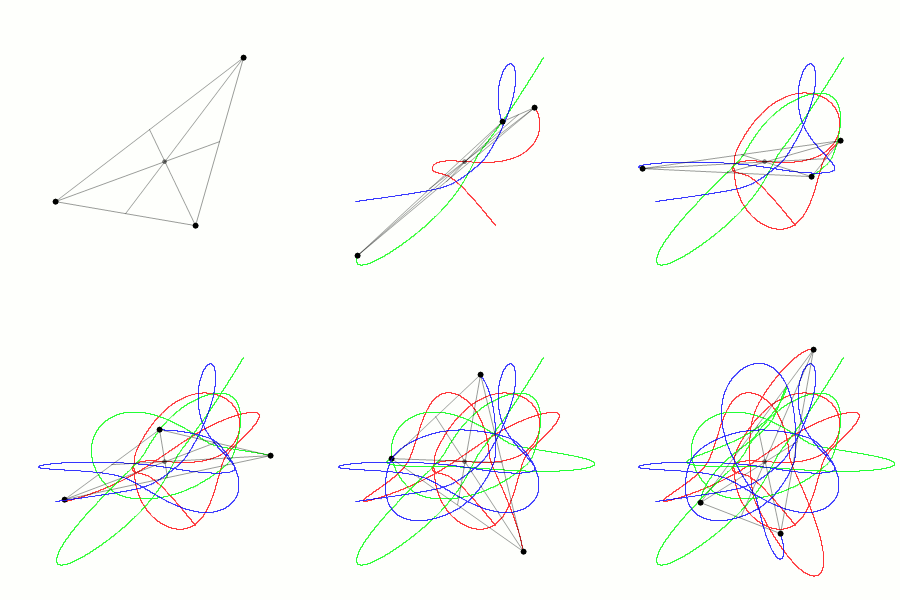
Approximate trajectories of three identical bodies located at the vertices of a scalene triangle and having zero initial velocities. The center of mass, in accordance with the law of conservation of momentum, remains in place. In physics, specifically classical mechanics, the three-body problem is to take the initial positions and velocities (or momenta) of three point masses orbiting each other in space and then to calculate their subsequent trajectories using Newton's laws of motion and Newton's law of universal gravitation.
Unlike the two-body problem, the three-body problem has no general closed-form analytic solution. The differential equations that govern the motions of three gravitating bodies are not integrable and cannot be solved to give explicit formulas for the positions of the bodies as a function of time. For most initial conditions, the dynamical system for three orbiting bodies is chaotic, and the only way to predict their motions is to estimate them using numerical methods.
Excerpted from Wikipedia’s “three-body problem” article, available under the CC BY-SA 4.0 licence.