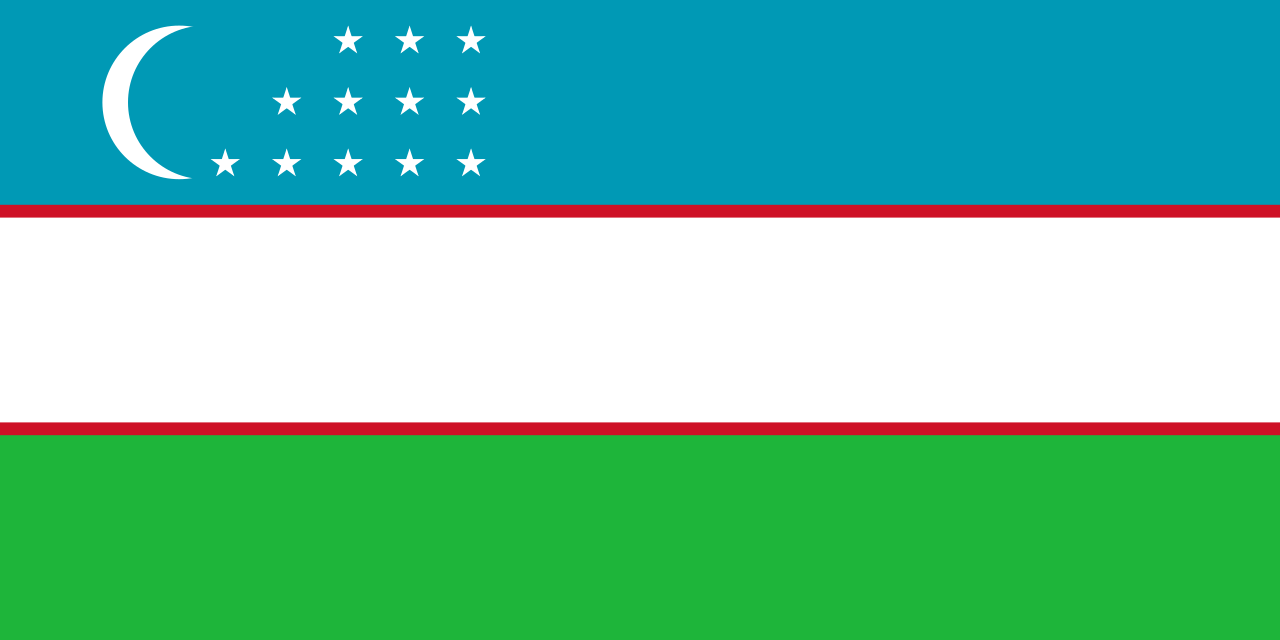
Uzbekistan
Sign in to saveAlso known as Republic of Uzbekistan
Uzbekistan, officially the Republic of Uzbekistan, is a doubly landlocked country located in Central Asia. It is surrounded by five countries: Kazakhstan to the north, Kyrgyzstan to the northeast, Tajikistan to the southeast, Afghanistan to the south, and Turkmenistan to the southwest, making it one of only two doubly landlocked countries on Earth, the other being Liechtenstein. The country has a population of more than 38.2 million, making it the most populous country in Central Asia. Uzbekistan is a member of the Organization of Turkic States. Uzbek, spoken by the Uzbek people, is the offici
OverviewAI-generated
Uzbekistan, officially the Republic of Uzbekistan, is a sovereign state located in Central Asia. Its capital is Tashkent, and the official language is Uzbek. The country shares borders with Kazakhstan, Kyrgyzstan, Tajikistan, and Afghanistan. It is a member of the United Nations, the Shanghai Cooperation Organisation, the Central Asian Cooperation Organization, and the Organization for Security and Co-operation in Europe.
The nation covers an area of 447,400 square kilometers. Its population is recorded at 37,859,698. The highest point in the country is Khazret Sultan. The currency is the Uzbek som. The top-level Internet domain is .uz, and the telephone country code is +998. The country is located in the UTC+05:00 time zone.
Synthesized by Vinony from 67 facts across 9 sources: Wikidata, REST Countries, Openweathermap, Open Meteo, World Bank, OpenStreetMap, PubMed, Vinony graph, Geo. Generated from structured data (not the Wikipedia text) and checked against those facts — may still contain errors.
In the Vinony graph
Uzbekistan is indexed among the 215 entries in Vinony's Countries collection.
Vinony's link graph records 22,214 inbound references to Uzbekistan, and connects out to Andijan massacre, Tajiks and demographics of Uzbekistan.
The entry is geolocated on the map in city_region, across 6 mapped points.
It sits within the topics 1991 establishments in Asia, Countries in Asia and Countries in Central Asia.
Weather now
cached 6h ago7-day forecast
via Open-Meteo
Country
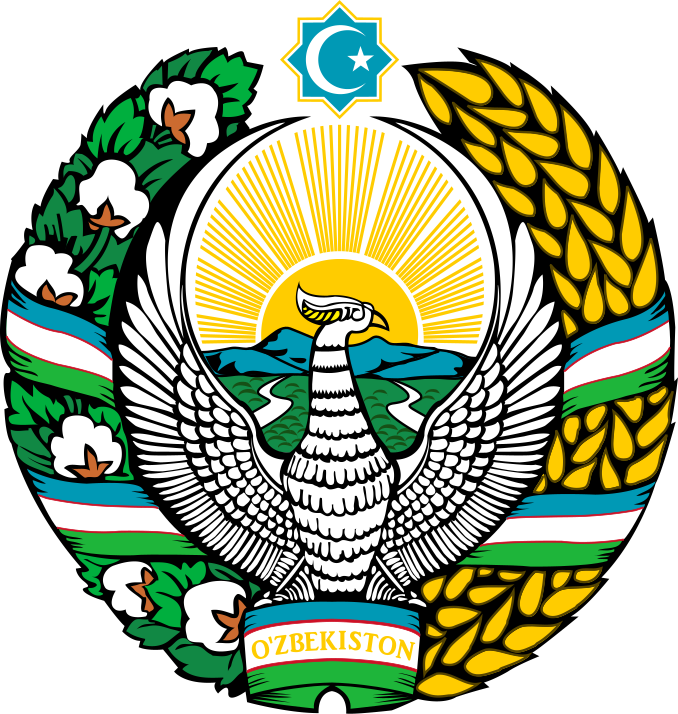
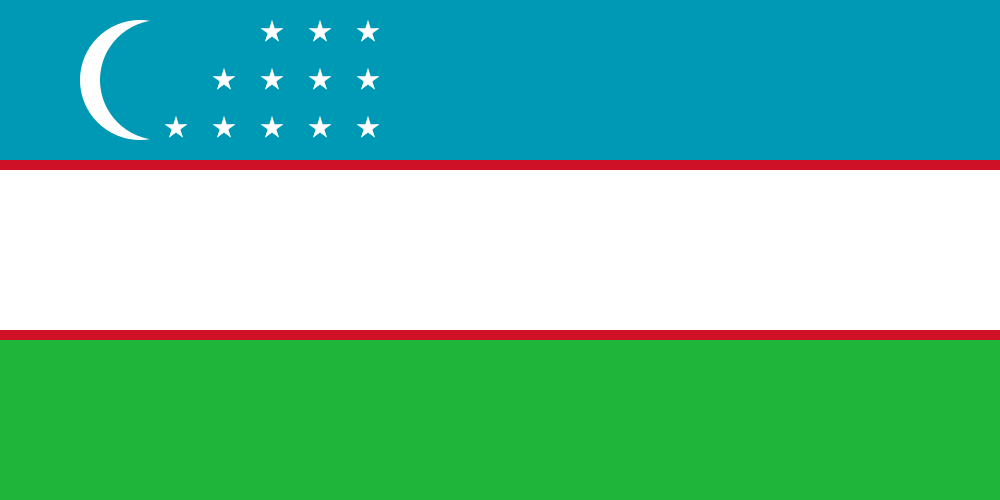
- Capital
- Tashkent
- Population
- 37,859,698
- Region
- Asia · Central Asia
- Demonym
- Uzbekistani
- Currencies
- UZS (so'm)
- Languages
- Russian, Uzbek
- Calling code
- +998
- Drives on
- Right
- Gini
- 35.3 (2003)
- FIFA code
- UZB
- TLD
- .uz
- Timezones
- UTC+05:00
- Borders
- AFG, KAZ, KGZ, TJK, TKM
via REST Countries
Indicators · World Bank
- GDP
- $115B(2024)
- Population
- 36,361,859(2024)
- Life expectancy
- 72.5 yrs(2024)
- Unemployment
- 4.6 %(2025)
- Urban population
- 51 %(2024)
- Internet users
- 89.5 %(2024)
- Forest area
- 8.5 %(2023)
- Renewable energy
- 1 %(2021)
via World Bank Open Data · CC BY 4.0
Wikipedia views (30d)
197,639 totalvia Wikimedia Pageviews API
Key facts
- Country.HDI_year
- 2023
- Country.HDI
- 0.740
- Country.conventional_long_name
- Republic of Uzbekistan
- Country.common_name
- Uzbekistan
- Country.image_flag
- Flag of Uzbekistan.svg
- Country.image_coat
- Emblem of Uzbekistan.svg
- Country.symbol_type
- Emblem
- Country.national_anthem
- "State Anthem of the Republic of Uzbekistan"
- Country.capital
- Tashkent
- Country.largest_city
- capital
- Country.official_languages
- Uzbek
- Country.recognised_languages
- Karakalpak
- Country.ethnic_groups_year
- 2021
- Country.religion_year
- 2020
- Country.demonym
- Uzbek • Uzbek
- Country.government_type
- Unitary semi-presidential republic
- Country.leader_title1
- President
- Country.leader_name1
- Shavkat Mirziyoyev
via Wikipedia infobox
Research
6,928 papers- The heavy burden of hepatitis D in Uzbekistan.Liver international : official journal of the International Association for the Study of the Liver · 2019Negro FDOI: 10.1111/liv.14244
- Challenges and Suggestions in Management of Lung and Liver Cancer in Uzbekistan: The Second Report of the Uzbekistan-Korea Oncology Consortium.ReviewInternational journal of environmental research and public health · 2022Rim CH, Lee WJ, Musaev B et al.DOI: 10.3390/ijerph191811727
- Challenges and Suggestions in the Management of Stomach and Colorectal Cancer in Uzbekistan: The Third Report of the Uzbekistan-Korea Oncology Consortium.ReviewInternational journal of environmental research and public health · 2023Rim CH, Lee WJ, Akhmedov O et al.DOI: 10.3390/ijerph20085477
- State of Transplantation in the Republic Of Uzbekistan: Existing Problems of Donation.ReviewExperimental and clinical transplantation : official journal of the Middle East Society for Organ Transplantation · 2024Khadjibaev F, Sultanov P, Ergashev D et al.DOI: 10.6002/ect.MESOT2023.O4
- First hematopoietic cell transplantation in Uzbekistan: Progress through education and cooperation.ReviewTransfusion and apheresis science : official journal of the World Apheresis Association : official journal of the European Society for Haemapheresis · 2016Karimov K, Tekgündüz E, Saidov A et al.DOI: 10.1016/j.transci.2016.01.014
- Comparison of Breast Cancer and Cervical Cancer in Uzbekistan and Korea: The First Report of The Uzbekistan-Korea Oncology Consortium.ReviewMedicina (Kaunas, Lithuania) · 2022Rim CH, Lee WJ, Musaev B et al.DOI: 10.3390/medicina58101428
- Evaluation and Management of Living Donors in the Setting of Living Donor Liver Transplant Program in the Republic of Uzbekistan.ReviewExperimental and clinical transplantation : official journal of the Middle East Society for Organ Transplantation · 2024Semash KDOI: 10.6002/ect.2024.0148
- Reproductive and sexual health among young adults in Uzbekistan.ReviewStudies in family planning · 2004Buckley C, Barrett J, Asminkin YPDOI: 10.1111/j.1728-4465.2004.00001.x
via PubMed
Wikidata facts
- Instance of
- country
- Named after
- Uzbeks
- Official name
- O‘zbekiston Respublikasi
- Demonym
- אוזבקיות
- Country
- Uzbekistan
- Contains
- Namangan Region
- Continent
- Asia
- Capital
- Tashkent
- Official language
- Uzbek
- Currency
- Banknotes of Uzbekistan, 1992
- Population
- 34915100
- Area
- 448978
- Head of government
- Abdulla Aripov
- Head of state
- Shavkat Mirziyoyev
- Form of government
- presidential system
- Legislature
- Oliy Majlis
- Shares border with
- Turkmenistan
- Highest point
- Khazret Sultan
- Official website
- www.gov.uz/en
- Image
- Uzbekistan - Location Map (2011) - UZB - UNOCHA.svg
- Life expectancy
- 72
- Nominal GDP
- 69238900000
- Unemployment rate
- 11
Show 67 more facts
- Calling code
- +998
- Licence plate code
- UZ
- Mains voltage
- 220
- Coat of arms
- Emblem of Uzbekistan
- Commons category
- Uzbekistan
- top-level Internet domain
- .uz
- topic's main category
- Category:Uzbekistan
- category for people who died here
- Category:Deaths in Uzbekistan
- category for people born here
- Category:Births in Uzbekistan
- category for films shot at this location
- Category:Films shot in Uzbekistan
- category of associated people
- Category:Uzbekistani people
- diplomatic relation
- Taiwan
- history of topic
- history of Uzbekistan
- IPA transcription
- ʉsˈbeːkɪstɑːn
- Commons gallery
- Oʻzbekiston
- mobile country code
- 434
- lowest point
- Sarygamysh Lake
- inception
- 1991-00-00
- driving side
- right
- geography of topic
- Geography of Uzbekistan
- language used
- Uzbeki Arabic
- emergency phone number
- 112
- age of majority
- 16
- trunk prefix
- 8
- marriageable age
- 17
- topic's main Wikimedia portal
- Portal:Uzbekistan
- office held by head of government
- Prime Minister of Uzbekistan
- ethnic group
- Tatars
- executive body
- Government of Uzbekistan
- office held by head of state
- President of Uzbekistan
- number of out-of-school children
- 360712
- total fertility rate
- 2.2
- maritime identification digits
- 437
- category for people buried here
- Category:Burials in Uzbekistan
- railway traffic side
- right
- Unicode character
- 🇺🇿
- central bank
- Central Bank of Uzbekistan
- native label
- Oʻzbekiston
- GS1 country code
- 478
- culture
- culture of Uzbekistan
- VAT rate
- 20
- BTI Status Index
- 4.15
- BTI Governance Index
- 3.83
- economy of topic
- economy of Uzbekistan
- demographics of topic
- demographics of Uzbekistan
- Democracy Index
- 2.12
- P8168
- Agios Nikolaos
- Human Development Index
- 0.727
- P11012
- July 31
- Gini coefficient
- 35.3
- hashtag
- Uzbekistan
- on focus list of Wikimedia project
- Wikipedia:Vital articles/Level/4
- Happy Planet Index score
- 54.1
- replaces
- Soviet Union
- public holiday
- Nowruz
- name in native language
- O‘zbekiston Respublikasi
- P12749
- Jammu and Kashmir
- birth rate
- 26.2
- male population
- 17838536
- death rate
- 4.8
- rural population
- 17657930
- female population
- 17809564
- urban population
- 17990170
- maintained by WikiProject
- WikiProject Asia
- located in/on physical feature
- Central Asia
Sources (15)
via Wikidata · CC0
Travel guide
Understand
The meaning of the name Uzbek is disputed. One version is that it is derived from Turkish 'uz/öz' ('good' or 'true') and 'bek' ('guardian'). Unlike the neighbouring Kazakhs and Kyrgyz, but like their close cousins the Uyghurs, the Uzbeks were mostly a sedentary people, building impressive cities along the old Silk Road
There is a large population of people in Uzbekistan that speak Tajik (or other dialects of Persian), owing to historic communities in the region. Some of those people consider themselves Uzbek while others consider themselves as Tajik/Persian and living in Uzbekistan. There are also plenty of people who come from mixed Uzbek-Tajik families.
Get in
thumb|375px|A map showing the visa requirements of Uzbekistan, with countries in shades of green having visa-free access; and countries in blue having e-visa.
See
Uzbekistan, a republic in the former Soviet Union, is one of the cradles of culture in the Central Asia region. The country offers an array of semi-arid landscapes and ancient sites, steeped with a history along the Silk Road.
Eat
When you go to restaurants, always ask for menu or price if they do not provide one. While some of the well-established restaurants provide surprisingly good value by European standards, some of the random or less popular restaurants try to take advantage of tourists by overcharging up to five times the normal price. thumbnail|Plov
Bread - Uzbeks eat lots of bread (non in Uzbek). Round bread is called lepioshka in Russian. You can buy it anywhere, in the bazaar it costs around 1,000-2,500 so‘m. It is delicious when freshly baked and makes a good snack by itself. Samarkand is very famous for its bread. The characteristic Samarkand bread obi-non is traditionally baked in clay furnaces. Bread is served with every meal. Chocolate - Not something you associate with Uzbekistan, but the country produces some very good chocolate cake. A slice of rich moist cake can cost 10,000 to 25,000 so‘m in a cafe or restaurant. However, if you purchase in a cake shop expect to pay 4,000 to 5,000 som per slice. A slice can cost even less if you are able to charm one from a seller in the wholesale section of the market. Individually wrapped chocolates are also available by the kilogram from mix and match bins in the markets and also in some convenience stores. Chuchvara - similar to ravioli and stuffed with mutton and onions (aka 'pelmeni' in Russian). Lagman - thick soup with meat, potatoes, spices, vegetables and pasta. By right, it should include 50 ingredients. Often carrot, red beet, cabbage…
Drink
There are two national drinks of Uzbekistan: tea and vodka (result of more than a century of Russian domination of the land). Tea is served virtually everywhere: home, office, cafes, etc. Uzbek people drink black tea in winter and green tea in summer, instead of water. If tea is served in the traditional manner, the server will pour tea into a cup from the teapot and then pour the tea back into the teapot. This action is repeated three times. These repetitions symbolize loy (clay) which seals thirst, moy (grease) which isolates from the cold and the danger and tchai (tea or water) which extinguishes the fire. If you are being served tea in an Uzbek home, the host will attempt at all times to make sure your cup is never filled. If the host fills your cup, it probably means that it is time for you to leave, but this occurs really rarely, because Uzbeks are very hospitable. The left hand is considered impure. The tea and the cups are given and taken by the right hand. A mind-numbing variety of brands of wine and vodka are available almost everywhere. thumb|Uzbekistan is probably not the first country you'll think of when you hear "wine", but it's certainly produced here
Since the Republic of Uzbekistan is a secular state, the sale/purchase and consumption of alcoholic beverages are allowed and absolutely free, as for example in Turkey or Russia. Previously, alcohol was sold in any stores, but now the laws allow selling alcoholic beverages only to those stores that have a licens…
Stay safe
thumb|Uzbek police in Samarkand The areas of Uzbekistan bordering Afghanistan should be avoided for all but essential travel. Extreme caution should also be exercised in areas of the Ferghana Valley bordering Tajikistan and Kyrgyzstan. There have been a number of security incidents in this region, as well as several exchanges of gunfire across the Uzbek/Kyrgyz border. Some border areas are also mined. Travellers should therefore avoid these areas and cross only at authorized border crossing points.
For the most part, Uzbekistan is generally safe for visitors, perhaps the by-product of a police state. There are many anecdotal (and a significant number of documented) reports of an increase in street crime, especially in the larger towns, particularly Tashkent. This includes an increase in violent crime. Information on crime is largely available only through word of mouth - both among locals and through the expat community - as the state-controlled press rarely, if ever, reports street crime. As economic conditions in Uzbekistan continue to deteriorate, street crime is increasing.
Normal precautions should be taken, as one would in virtually any country. Especially in the cities (few travellers will spend much time overnight in the small villages), be careful after dark, avoid unlighted areas, and don't walk alone. Even during the day, refrain from openly showing significant amounts of cash. Men should keep wallets in a front pocket and women should keep purses in front of the…
Stay healthy
Uzbekistan's health care is not up to Western standards. There is often a shortage of medicines and medical supplies. Travellers should take the necessary medicines (including prescriptions, see section on laws and practices) and supplies with them. Local hospitals should be used with caution.
Drink only bottled water. Tap water should be boiled before drinking and ice cubes should be avoided. Hygiene should also be taken into account when preparing food and peel fruits and vegetables.
Air quality in the Karakalpakstan and Xorazmi regions is particularly poor due to salt, dust and toxins emitted from the Aral Sea.
Uzbekistan has not implemented a no-smoking policy in bars and restaurants, unlike many Western countries. Consequently, enclosed spaces can be very unpleasant for non-smokers, especially in the cold weather.
Fruits and vegetables should be peeled before consumption. Avoid drinking home-brewed vodka and brandy. These are highly likely to contain methanol, the risk of which should not be taken lightly. One moderately famous and high-quality vodka is Qarataw.
Visitors should consider tap water to be unsafe to drink in regions, while in capital of Uzbekistan the water is safe for drinking. In any case drinking bottled water is advised.
Respect
In Uzbekistan, and in Central Asia in general, elderly people are greatly respected. Always treat the elderly with great respect and be deferent to them in all situations.
Also be polite with females. Traditionally it is not welcomed to flirt openly with women. If you are a male and there is an option to address a male with the question instead of female, choose it. But likewise use caution if seeking out a same-sex conversation on a romantic level, as LGBT rights aren't a thing in Uzbekistan but rather still criminalized.
This might strike you as a quirk, but it really is not: bread is sacred in Uzbekistan. Do not waste it, and if you do: do not do so visibly. Don't worry, you are not obliged to eat all the bread you get served in the restaurant, but if you are carelessly throwing away a half a loaf in the street you will get some mean looks. Either way, Uzbek bread is among the best in the world, so you'll probably enjoy it until the last crumb.
Connect
Mobile connection works in most parts of Uzbekistan and the services are cheap. The mobile service providers are Beeline, Mobiuz, Ucell, UzTelecom (a.k.a. UzMobile). Also Perfectum, which mostly uses CDMA technology, useless for visitors as of March 2026. In Tashkent only, they have 5G.)
Global or third party eSIMs essentially all use the Beeline network only (as of March 2026, despite some claiming additional ones), which is fine in cities but not as great coverage elsewhere.
In the Tashkent airport arrivals area (before customs), there are kiosks for several networks - Beeline, Mobiuz, Ucell, UzTelecom - where you can get a SIM or eSIM.
Generally, a foreigner can get a SIM card after showing his passport. For activating the cell phone connection a person has to be registered. Some vendors are not aware of the law and refuse to sell to foreigners. (In the airport this would not be a problem.)
If you plan to travel around to the countryside, the Ucell network has the best coverage according to locals (2024). You can get the SIM, with 24 Gb, calls and some SMS for 40k per month in the official shop at the center of Tashkent. There are bigger packages available; an eSIM is available for an extra 500, as of May 2024.
You can find Internet cafés in most of the cities. Speeds can sometimes be fast but generally speed is relatively slow.
Some restaurants offer WiFi.
Travel guide from Wikivoyage (CC BY-SA 4.0)
~40 min read
Encyclopedic overview
50 sectionsContents
- Etymology
- History
- Prehistory and ancient history
- Medieval history
- Timurid period
- Uzbek period
- Russian conquest
- Soviet period
- Independence
- Geography and climate
- Environment
- Air pollution
- Responses to climate change
- Politics
- Foreign relations
- Human rights
- Recent developments
- Administrative divisions
- Largest cities
- Economy
- Demographics
- Religion
- Jewish community
- Languages
- Communications
- Censorship
- Transportation
- Civil Aviation
- Military
- Culture
- Media
- Music
- Education
- Holidays
- Cuisine
- Sport
- Football
- Cycling
- Wrestling
- Boxing
- Ice hockey
- Tennis
- Chess
- Other Sports
- UNESCO World Heritage sites
- See also
- Notes
- References
- Further reading
- External links
Uzbekistan, officially the Republic of Uzbekistan, is a doubly landlocked country located in Central Asia. It is bordered by Kazakhstan to the north, Kyrgyzstan to the northeast, Tajikistan to the southeast, Afghanistan to the south, and Turkmenistan to the southwest. This makes it one of the only two doubly landlocked countries in the world, the other being Liechtenstein. The country has a population of more than 38.2 million, making it the most populous Central Asian republic. Uzbekistan is a member of the Organization of Turkic States. Uzbek (both in Cyrillic and Turkic scripts), spoken by the Uzbek people who form nearly 85% of the population, is the official language while Russian and Tajik are significant minority languages.
The first recorded settlers in Uzbekistan were Eastern Iranian nomads, known as Scythians, who founded kingdoms in Khwarazm, Sogdiana, and Bactria in the 8th–6th centuries BC, as well as in Fergana and Margiana in the 3rd century BC – 6th century AD. The area was incorporated into the Achaemenid Empire and, after a period of Greco-Bactrian rule, was part of the Sasanian Empire until the Muslim conquest of Persia in the seventh century. The early Muslim conquests and the subsequent Samanid Empire resulted in the spread of Islam among the local people. During this period, cities began to grow rich from the Silk Road, and became a center of the Islamic Golden Age. The local Khwarazmian Empire was destroyed in the Mongol invasion in the 13th century, leading to a dominance by Mongol peoples. Timur in the 14th century established the Timurid Empire. The Timurid capital of Samarkand became a center of science under the rule of Ulugh Beg, giving birth to the Timurid Renaissance. The territories of the Timurid dynasty were conquered by Kipchak Shaybanids in the 16th century. Most of Central Asia was gradually incorporated into the Russian Empire during the 19th century, with Tashkent becoming the political center of Russian Turkestan. In 1924, national delimitation created the Uzbek Soviet Socialist Republic as a republic of the Soviet Union. During the Soviet era, Uzbekistan became a leading producer of farm products such as cotton and melons, while also making significant advances in science and technology. It declared independence as the Republic of Uzbekistan in 1991 following the Soviet collapse.
Excerpted from Wikipedia’s “Uzbekistan” article, available under the CC BY-SA 4.0 licence.
Gallery (59)
On the map
6 mapped locations
Available in 255 languages
- Español
- Français
- Deutsch
- 中文
- 日本語
- Русский
- Português
- Italiano
- العربية
- हिन्दी
- Abkhazian
- Achinese
- Adyghe
- Afrikaans
- Albanian
- Albanian
- Amharic
- ami
Show 236 more
- Angika
- Aragonese
- Aramaic
- Armenian
- Arpitan
- Assamese
- Asturian
- Avaric
- Awadhi
- Aymara
- azb
- Azerbaijani
- Bahasa Indonesia
- Balinese
- Bangla
- Bashkir
- Basque
- bat_smg
- Bavarian
- be_x_old
- Belarusian
- Betawi
- Bhojpuri
- Bikol
- Bishnupriya
- Bislama
- Bosnian
- Breton
- Buginese
- Bulgarian
- Buriat
- Burmese
- Catalan
- cbk_zam
- cdo
- Cebuano
- Central Dusun
- Central Kurdish
- Chechen
- Cherokee
- Cheyenne
- Church Slavic
- Chuvash
- Cornish
- Corsican
- Crimean Tatar
- Croatian
- Czech
- dag
- Danish
- Divehi
- dty
- Dzongkha
- Egyptian Arabic
- Erzya
- Esperanto
- Estonian
- Ewe
- Extremaduran
- Faroese
- Fiji Hindi
- Filipino
- Finnish
- fiu_vro
- Gagauz
- Galician
- gcr
- Georgian
- Gilaki
- Goan Konkani
- Greek
- Guarani
- Gujarati
- Haitian Creole
- Hakka Chinese
- Hausa
- Hawaiian
- Hebrew
- Hungarian
- hyw
- Iban
- Icelandic
- Ido
- Iloko
- Inari Sami
- Interlingua
- Interlingue
- Irish
- Jamaican Creole English
- Javanese
- Kabardian
- Kabyle
- Kannada
- Kanuri
- Kara-Kalpak
- Karachay-Balkar
- Kashmiri
- Kashubian
- Kazakh
- kbp
- kge
- Khmer
- Kikuyu
- Kinyarwanda
- Komi
- Kongo
- Kurdish
- Kyrgyz
- Ladino
- Lao
- Latin
- Latvian
- Lezghian
- Ligurian
- Limburgish
- Lingala
- Lingua Franca Nova
- Lithuanian
- lld
- Lombard
- Low German
- Lower Sorbian
- Luxembourgish
- Macedonian
- Madurese
- Maithili
- Malagasy
- Malay
- Malayalam
- Maltese
- Manipuri
- Manx
- Māori
- Marathi
- Mari
- Mazanderani
- Minangkabau
- Mingrelian
- Moksha
- Mongolian
- Moroccan Arabic
- Navajo
- Nederlands
- Nepali
- Newari
- Northern Frisian
- Northern Sami
- Norwegian
- Norwegian Nynorsk
- Novial
- Occitan
- Odia
- Old English
- olo
- Oromo
- Ossetic
- Pampanga
- Papiamento
- Pashto
- Picard
- Piedmontese
- Polski
- Punjabi
- Quechua
- Romanian
- Rusyn
- Samoan
- Sanskrit
- Santali
- Sardinian
- Scots
- Scottish Gaelic
- Serbian
- Serbian (Latin)
- Shan
- Shona
- Sicilian
- Silesian
- simple
- Sindhi
- Sinhala
- skr
- Slovak
- Slovenian
- Somali
- Standard Moroccan Tamazight
- Sundanese
- Svenska
- Swahili
- Swati
- szy
- Tachelhit
- Tajik
- Talysh
- Tamil
- Taroko
- Tatar
- tay
- Telugu
- Tetum
- Tibetan
- Tiếng Việt
- Toki Pona
- Tongan
- Tumbuka
- Türkçe
- Turkmen
- Tuvinian
- Udmurt
- Ukrainian
- Upper Sorbian
- Urdu
- Uyghur
- Uzbek
- Venetian
- Veps
- Volapük
- Waray
- Welsh
- West Flemish
- Western Frisian
- Western Panjabi
- Wolof
- Wu Chinese
- Yakut
- Yiddish
- Yoruba
- Zaza
- Zeelandic
- zh_classical
- zh_min_nan
- zh_yue
- Zhuang
- فارسی
- ไทย
- 한국어
via Wikidata sitelinks · CC0