Category
page 1Biology of bipolar disorder

herpes simplex
Herpes simplex, often known simply as herpes, is a viral infection caused by the herpes simplex virus. Herpes infections are categorized by the area of the body that is infected. The two major types of herpes are oral herpes and genital herpes, though other forms also exist.

toxoplasmosis
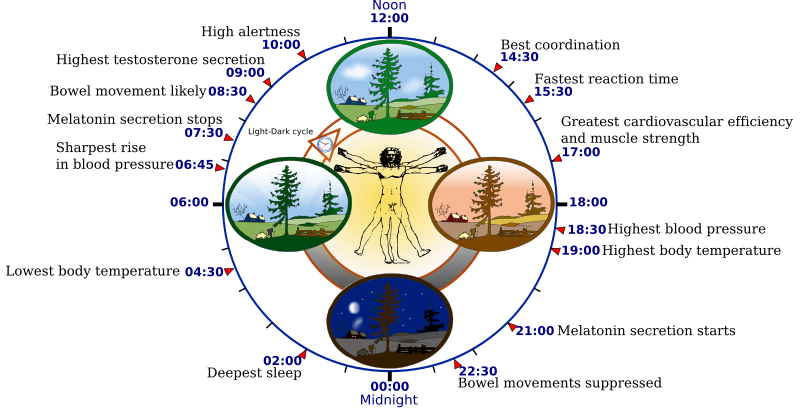
circadian rhythm
natural internal process that regulates the sleep-wake cycle

inositol
In biochemistry, medicine, and related sciences, inositol generally refers to '''myo-inositol (formerly meso-inositol'), the most important stereoisomer of the chemical compound cyclohexane-1,2,3,4,5,6-hexol. Its formula is ; the molecule has a ring of six carbon atoms, each with a hydrogen atom and a hydroxy group (–OH). In myo''-inositol, two of the hydroxyls, neither adjacent nor opposite, lie above the respective hydrogens relative to the mean plane of the ring.

oligodendrocyte
Oligodendrocytes (), also known as oligodendroglia, are a type of neuroglia whose main function is to provide the myelin sheath to neuronal axons in the central nervous system (CNS). Myelination gives metabolic support to, and insulates the axons of most vertebrates. A single oligodendrocyte can extend its processes to cover up to 40 axons, that can include multiple adjacent axons. The myelin sheath is segmented along the axon's length at gaps known as the nodes of Ranvier. In the peripheral nervous system the myelination of axons is carried out by Schwann cells.
vitamin B12 deficiency
vitamin metabolic disorder that results from low blood levels of vitamin B12

aquaporin
Aquaporins, also called water channels, are channel proteins from a larger family of major intrinsic proteins that form pores in the membrane of biological cells, mainly facilitating transport of water between cells. The cell membranes of a variety of different bacteria, fungi, animal and plant cells contain aquaporins through which water can flow more rapidly into and out of the cell than by diffusing through the phospholipid bilayer. Aquaporins have six membrane-spanning α-helical domains with both carboxylic and amino terminals on the cytoplasmic side. Two hydrophobic loops contain conserve
S-adenosylmethionine
chemical compound found in all domains of life with largely unexplored effects
reelin
Reelin, encoded by the RELN gene, is a large secreted extracellular matrix glycoprotein that helps regulate processes of neuronal migration and positioning in the developing brain by controlling cell–cell interactions. Besides this important role in early development, reelin continues to work in the adult brain. It modulates synaptic plasticity by enhancing the induction and maintenance of long-term potentiation. It also stimulates dendrite and dendritic spine development in the hippocampus, and regulates the continuing migration of neuroblasts generated in adult neurogenesis sites of the subv
stimulant psychosis
psychotic disorder that appears in some people who abuse stimulant drugs

polypyrrole
class=skin-invert-image|thumb|Polypyrrole
class=skin-invert-image|thumb|Pyrrole can be polymerised electrochemically.
Polypyrrole (PPy) is an organic polymer obtained by oxidative polymerization of pyrrole. It is a solid with the formula H(C4H2NH)nH. It is an intrinsically conducting polymer, used in electronics, optical, biological and medical fields.
solute carrier family 6 member 4
mammalian protein found in Homo sapiens
slow-wave sleep
3rd and 4th sleep stage
HTR2A
protein-coding gene in the species Homo sapiens

ankyrin
Ankyrins are a family of proteins that mediate the attachment of integral membrane proteins to the spectrin-actin based membrane cytoskeleton. Ankyrins have binding sites for the beta subunit of spectrin and at least 12 families of integral membrane proteins. This linkage is required to maintain the integrity of the plasma membranes and to anchor specific ion channels, ion exchangers and ion transporters in the plasma membrane. The name is derived from the Greek word ἄγκυρα (ankyra) for "anchor".
glutamate decarboxylase
class of enzymes
Borna disease
horse disease
glial fibrillary acidic protein
mammalian protein found in Homo sapiens
HTR4
protein-coding gene in the species Homo sapiens
biological psychiatry
approach to psychiatry that aims to understand mental disorder in terms of the biological function of the nervous system
Acetylserotonin O-methyltransferase
mammalian protein found in Homo sapiens
AQP2
Aquaporin-2 (AQP-2) is found in the apical cell membranes of the kidney's collecting duct principal cells and in intracellular vesicles located throughout the cell. It is encoded by the gene.
NOS1
Nitric oxide synthase 1 (neuronal), also known as NOS1, is an enzyme that in humans is encoded by the NOS1 gene.
PPARD
protein-coding gene in the species Homo sapiens
MBNL2
Muscleblind-like protein 2 is a protein that in humans is encoded by the MBNL2 gene.
ATF5
Activating transcription factor 5, also known as ATF5, is a protein that, in humans, is encoded by the ATF5 gene.
DISC1
Disrupted in schizophrenia 1 is a protein that in humans is encoded by the DISC1 gene. In coordination with a wide array of interacting partners, DISC1 has been shown to participate in the regulation of cell proliferation, differentiation, migration, neuronal axon and dendrite outgrowth, mitochondrial transport, fission and/or fusion, and cell-to-cell adhesion. Several studies have shown that unregulated expression or altered protein structure of DISC1 may predispose individuals to the development of schizophrenia, clinical depression, bipolar disorder, and other psychiatric conditions. The ce
TACR1
protein-coding gene in the species Homo sapiens
Inositol-phosphate phosphatase
class of enzymes
CACNA1C
Voltage-dependent L-type calcium channel subunit alpha-1C
(also known as Cav1.2) is a protein that in humans is encoded by the CACNA1C gene. Cav1.2 is a subunit of L-type voltage-dependent calcium channel.
NOS1AP
Nitric oxide synthase 1 adaptor protein (NOS1AP) also known as carboxyl-terminal PDZ ligand of neuronal nitric oxide synthase protein (CAPON) is a protein that in humans is encoded by the NOS1AP gene.
ANK3
Ankyrin-3 (ANK-3), also known as ankyrin-G, is a protein from ankyrin family that in humans is encoded by the ANK3 gene.
DOCK9
protein-coding gene in the species Homo sapiens
SYN3
Synapsin-3 is a protein that in humans is encoded by the SYN3 gene.
DZIP1
Zinc finger protein DZIP1 is a protein that in humans is encoded by the DZIP1 gene.
SYNGR1
Synaptogyrin-1 is a protein that in humans is encoded by the SYNGR1 gene.
glycogen synthase kinase 3
Glycogen synthase kinase 3 (GSK-3) is a serine/threonine protein kinase that mediates the addition of phosphate molecules onto serine and threonine amino acid residues. First discovered in 1980 as a regulatory kinase for its namesake, glycogen synthase (GS), GSK-3 has since been identified as a protein kinase for over 100 different proteins in a variety of different pathways. In mammals, including humans, GSK-3 exists in two isozymes encoded by two homologous genes GSK-3α (GSK3A) and GSK-3β (GSK3B). GSK-3 has been the subject of much research since it has been implicated in a number of disease
Paternal age effect
health effects of an older father at conception
FABP7
Fatty acid binding protein 7, brain (FABP7; also brain lipid binding protein, BLBP), is a human gene.
SRSF1
protein-coding gene in the species Homo sapiens
GNAL
Guanine nucleotide-binding protein G(olf) subunit alpha is a protein that in humans is encoded by the GNAL gene.
Its main product is the heterotrimeric G-protein alpha subunit Golf-α, a member of the Gs alpha subunit family that is a key component of G protein-coupled receptor-regulated adenylyl cyclase signal transduction pathways in the olfactory system and the striatum in the brain. It also mediated D1 receptor signalling in the striatum and is hence involved in motor control.
NPAS3
NPAS3 or Neuronal PAS domain protein 3 is a brain-enriched transcription factor belonging to the bHLH-PAS superfamily of transcription factors, the members of which carry out diverse functions, including circadian oscillations, neurogenesis, toxin metabolism, hypoxia, and tracheal development. NPAS3 contains a basic helix-loop-helix structural motif and two PAS domain, like the other proteins in the superfamily.
GPR18
protein-coding gene in the species Homo sapiens
NCS1
protein-coding gene in the species Homo sapiens
AVPR1A
protein-coding gene in the species Homo sapiens
CLDN10
Claudin-10 is a protein that in humans is encoded by the CLDN10 gene. It belongs to the group of claudins.