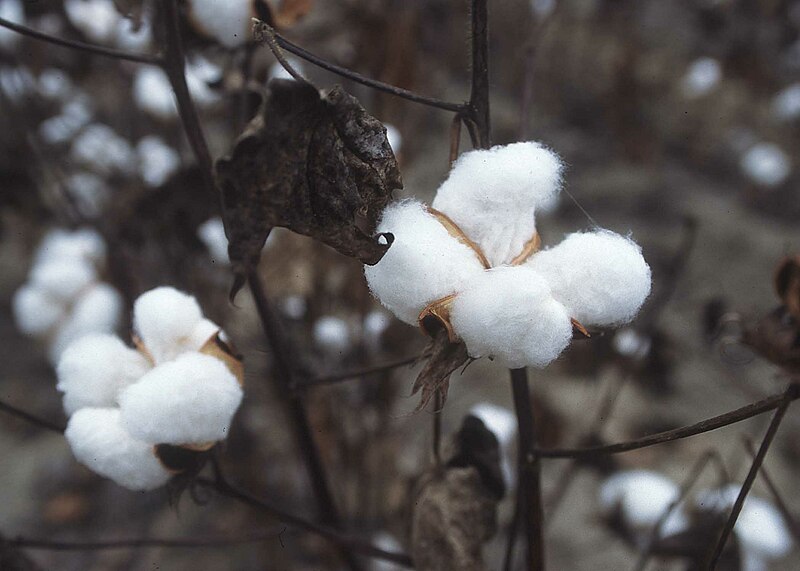
File:CottonPlant.JPG · Wikimedia Commons · See Wikimedia Commons
cotton
Sign in to saveAlso known as cotton fiber, cotton fibre
Cotton (from Arabic qutn) is a soft, fluffy staple fiber that grows in a boll, or protective case, around the seeds of the cotton plants of the genus Gossypium in the mallow family Malvaceae. The fiber is almost pure cellulose and may contain minor percentages of waxes, fats, pectins, and water. Under natural conditions, cotton bolls facilitate the dispersal of the seeds.
Cotton is a soft, fluffy fiber that grows in protective cases around the seeds of certain plants and is composed almost entirely of cellulose. It has been important throughout history as a material for making textiles and other products, and it remains one of the most widely used natural fibers in the world today.
AI-generated from the Wikipedia summary — may contain errors.
Research
46,988 papers- Efficient genotype-independent cotton genetic transformation and genome editing.Journal of integrative plant biology · 2023Ge X, Xu J, Yang Z et al.DOI: 10.1111/jipb.13427
- Molecular Regulation of Cotton Fiber Development: A Review.ReviewInternational journal of molecular sciences · 2022Jan M, Liu Z, Guo C et al.DOI: 10.3390/ijms23095004
- Transgenic Cotton: From Biotransformation Methods to Agricultural Application.ReviewMethods in molecular biology (Clifton, N.J.) · 2019Zhang BDOI: 10.1007/978-1-4939-8952-2_1
- Recent progression and future perspectives in cotton genomic breeding.ReviewJournal of integrative plant biology · 2023Yang Z, Gao C, Zhang Y et al.DOI: 10.1111/jipb.13388
- An Overview of Cotton Gland Development and Its Transcriptional Regulation.ReviewInternational journal of molecular sciences · 2022Jan M, Liu Z, Guo C et al.DOI: 10.3390/ijms23094892
- Cotton proteomics for deciphering the mechanism of environment stress response and fiber development.ReviewJournal of proteomics · 2014Zhou M, Sun G, Sun Z et al.DOI: 10.1016/j.jprot.2014.03.017
- Gossypium Genomics: Trends, Scope, and Utilization for Cotton Improvement.ReviewTrends in plant science · 2020Yang Z, Qanmber G, Wang Z et al.DOI: 10.1016/j.tplants.2019.12.011
- Recent advances and future perspectives in early-maturing cotton research.ReviewThe New phytologist · 2023Zhao H, Chen Y, Liu J et al.DOI: 10.1111/nph.18611
via PubMed
Wikidata facts
- Instance of
- raw material
- Subclass of
- plant fiber
- Image
- Cotton - പരുത്തി 03.JPG
- Has use
- batting
Show 7 more facts
- Commons category
- Cotton
- topic's main category
- Category:Cotton
- natural product of taxon
- Gossypium hirsutum
- Commons gallery
- Cotton
- has characteristic
- hygroscopy
- on focus list of Wikimedia project
- Wikipedia:Vital articles/Level/4
- recycling code
- 60
via Wikidata · CC0
~60 min read
Encyclopedic overview
50 sectionsContents
- Types
- Etymology
- History
- Early history
- Americas
- South Asia
- Levant
- Iran
- Arabia
- Kingdom of Kush
- China
- Middle Ages
- Eastern world
- Europe
- Early modern period
- Mughal India
- Egypt
- Britain
- East India Company
- Industrial Revolution
- United States
- The Moon
- Cultivation
- Water footprint
- Genetic modification
- Organic production
- Pests and weeds
- Global pest problems
- North American insect pests
- Harvesting
- Competition from synthetic fibers
- Competition from natural fibers
- Uses
- Cottonseed
- Cotton linters
- Long staple cotton
- Ornamental use
- International trade
- Production
- Fair trade
- Trading
- Critical temperatures
- Fiber properties
- Morphology
- Dead cotton
- Genome
- See also
- References
- Further reading
- External links
Cotton (from Arabic qutn) is a soft, fluffy staple fiber that grows in a boll, or protective case, around the seeds of the cotton plants of the genus Gossypium in the mallow family Malvaceae. The fiber is almost pure cellulose and may contain minor percentages of waxes, fats, pectins, and water. Under natural conditions, cotton bolls facilitate the dispersal of the seeds.
The plant is a shrub native to tropical and subtropical regions around the world, including the Americas, Africa (including Egypt) and India. The greatest diversity of wild cotton species is found in Mexico, followed by Australia and Africa. Cotton was independently domesticated in the Old and New Worlds.
Excerpted from Wikipedia’s “cotton” article, available under the CC BY-SA 4.0 licence.
Gallery (52)
Available in 154 languages
- Español
- Français
- Deutsch
- 中文
- 日本語
- Русский
- Português
- Italiano
- العربية
- हिन्दी
- abstract
- Afrikaans
- Albanian
- Albanian
- Amharic
- ami
- Angika
- Aragonese
Show 135 more
- Assamese
- Asturian
- Awadhi
- Aymara
- azb
- Azerbaijani
- Bahasa Indonesia
- Bangla
- Banjar
- Bashkir
- Basque
- bat_smg
- be_x_old
- Belarusian
- Bikol
- Bosnian
- Breton
- Bulgarian
- Buriat
- Catalan
- cdo
- Cheyenne
- Chuvash
- Cornish
- Croatian
- Czech
- Danish
- dty
- Egyptian Arabic
- Esperanto
- Estonian
- Faroese
- Fiji Hindi
- Finnish
- fiu_vro
- Galician
- Georgian
- Greek
- Guarani
- Gujarati
- Hausa
- Hawaiian
- Hebrew
- Hungarian
- Icelandic
- Ido
- Iloko
- Interlingua
- Irish
- Javanese
- Kabyle
- Kannada
- Kara-Kalpak
- Karachay-Balkar
- Kazakh
- Kurdish
- Latin
- Latvian
- Limburgish
- Lingala
- Lingua Franca Nova
- Lithuanian
- Lombard
- Low German
- Luxembourgish
- Macedonian
- Maithili
- Malagasy
- Malay
- Malayalam
- Manx
- Marathi
- Minangkabau
- Mingrelian
- Mongolian
- Nederlands
- Nepali
- Newari
- Nias
- Northern Frisian
- Norwegian
- Norwegian Nynorsk
- Obolo
- Occitan
- Odia
- Pashto
- Piedmontese
- Polski
- Punjabi
- Quechua
- Romanian
- Santali
- Scottish Gaelic
- Serbian
- Serbian (Latin)
- Shona
- Sicilian
- simple
- Sindhi
- Slovak
- Slovenian
- Somali
- Sundanese
- Svenska
- Swahili
- szy
- Tajik
- Tamil
- Tatar
- Telugu
- Tiếng Việt
- Toki Pona
- Türkçe
- Turkmen
- Ukrainian
- Urdu
- Uyghur
- Uzbek
- Veps
- Waray
- Wayuu
- Welsh
- Western Frisian
- Western Panjabi
- Wolof
- Wu Chinese
- Yakut
- Yiddish
- Zaza
- zh_min_nan
- zh_yue
- Zhuang
- فارسی
- ไทย
- 한국어
via Wikidata sitelinks · CC0