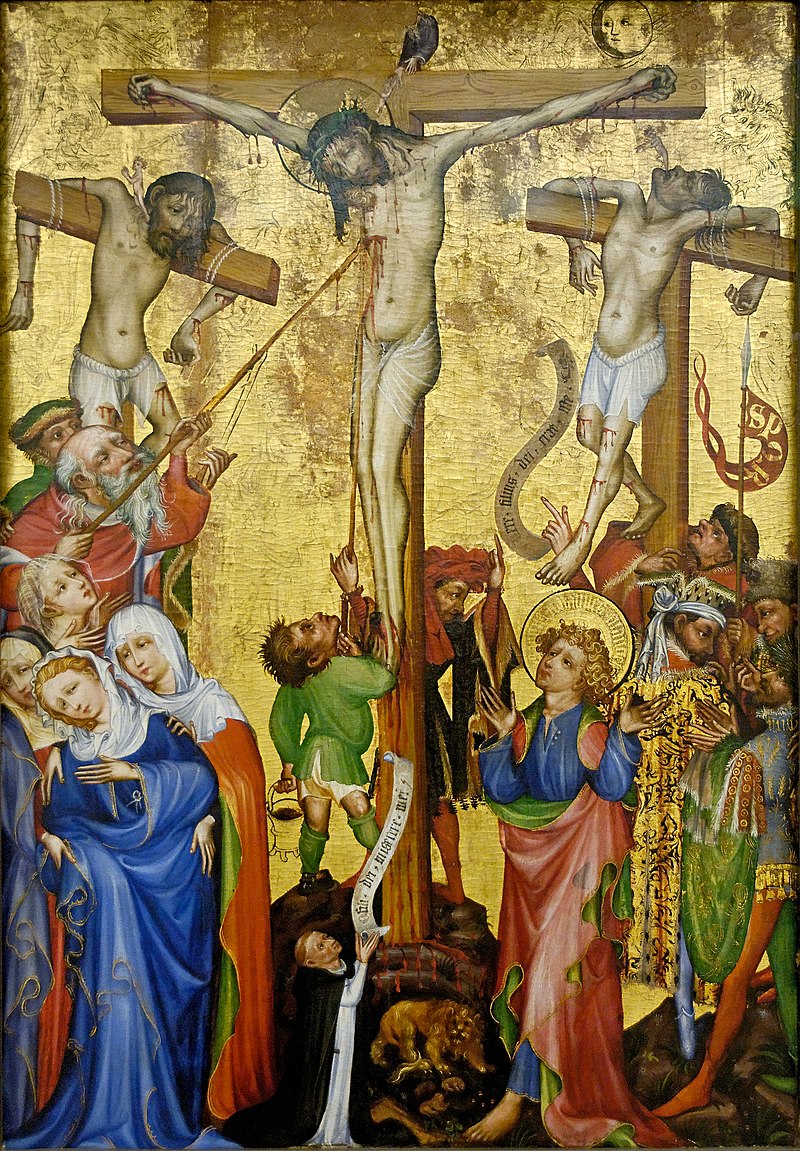
File:Crucifixion_Strasbourg_Unterlinden_Inv88RP536.jpg · Wikimedia Commons · See Wikimedia Commons
crucifixion
Sign in to savethumb|A 15th-century depiction of Jesus crucified between [[the two thieves]]
Crucifixion was an ancient method of execution in which a person was fastened to a wooden cross, typically by nails or ropes, and left to die—a painful and prolonged death. It matters primarily because Jesus Christ was crucified according to Christian tradition, making it a central event in Christianity and one of the most significant moments in Western history.
AI-generated from the Wikipedia summary — may contain errors.
In the Vinony graph
Vinony's link graph records 1,540 inbound references to crucifixion, and connects out to Jesus, Paul the Apostle and Andrew the Apostle.
Vinony files it under Crosses by function, Crucifixion and Execution methods.
Vinony links it to 74 Wikipedia language editions.
Wikidata facts
- Image
- Antonello da Messina 027.jpg
Show 4 more facts
- described by source
- Wikitólica
- Commons category
- Crucifixion
- topic's main category
- Category:Crucifixion
- P8168
- Larnaca
Sources (5)
via Wikidata · CC0
~43 min read
Encyclopedic overview
25 sectionsContents
- Terminology
- Detail
- Cross shape
- Nail placement
- Cause of death
- Survival
- History
- Pre-Roman states
- Ancient Rome
- Islam
- Japan
- Burma
- Archaeological evidence
- Modern use
- Europe
- South Sudan
- Legal execution in Islamic states
- Jihadism
- Other incidents
- In culture and arts
- As a devotional practice
- Notable crucifixions
- See also
- References
- External links
thumb|A 15th-century depiction of Jesus crucified between [[the two thieves]]
Crucifixion is a method of capital punishment in which the condemned is tied or nailed to a large wooden cross, beam or stake and left to hang until eventual death, which could take minutes to days. It was first used as a punishment by the Achaemenids, Carthaginians, and Romans, among others. Crucifixion has been used in some countries as recently as the 21st century.
Excerpted from Wikipedia’s “crucifixion” article, available under the CC BY-SA 4.0 licence.
Gallery (32)
Available in 74 languages
- Español
- Français
- Deutsch
- 中文
- 日本語
- Русский
- Português
- Italiano
- العربية
- Afrikaans
- Albanian
- Armenian
- Asturian
- Azerbaijani
- Bahasa Indonesia
- Bangla
- Basque
- Bikol
Show 55 more
- Bulgarian
- Burmese
- Catalan
- Croatian
- Czech
- Danish
- Egyptian Arabic
- Esperanto
- Estonian
- Filipino
- Finnish
- Galician
- Georgian
- Greek
- Hausa
- Hebrew
- Hungarian
- Icelandic
- Ido
- Interlingua
- Kannada
- Latin
- Latvian
- Lithuanian
- Low German
- Luxembourgish
- Macedonian
- Malay
- Malayalam
- Marathi
- Mingrelian
- Nederlands
- Nias
- Norwegian
- Polski
- Romanian
- Serbian
- Serbian (Latin)
- simple
- Slovak
- Slovenian
- Svenska
- Tamil
- Tiếng Việt
- Türkçe
- Turkmen
- Ukrainian
- Urdu
- Welsh
- Western Frisian
- Wu Chinese
- zh_yue
- فارسی
- ไทย
- 한국어
via Wikidata sitelinks · CC0