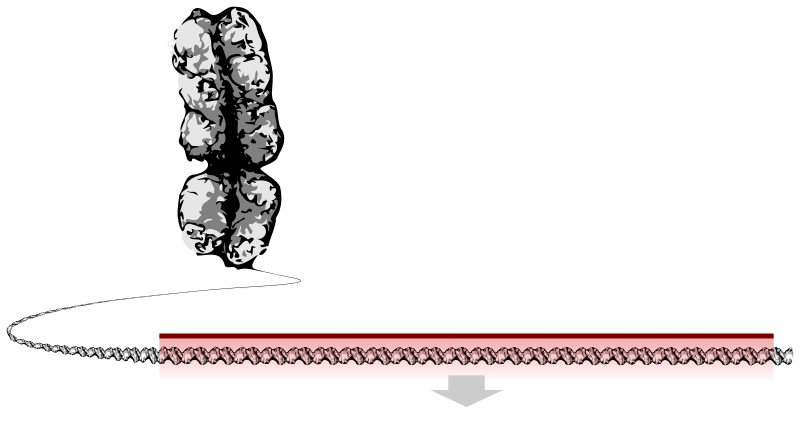
File:Chromosome_DNA_Gene_unannotated.svg · Wikimedia Commons · See Wikimedia Commons
deoxyribonucleic acid
Sign in to saveAlso known as DNA spiral, deoxyribose nucleic acid, DNA
thumb|right|upright=1.33|The structure of the DNA double helix (type [[B-DNA). The atoms in the structure are colour-coded by element and the detailed structures of two base pairs are shown in the bottom right.]] thumb|Simplified diagram
Deoxyribonucleic acid, or DNA, is a molecule that carries the genetic instructions for life in all living organisms, organized in a distinctive double helix structure made up of base pairs. It matters because it stores and transmits the biological information that determines the characteristics and functions of living things.
AI-generated from the Wikipedia summary — may contain errors.
Research
2,021,497 papers- DEOXYRIBONUCLEIC acid.British medical journal · 1956
- Deoxyribonucleic acid.British medical bulletin · 1962BURTON KDOI: 10.1093/oxfordjournals.bmb.a069930
- Deoxyribonucleic acid polymer nanoparticle hydrogels.Chemical communications (Cambridge, England) · 2021Bagley RHT, Jones STDOI: 10.1039/d1cc05668a
- Cytoplasmic deoxyribonucleic acid.ReviewInternational review of cytology · 1965Gahan PB, Chayen JDOI: 10.1016/s0074-7696(08)60555-0
- Biochemistry of deoxyribonucleic acid and ribonucleic acid replication.ReviewBritish medical bulletin · 1965Smellie RMDOI: 10.1093/oxfordjournals.bmb.a070395
- Deoxyribonucleic acid code.Nature · 1962AGENO MDOI: 10.1038/195998a0
- Physical properties of deoxyribonucleic acid.ReviewAnnual review of biochemistry · 1966Josse J, Eigner JDOI: 10.1146/annurev.bi.35.070166.004041
- [The mitochondrial deoxyribonucleic acid].ReviewPostepy biochemii · 1966Wierzbicki R, Bartkowiak J
via PubMed
Wikidata facts
- Part of
- nucleus
- Has part
- nucleotide
- Image
- DNA animation.gif
Show 11 more facts
- Unicode character
- 🧬
- on focus list of Wikimedia project
- Wikipedia:Vital articles/Level/4
- Commons gallery
- DNA
- Commons category
- DNA
- topic's main category
- Category:DNA
- studied by
- genealogical DNA test
- shape
- spring
- short name
- DNK
- develops from
- ribonucleic acid
- hashtag
- DNA
- maintained by WikiProject
- WikiProject Biology
Sources (8)
via Wikidata · CC0
~64 min read
Encyclopedic overview
45 sectionsContents
- Properties
- Nucleobase classification
- Non-canonical bases
- Grooves
- Base pairing
- ssDNA vs. dsDNA
- Amount
- Sense and antisense
- Supercoiling
- Alternative DNA structures
- Alternative DNA chemistry
- Quadruplex structures
- Branched DNA
- Artificial bases
- Acidity
- Macroscopic appearance
- Chemical modifications and altered DNA packaging
- Base modifications and DNA packaging
- Damage
- Biological functions
- Genomes
- Transcription and translation
- Replication
- Extracellular nucleic acids
- Interactions with proteins
- DNA-binding proteins
- DNA-modifying enzymes
- Nucleases and ligases
- Topoisomerases and helicases
- Polymerases
- Genetic recombination
- Evolution
- Uses in technology
- Genetic engineering
- DNA profiling
- DNA enzymes or catalytic DNA
- Bioinformatics
- DNA nanotechnology
- History and anthropology
- Information storage
- History
- See also
- References
- Further reading
- External links
thumb|right|upright=1.33|The structure of the DNA double helix (type [[B-DNA). The atoms in the structure are colour-coded by element and the detailed structures of two base pairs are shown in the bottom right.]] thumb|Simplified diagram
Deoxyribonucleic acid (; DNA) is a polymer composed of two polynucleotide chains that coil around each other to form a double helix. The polymer carries genetic instructions for the development, functioning, growth and reproduction of all known organisms and many viruses. DNA and ribonucleic acid (RNA) are nucleic acids. Alongside proteins, lipids and complex carbohydrates (polysaccharides), nucleic acids are one of the four major types of macromolecules that are essential for all known forms of life.
Excerpted from Wikipedia’s “deoxyribonucleic acid” article, available under the CC BY-SA 4.0 licence.
Gallery (52)
Available in 170 languages
- Español
- Français
- Deutsch
- 中文
- 日本語
- Русский
- Português
- Italiano
- العربية
- हिन्दी
- abstract
- Afrikaans
- Albanian
- Albanian
- Amharic
- Aragonese
- Armenian
- Assamese
Show 151 more
- Asturian
- azb
- Azerbaijani
- Bahasa Indonesia
- Balinese
- Bangla
- Banjar
- Bashkir
- Basque
- bat_smg
- be_x_old
- Belarusian
- Bhojpuri
- Bikol
- blk
- Bosnian
- Breton
- btm
- Bulgarian
- Buriat
- Burmese
- Catalan
- cdo
- Cebuano
- Central Kurdish
- Chechen
- Chuvash
- Cornish
- Croatian
- Czech
- Danish
- Egyptian Arabic
- Esperanto
- Estonian
- Extremaduran
- Faroese
- Fiji Hindi
- Filipino
- Finnish
- Friulian
- Galician
- gcr
- Georgian
- Gorontalo
- Greek
- Guarani
- Haitian Creole
- Hakka Chinese
- Hebrew
- Hungarian
- Icelandic
- Ido
- Iloko
- Ingush
- Interlingua
- Irish
- Jamaican Creole English
- Javanese
- Kannada
- Kashmiri
- Kashubian
- Kazakh
- Khmer
- Kurdish
- Kyrgyz
- Lao
- Latin
- Latvian
- Lezghian
- Ligurian
- Limburgish
- Lingua Franca Nova
- Lithuanian
- lld
- Lombard
- Low German
- Macedonian
- Madurese
- Malagasy
- Malay
- Malayalam
- Marathi
- Mazanderani
- Mingrelian
- Mongolian
- Nederlands
- Nepali
- Newari
- Northern Frisian
- Norwegian
- Norwegian Nynorsk
- Novial
- Occitan
- Oromo
- Pampanga
- Papiamento
- Pashto
- Pennsylvania German
- Piedmontese
- Polski
- Punjabi
- Quechua
- rki
- Romanian
- Rusyn
- Sardinian
- Saterland Frisian
- Scots
- Scottish Gaelic
- Serbian
- Serbian (Latin)
- Sicilian
- Silesian
- simple
- Sindhi
- Sinhala
- Slovak
- Slovenian
- Somali
- Sundanese
- Svenska
- Swahili
- Tajik
- Tamil
- Tatar
- Telugu
- Tiếng Việt
- Tok Pisin
- Türkçe
- Ukrainian
- Urdu
- Uyghur
- Uzbek
- Venetian
- Walloon
- Waray
- Welsh
- West Flemish
- Western Frisian
- Western Panjabi
- Wu Chinese
- Yakut
- Yiddish
- Yoruba
- zh_classical
- zh_min_nan
- zh_yue
- Zulu
- فارسی
- ไทย
- 한국어
via Wikidata sitelinks · CC0