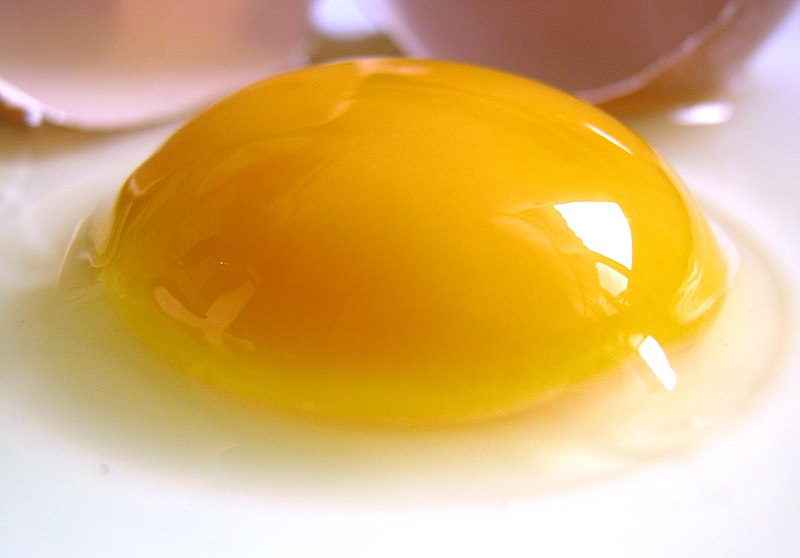
File:Raw_egg.jpg · Wikimedia Commons · See Wikimedia Commons
egg yolk
Sign in to saveAlso known as yolk
thumb|The yolk of a chicken egg thumb|Diagram of a fish egg; the yolk is the area which is marked 'C' Among animals which produce eggs, the yolk (; also known as the vitellus) is the nutrient-bearing portion of the egg whose primary function is to supply food for the development of the embryo. Some types of egg contain no yolk, for example because they are laid in situations where the food supply is sufficient (such as in the body of the host of a parasitoid) or because the embryo develops in the parent's body, which supplies the food, usually through a placenta. Reproductive systems in which
The yolk is the nutrient-rich portion of an egg that provides food for a developing embryo to grow. While most eggs contain yolk, some types don't need it because the embryo gets nourishment from other sources, such as the parent's body or the surrounding environment.
AI-generated from the Wikipedia summary — may contain errors.
Research
14,290 papers- Egg Yolk Antibody for Passive Immunization: Status, Challenges, and Prospects.ReviewJournal of agricultural and food chemistry · 2023Wang H, Zhong Q, Lin JDOI: 10.1021/acs.jafc.2c09180
- Egg yolk phospholipids as an ideal precursor of fatty note odorants for chicken meat and fried foods: A review.ReviewFood chemistry · 2023Chen DW, Wan P, Yao J et al.DOI: 10.1016/j.foodchem.2022.135177
- Biological Activities of Egg Yolk Lipids: A Review.ReviewJournal of agricultural and food chemistry · 2020Xiao N, Zhao Y, Yao Y et al.DOI: 10.1021/acs.jafc.9b06616
- Egg yolk antibodies for passive immunity.ReviewAnnual review of food science and technology · 2012Kovacs-Nolan J, Mine YDOI: 10.1146/annurev-food-022811-101137
- Egg Yolk Immunoglobulins (IgY) Purification, Activity Enhancement, and Potential Benefits for Human Health.ReviewNutrients · 2025Qiu H, Jin X, Zhang X et al.DOI: 10.3390/nu17172890
- Gelation behavior of egg yolk under physical and chemical induction: A review.ReviewFood chemistry · 2021Zhao Y, Feng F, Yang Y et al.DOI: 10.1016/j.foodchem.2021.129569
- How Can the Value and Use of Egg Yolk Be Increased?ReviewJournal of food science · 2019Huang X, Ahn DUDOI: 10.1111/1750-3841.14430
- Egg yolk oil accelerates wound healing in streptozotocin induced diabetic rats.Biotechnic & histochemistry : official publication of the Biological Stain Commission · 2023Ili P, Sari FDOI: 10.1080/10520295.2022.2115554
via PubMed
Wikidata facts
- Instance of
- food ingredient
- Subclass of
- animal product
- Part of
- egg as food
- Material used
- egg as food
- Image
- Yolks.jpg
via Wikidata · CC0
~11 min read
Encyclopedic overview
13 sectionsContents
- Avian egg yolk
- Uses
- Composition of chicken egg yolk
- Yolk proteins
- Yolk vitamins and minerals
- Double-yolk eggs
- Yolkless eggs
- Yolk color
- In fish
- In crustaceans
- See also
- References
- External links
thumb|The yolk of a chicken egg thumb|Diagram of a fish egg; the yolk is the area which is marked 'C' Among animals which produce eggs, the yolk (; also known as the vitellus) is the nutrient-bearing portion of the egg whose primary function is to supply food for the development of the embryo. Some types of egg contain no yolk, for example because they are laid in situations where the food supply is sufficient (such as in the body of the host of a parasitoid) or because the embryo develops in the parent's body, which supplies the food, usually through a placenta. Reproductive systems in which the mother's body supplies the embryo directly are said to be matrotrophic; those in which the embryo is supplied by yolk are said to be lecithotrophic. In many species, such as all birds, and most reptiles and insects, the yolk takes the form of a special storage organ constructed in the reproductive tract of the mother. In many other animals, especially very small species such as some fish and invertebrates, the yolk material is not in a special organ, but inside the egg cell.
As stored food, yolks are often rich in vitamins, minerals, lipids and proteins. The proteins function partly as food in their own right, and partly in regulating the storage and supply of the other nutrients. For example, in some species the amount of yolk in an egg cell affects the developmental processes that follow fertilization.
Excerpted from Wikipedia’s “egg yolk” article, available under the CC BY-SA 4.0 licence.
Gallery (18)
Available in 71 languages
- Español
- Français
- Deutsch
- 中文
- 日本語
- Русский
- Português
- Italiano
- العربية
- हिन्दी
- Amharic
- Aragonese
- Armenian
- Asturian
- Bahasa Indonesia
- Bangla
- Basque
- Bavarian
Show 52 more
- Belarusian
- Bosnian
- Bulgarian
- Catalan
- Croatian
- Czech
- Danish
- Esperanto
- Estonian
- Filipino
- Galician
- Greek
- Hebrew
- Ido
- Irish
- Javanese
- Kabyle
- Kannada
- Latin
- Latvian
- Limburgish
- Macedonian
- Malay
- Malayalam
- Nederlands
- Norwegian
- Oromo
- Pashto
- Polski
- Romanian
- Scottish Gaelic
- Serbian
- Serbian (Latin)
- simple
- Slovak
- Somali
- Sundanese
- Svenska
- szy
- Tiếng Việt
- Türkçe
- Ukrainian
- Waray
- Welsh
- West Flemish
- Western Frisian
- Wu Chinese
- zh_yue
- Zhuang
- فارسی
- ไทย
- 한국어
via Wikidata sitelinks · CC0