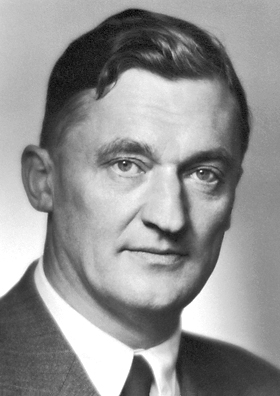
File:Hugo_Theorell_nobel.jpg · Wikimedia Commons · See Wikimedia Commons
Hugo Theorell was a Swedish biochemist who won the Nobel Prize in Physiology or Medicine in 1955 for his discoveries about enzymes and how they work in living cells. His research helped scientists understand the fundamental chemical processes that keep organisms alive, laying important groundwork for modern biochemistry and medicine.
AI-generated from the Wikipedia summary — may contain errors.
Person · Open Library
- Works
- 3
Top works
- Studien Über Die Plasmalipoide des Blutes
- The Mechanism of action of dehydrogenases
- Växlande vindar
via Open Library + Wikidata
Recent publications · Crossref
5 total works indexed
- [13] Catalase in vitro
· 1984 · cited 21,322x
- A global reference for human genetic variation
· 2015 · cited 17,798x
- Global burden of 369 diseases and injuries in 204 countries and territories, 1990–2019: a systematic analysis for the Global Burden of Disease Study 2019
· 2020 · cited 15,989x
- 2018 ESC/ESH Guidelines for the management of arterial hypertension
· 2018 · cited 8,303x
- 2020 ESC Guidelines for the diagnosis and management of atrial fibrillation developed in collaboration with the European Association for Cardio-Thoracic Surgery (EACTS)
· 2020 · cited 8,249x
via Crossref · CC0
Nobel Prize
- The Nobel Prize in Physiology or Medicine1955
“for his discoveries concerning the nature and mode of action of oxidation enzymes”
Wikidata facts
- Instance of
- human
- Given name
- Hugo
- Gender
- male
- Citizenship
- Sweden
- Place of death
- Stockholm
- Occupation
- physician
- Employer
- Uppsala University
- Languages spoken
- Swedish
- Field of work
- biochemistry
- Image
- Hugo Theorell nobel.jpg
- Residence
- Sweden
Show 8 more facts
- place of burial
- Q252312
- date of birth
- 1903-07-06
- date of death
- 1982-08-15
- nominated for
- Nobel Prize in Physiology or Medicine
- name in native language
- Axel Hugo Teodor Theorell
- date of burial or cremation
- 1982-09-07
- Commons category
- Hugo Theorell
- interested in
- biochemistry
Sources (8)
via Wikidata · CC0
~2 min read
Encyclopedic overview
Axel Hugo Theodor Theorell ForMemRS (6 July 1903 – 15 August 1982) was a Swedish scientist and Nobel Prize laureate in medicine.
Life
Excerpted from Wikipedia’s “Hugo Theorell” article, available under the CC BY-SA 4.0 licence.