Li, Yan-Da;Tihelka, Erik;Dahan, Loïc;Huang, Di-Ying;Cai, Chen-Yang
Nosodendridae
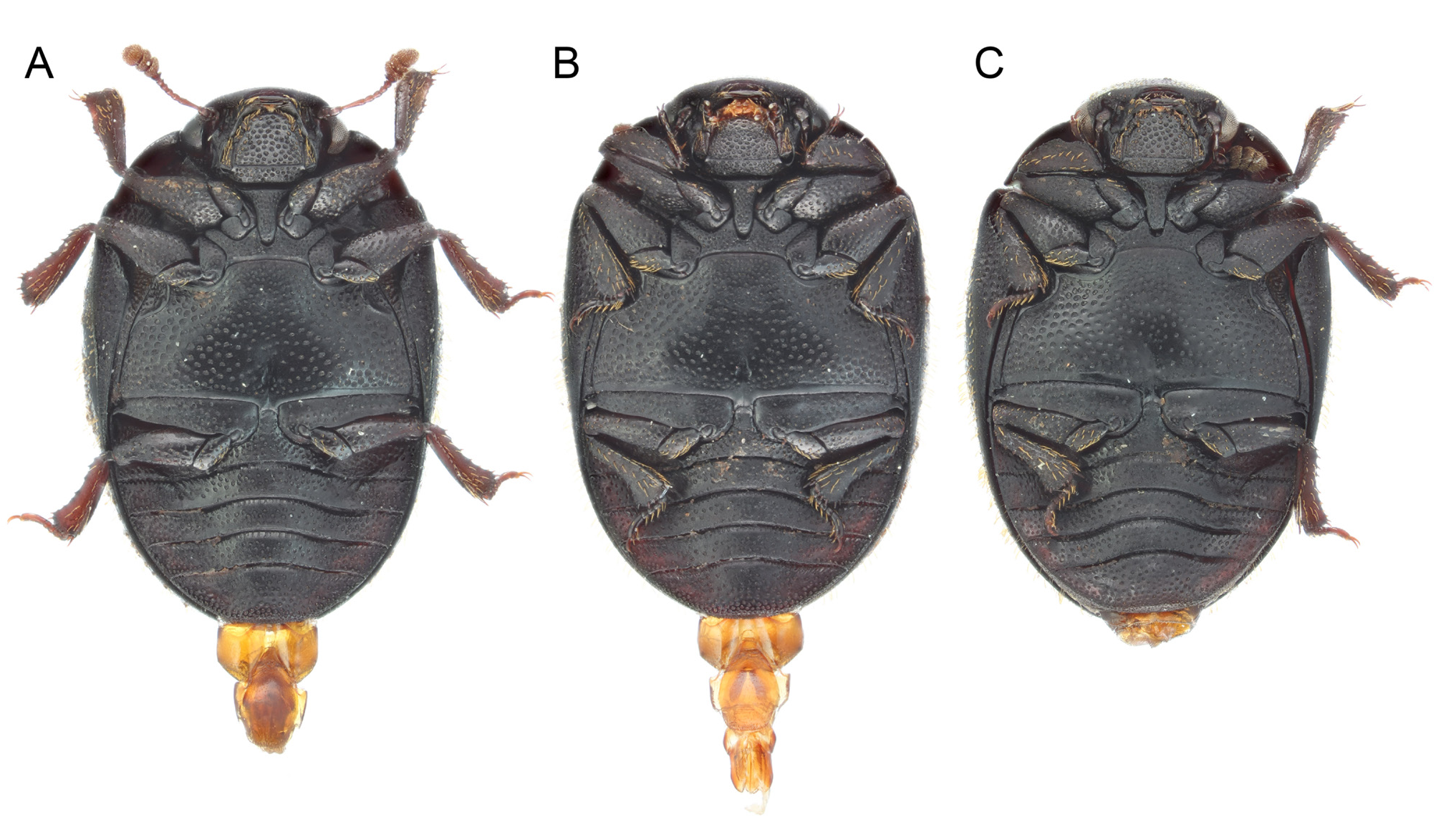
Sign in to saveNosodendridae is a family of beetles, with less than a hundred species in three extant genera, which are found worldwide. Nosodendron, the largest genus, is found in forests and attracted to yeast generated slime on the wounds of trees, and likely consumes fermented substances as well as fungi and microorganisms. Several additional genera and species are known from the fossil record. Nosodendridae is considered to be an isolated lineage within Polyphaga, being the sister group to the clade containing Staphyliniformia, Bostrichoidea and Cucujiformia.
In the Vinony graph
Vinony's link graph records 656 inbound references to Nosodendridae, and connects out to Animalia, insect and arthropod.
Vinony files it under Beetle families, Bostrichoidea and Taxa named by Wilhelm Ferdinand Erichson.
Vinony links it to 17 Wikipedia language editions.
Species
FAMILY
- KingdomAnimalia
- PhylumArthropoda
- ClassInsecta
- OrderColeoptera
- FamilyNosodendridae
Латинское название Nosodendridae Erichson, 1846 Рода †Nosotetocus Nosodendron Систематикана Викивидах Изображенияна Викискладе ITIS 114973 NCBI 186078 Нозодендриды (лат. Nosodendridae) — семейство насекомых из отряда жесткокрылых, включает 2 рода и около 30 видов. Древнейшие находки семейства в ископаемом состоянии происходят из мелового бирманского янтаря[1]. Содержание 1 Описание 2 Систематика и распространение 3 Примечания 4 Ссылки Описание Маленькие жуки, 2,5—5,5 мм в длину. Усики 11-члениковые. Систематика и распространение Некоторые виды семейства: Nosodendron Nosodendron fasciculare (Olivier, 1790) — наиболее распространены на севере Европы: в Дании и Южной Швеции Nosodendron californicum Horn, 1874 — Северная Америка Nosodendron unicolor Say, 1824 — Северная Америка Примечания ↑ Congshuang Deng, Yu-Lingzi Zhou, Adam Ślipiński, Dong Ren, Hong Pang. The first wounded-tree beetle (Coleoptera: Nosodendridae) from Cretaceous Burmese amber // Cretaceous Research. — 2019-01-01. — Т. 93. — С. 211–215. — ISSN 0195-6671. — DOI:10.1016/j.cretres.2018.09.019.
via GBIF
Museum specimens
- Specimen records
- 28
- With media
- 8
- Family
- Nosodendridae
- Collections
- MHNCA, INECOL, TTU, LCDI, KU, PSUC
- Recorded in
- Mexico, United States, Guatemala, Costa Rica, Ecuador
Wikidata facts
- Instance of
- taxon
- Image
- Nosodendron.jpg
Show 5 more facts
- Commons category
- Nosodendridae
- taxon name
- Nosodendridae
- taxon rank
- family
- topic's main category
- Category:Nosodendridae
- taxon common name
- 小丸甲科
Sources (1)
via Wikidata · CC0
~2 min read
Encyclopedic overview
3 sectionsContents
- Genera and species
- References
- External links
Nosodendridae is a family of beetles, with less than a hundred species in three extant genera, which are found worldwide. Nosodendron, the largest genus, is found in forests and attracted to yeast generated slime on the wounds of trees, and likely consumes fermented substances as well as fungi and microorganisms. Several additional genera and species are known from the fossil record. Nosodendridae is considered to be an isolated lineage within Polyphaga, being the sister group to the clade containing Staphyliniformia, Bostrichoidea and Cucujiformia.
== Genera and species == †Basinosa †B. pengweii (Cenomanian; Burmese amber, Myanmar) †Mesonosa †M. scandens (Cenomanian; Burmese amber, Myanmar) Nosodendron Nd. africanum Nd. agaboides Nd. angelum Nd. asiaticum Nd. australe Nd. australicum Nd. batchianum Nd. bilyi Nd. boliviense Nd. bucki Nd. californicum Nd. calvum Nd. celebense Nd. ceylanicum Nd. chelonarium Nd. coenosum Nd. derasum Nd. disjectum Nd. dybasi Nd. elongatum Nd. fasciatum Nd. fasciculare Nd. fijiense Nd. glabratum Nd. grande Nd. hageni Nd. helferi Nd. hispidum Nd. horaki Nd. incognitum Nd. indicum Nd. interruptum Nd. jakli Nd. kalimantanus Nd. laosense Nd. latifrons Nd. latum Nd. leechi Nd. lentum Nd. madagascariense Nd. manuselae Nd. marginatum Nd. mediobasale Nd. mexicanum Nd. moluccense Nd. nepalense Nd. niasense Nd. nitidum Nd. nomurai Nd. oblongum Nd. ovatum Nd. pauliani Nd. politum Nd. prudeki Nd. punctatostriatum Nd. punctulatum Nd. reichardti Nd. ritsemae Nd. sikkimense Nd. slipinskii Nd. strigiferum Nd. subtile Nd. testudinum Nd. thompsoni Nd. tiomanense Nd. tonkineum Nd. tritavum Nd. unicolor Nd. vestitum Nd. zealandicum Nosoglobulus Ng. loebli Ng. smetanai Nosotetocus Nt. debilis Nt. marcovi Nt. vespertinus
Excerpted from Wikipedia’s “Nosodendridae” article, available under the CC BY-SA 4.0 licence.
Gallery (3)
Available in 17 languages
- Español
- Русский
- العربية
- Cebuano
- Czech
- Egyptian Arabic
- Hungarian
- Lithuanian
- Nederlands
- Norwegian
- Polski
- Svenska
- Tiếng Việt
- Türkçe
- Waray
- فارسی
via Wikidata sitelinks · CC0