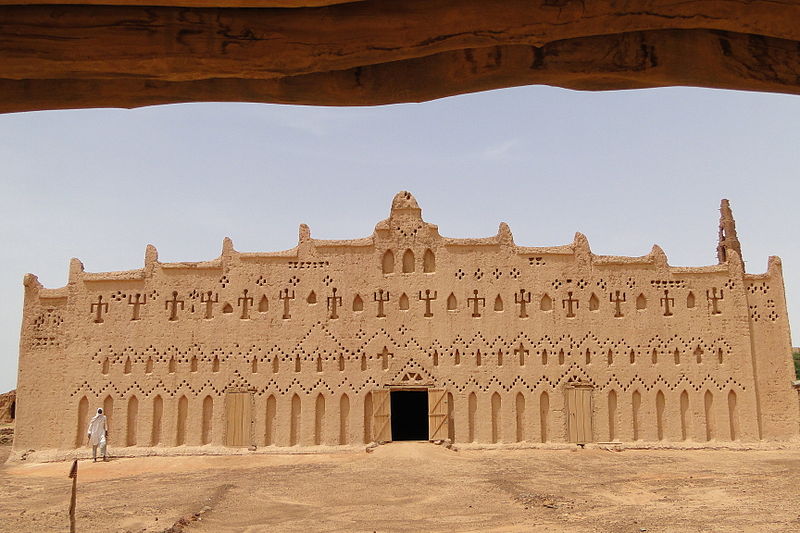
File:Mud_Mosque_-_Bani_-_Sahel_Region_-_Burkina_Faso_-_02.jpg · Wikimedia Commons · See Wikimedia Commons
Sahel
Sign in to saveAlso known as West African Sahel region, West African Sahel
The Sahel region (; ), or Sahelian acacia savanna, is a biogeographical region in Africa. It is the transition zone between the more humid Sudanian savannas to its south and the drier Sahara to the north. The Sahel has a hot semi-arid climate and stretches across the southernmost latitudes of North Africa between the Atlantic Ocean and the Red Sea. Although geographically located in the tropics, the Sahel does not have a tropical climate.
The Sahel is a vast transition zone stretching across North Africa between the Atlantic Ocean and the Red Sea, characterized by a hot semi-arid climate that lies between the wetter savannas to its south and the Sahara Desert to its north. It matters because this biogeographical region represents a critical ecological boundary and is home to distinctive plant and animal communities adapted to its unique climate conditions.
AI-generated from the Wikipedia summary — may contain errors.
Key facts
- Ecoregion.name
- Sahel
- Ecoregion.map_caption
- The Sahel region in Africa: a belt up to wide that spans from the Atlantic Ocean to the Red Sea
- Ecoregion.biogeographic_realm
- Afrotropical
- Ecoregion.biome
- Tropical and subtropical grasslands, savannas, and shrublands
- Ecoregion.animals
- Camels, horses
- Ecoregion.bird_species
- Migratory birds
- Ecoregion.mammal_species
- Oryx, gazelles, African buffalo
- Ecoregion.border
- East Saharan montane xeric woodlands
- Ecoregion.border1
- East Sudanian savanna
- Ecoregion.border2
- Ethiopian montane forests
- Ecoregion.border3
- Inner Niger Delta
- Ecoregion.border4
- Lake Chad flooded savanna
- Ecoregion.border5
- South Saharan steppe and woodlands
- Ecoregion.border6
- Sudd flooded grasslands
- Ecoregion.border7
- West Saharan montane xeric woodlands
- Ecoregion.border8
- West Sudanian savanna
- Ecoregion.area
- 3,053,200
- Ecoregion.country
- Algeria
via Wikipedia infobox
Wikidata facts
- Instance of
- region
- Demonym
- saheliano
- Country
- Algeria
- Time zone
- UTC+01:00
- Shares border with
- sub-Saharan Africa
- Image
- Sahel Scene - Dori - Sahel Region - Burkina Faso.jpg
- Said to be same as
- Sudan
Show 7 more facts
- located in/on physical feature
- Africa
- Commons category
- Sahel
- topic's main category
- Category:Sahel
- different from
- Sahil
- on focus list of Wikimedia project
- Wikipedia:Vital articles/Level/4
- native label
- Sahel
- described by source
- Encyclopædia Britannica 11th edition
Sources (3)
via Wikidata · CC0
~26 min read
Encyclopedic overview
29 sectionsContents
- Etymology
- Geography
- Flora and fauna
- Climate
- Recent droughts
- 2010 drought
- Desertification and soil loss
- Protected areas
- Culture
- Music
- Language
- French
- Colonial History
- Status of the French language
- Linguistic Specificities
- History
- Early agriculture
- Sahelian kingdoms
- Colonial period
- Independence
- Instability and violence
- Terrorism
- Human rights issues and political instability
- Other challenges
- See also
- References
- Sources
- Further reading
- External links
The Sahel region (; ), or Sahelian acacia savanna, is a biogeographical region in Africa. It is the transition zone between the more humid Sudanian savannas to its south and the drier Sahara to the north. The Sahel has a hot semi-arid climate and stretches across the southernmost latitudes of North Africa between the Atlantic Ocean and the Red Sea. Although geographically located in the tropics, the Sahel does not have a tropical climate.
Especially in the western Sahel, there are frequent shortages of food and water due to its very high government corruption and the semi-arid climate. Nonetheless, the region has sustained very high human birthrates, resulting in a rapid increase in population. In recent times, various coups, insurgencies, terrorism and foreign interventions have taken place in many Sahel countries, especially across former Françafrique.
Excerpted from Wikipedia’s “Sahel” article, available under the CC BY-SA 4.0 licence.
Gallery (34)
Available in 91 languages
- Español
- Français
- Deutsch
- 中文
- 日本語
- Русский
- Português
- Italiano
- العربية
- हिन्दी
- Afrikaans
- Albanian
- Armenian
- Arpitan
- Asturian
- Azerbaijani
- Bahasa Indonesia
- Bangla
Show 72 more
- Bashkir
- Basque
- Belarusian
- Bosnian
- Breton
- Bulgarian
- Catalan
- Croatian
- Czech
- Danish
- Egyptian Arabic
- Esperanto
- Estonian
- Faroese
- Filipino
- Finnish
- Galician
- Georgian
- Greek
- Hausa
- Hebrew
- Hungarian
- Icelandic
- Ido
- Irish
- Kazakh
- Latin
- Latvian
- Lithuanian
- Macedonian
- Malagasy
- Malay
- Malayalam
- Marathi
- Mingrelian
- Navajo
- Nederlands
- Northern Frisian
- Norwegian
- Norwegian Nynorsk
- Occitan
- Polski
- Romanian
- Rusyn
- Serbian
- Serbian (Latin)
- Shona
- simple
- Sindhi
- Slovak
- Slovenian
- Somali
- Svenska
- Swahili
- Tamil
- Tatar
- Tiếng Việt
- Türkçe
- Ukrainian
- Urdu
- Venetian
- Waray
- Welsh
- Western Frisian
- Western Panjabi
- Wolof
- Wu Chinese
- Zaza
- zh_yue
- فارسی
- ไทย
- 한국어
via Wikidata sitelinks · CC0