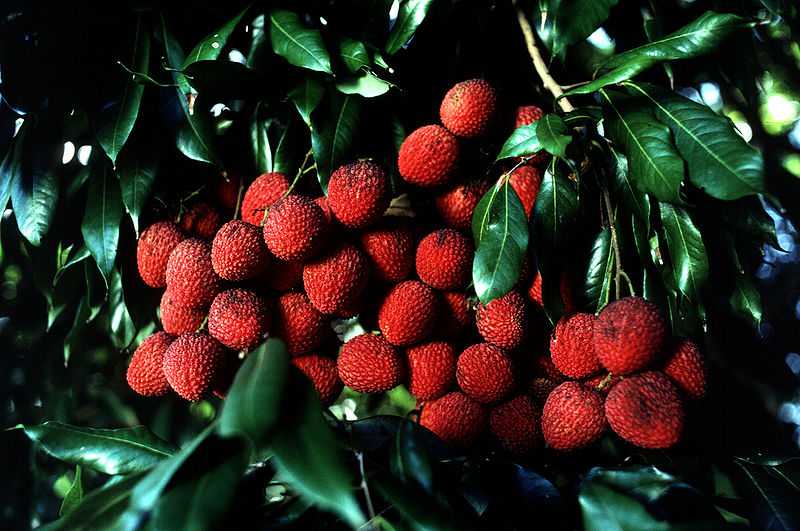
File:Lychee.jpg · Wikimedia Commons · See Wikimedia Commons
Sapindaceae
Sign in to saveThe Sapindaceae are a family of flowering plants in the order Sapindales known as the soapberry family. It contains 138 genera and 1,858 accepted species. Examples include horse chestnut, maples, ackee and lychee.
OverviewAI-generated
Sapindaceae is a family of plants within the order Sapindales. It belongs to the class Magnoliopsida and the phylum Tracheophyta in the kingdom Plantae. The family was described by de Jussieu in 1789 and is currently accepted as a valid taxon. Its type genus is Sapindus, and it has the synonym Hippocastanaceae. Members of this family utilize CAM photosynthesis.
The family has been recorded in various databases, including 5,363,639 occurrences in GBIF and 3,675 entries in PubMed. Specific records from iDigBio include 5,879 records and 3,203 media items, with collections from institutions in Mexico and the United States. Sapindaceae is also referenced by 1,279 other encyclopedia articles.
Synthesized by Vinony from 41 facts across 8 sources: Wikidata, WoRMS, GBIF, PubMed, Gbif Occ, Plants of the World, iDigBio, Vinony graph. Generated from structured data (not the Wikipedia text) and checked against those facts — may still contain errors.
Species
Sapindaceae
FAMILY
- KingdomPlantae
- PhylumTracheophyta
- ClassMagnoliopsida
- OrderSapindales
- FamilySapindaceae
無患子科(学名:Sapindaceae)是真双子叶植物無患子目的一個科。近期的分類系統(APG分类法)主張將槭樹科和七葉樹科這兩個科併入到無患子科內。無患子科約有140-150屬,1400-2000種。中国有27属约250多种,分布在全国各地。 目录 1 名称 2 特征 3 用途 4 分类 5 参考文献 名称 相傳以無患樹的木材製成的木棒可以驅魔殺鬼,因此名為無患。無患子拉丁学名Sapindus是soap indicus的缩写,意思是"印度的肥皂",因为它那厚肉質狀的果皮含有皂素,只要用水搓揉便會產生泡沫。 特征 本科植物為喬木、灌木、草本或藤本。分佈於全世界,由溫帶至熱帶地區均有分佈。多具有乳汁,在葉子或種子內含有微毒的皂素。 葉互生或對生(槭樹屬、七葉樹屬及其他少數屬),葉有葉柄,通常沒有托葉。大多為複葉,有三出複葉、羽狀複葉或二回羽狀複葉。不過槭樹屬大多是掌狀單葉,七葉樹屬和三叶树属(Billia)是掌狀複葉。 花為單性花或功能性的單性花(雌花內有不具功能的雄蕊)。花序為聚繖花序,稀為單生花。雌花通常生於花序的底部,而雄花生於花序的頂端。花萼五片(有時為四片),分離或結合。花瓣五片(有時為四片或無花瓣),花瓣通常分離,不過有時會在基部結合。雄蕊通常有八枚(或四枚至十枚或更多),分成兩圈,每四枚雄蕊排成一圈。花絲常有毛。 果實為肉果或乾果,開裂或不開裂。果實有蒴果、堅果、漿果、核果、離果或翅果。種子有種皮,沒有胚乳,胚為彎曲胚。 用途 無患子科植物有很多種類是有經濟價值的熱帶果樹,例如:荔枝、瓜拿納、龍眼、紅毛丹、蜜果、阿開木,無患子等。欒樹和楓樹可以做觀賞樹木及行道樹。 分类 楓屬(Acer),本屬以前屬於楓樹科(日本舊稱槭屬,現稱カエデ屬)。 七葉樹屬(Aesculus),本屬以前屬於七葉樹科。 Alectryon 止宮樹屬(Allophylus),又名異木患屬。本屬約有190種。 Allosanthus 细子龙属(Amesiodendron) 滇赤才屬(Aphania) Aporrhiza Arfeuillea 滨木患属(Arytera) Atalaya Athyana Averrhoidium Beguea 三叶树属(Billia),本屬以前屬於七葉樹科。 Bizonula 阿開木屬(Blighia) Blighiopsis Blomia Bridgesia Camptolepis 倒地鈴屬(Cardiospermum) Castanospora Chonopetalum Chouxia Chytranthus Conchopetalum Cossinia Cubilia Cupania Cupaniopsis,本屬約有60種。 Deinbollia 茶条木属(Delavaya) Diatenopteryx Dictyoneura Diloden
via GBIF · Kew POWO
Museum specimens
- Specimen records
- 5,879
- With media
- 3,203
- Family
- Sapindaceae
- Collections
- IBUNAM, DERN-IMECBIO-CUCSUR-UDG, IIB-UV, UCMP, ECOSUR, FC-UNAM
- Recorded in
- Mexico, United States
Research
3,675 papers- Evolution of secondary growth: have pattern, got process? A commentary on 'Molecular phylogeny of Urvillea (Paullinieae, Sapindaceae) and its implications in stem vascular diversity'.Annals of botany · 2023Tomescu AMFDOI: 10.1093/aob/mcad166
- Molecular phylogeny of Urvillea (Paullinieae, Sapindaceae) and its implications in stem vascular diversity.Annals of botany · 2023Cunha Neto IL, Rizzieri YC, Cabanillas PA et al.DOI: 10.1093/aob/mcad093
- Reproductive biology of Talisia esculenta (Cambess.) Radlk. (Sapindaceae).Brazilian journal of biology = Revista brasleira de biologia · 2025Silva MLM, Araújo LDA, Alves EU et al.DOI: 10.1590/1519-6984.289342
- SapBase: A central portal for functional and comparative genomics of Sapindaceae species.Journal of integrative plant biology · 2024Li J, Chen C, Zeng Z et al.DOI: 10.1111/jipb.13680
- A Zebrafish Embryo Model to Screen Potential Therapeutic Compounds in Sapindaceae Poisoning.Molecules (Basel, Switzerland) · 2024Wouters CP, Klein B, Price N et al.DOI: 10.3390/molecules29204954
- Dodonaea viscosa (Sapindaceae) as a phytoremediator for soils contaminated by heavy metals in abandoned mines.Environmental science and pollution research international · 2023Castañeda-Espinoza J, Salinas-Sánchez DO, Mussali-Galante P et al.DOI: 10.1007/s11356-022-22374-5
- Phylogeny of Paullinia L. (Paullinieae: Sapindaceae), a diverse genus of lianas with dynamic fruit evolution.Molecular phylogenetics and evolution · 2019Chery JG, Acevedo-Rodríguez P, Rothfels CJ et al.DOI: 10.1016/j.ympev.2019.106577
- Seed dormancy of Cardiospermum halicacabum (Sapindaceae) from three precipitation zones in Sri Lanka.Plant biology (Stuttgart, Germany) · 2021Thusithana V, Amarasekara RWK, Gehan Jayasuriya KMG et al.DOI: 10.1111/plb.13189
via PubMed
Wikidata facts
- Instance of
- taxon
- Image
- Lychee.jpg
Show 9 more facts
- taxon rank
- family
- taxon name
- Sapindaceae
- Commons category
- Sapindaceae
- topic's main category
- Category:Sapindaceae
- taxon common name
- 无患子科
- taxonomic type
- Sapindus
- taxon synonym
- Hippocastanaceae
via Wikidata · CC0
~4 min read
Encyclopedic overview
5 sectionsContents
- Description
- Classification
- Notable species
- References
- External links
The Sapindaceae are a family of flowering plants in the order Sapindales known as the soapberry family. It contains 138 genera and 1,858 accepted species. Examples include horse chestnut, maples, ackee and lychee.
The Sapindaceae occur in temperate to tropical regions, many in laurel forest habitat, throughout the world. Many are laticiferous, i.e. they contain latex, a milky sap, and many contain mildly toxic saponins with soap-like qualities in either the foliage and/or the seeds, or roots. The largest genera are Serjania, Paullinia, Allophylus and Acer.
Excerpted from Wikipedia’s “Sapindaceae” article, available under the CC BY-SA 4.0 licence.
Gallery (17)
Available in 61 languages
- Español
- Français
- Deutsch
- 中文
- 日本語
- Русский
- Português
- Italiano
- العربية
- Afrikaans
- Asturian
- Azerbaijani
- Bahasa Indonesia
- Basque
- be_x_old
- Belarusian
- Bosnian
- Bulgarian
Show 42 more
- Catalan
- Cebuano
- Corsican
- Croatian
- Czech
- Danish
- Egyptian Arabic
- Esperanto
- Estonian
- Finnish
- Galician
- Georgian
- Hebrew
- Hungarian
- Komi
- Komi-Permyak
- Kurdish
- Latvian
- Lithuanian
- Malagasy
- Malayalam
- Nederlands
- Northern Frisian
- Norwegian
- Polski
- Quechua
- Scots
- Serbian
- simple
- Slovenian
- Sundanese
- Svenska
- Telugu
- Tiếng Việt
- Türkçe
- Ukrainian
- Upper Sorbian
- Waray
- zh_yue
- فارسی
- ไทย
- 한국어
via Wikidata sitelinks · CC0