Synechanthus · Kew POWO · Kew Plants of the World Online
Synechanthus
Sign in to saveSynechanthus is a monoecious genus of flowering plant in the palm family found in Mexico, Central and South America. Commonly called bola, palmilla, or jelly bean palm, they are closely related to members of Chamaedorea, only distinguished by their flower and fruit form. The Greek genus name is a combination of "united" and "flower".
In the Vinony graph
Vinony's link graph records 216 inbound references to Synechanthus, and connects out to Chambeyronia, Arecaceae and Phoenix.
Vinony files it under Arecaceae genera, Chamaedoreeae and Flora of the Neotropical realm.
Vinony links it to 9 Wikipedia language editions.
Species
GENUS
- KingdomPlantae
- PhylumTracheophyta
- ClassLiliopsida
- OrderArecales
- FamilyArecaceae
via GBIF · Kew POWO
Museum specimens
- Specimen records
- 18
- With media
- 7
- Family
- Arecaceae
- Collections
- US, IBUNAM, MO, NY, UF, K
- Recorded in
- Mexico, Guatemala, Belice, Ecuador, Colombia, Panama, Costa Rica
Wikidata facts
Show 7 more facts
- taxon rank
- genus
- taxon name
- Synechanthus
- topic's main category
- Category:Synechanthus
- Commons category
- Synechanthus
- taxonomic type
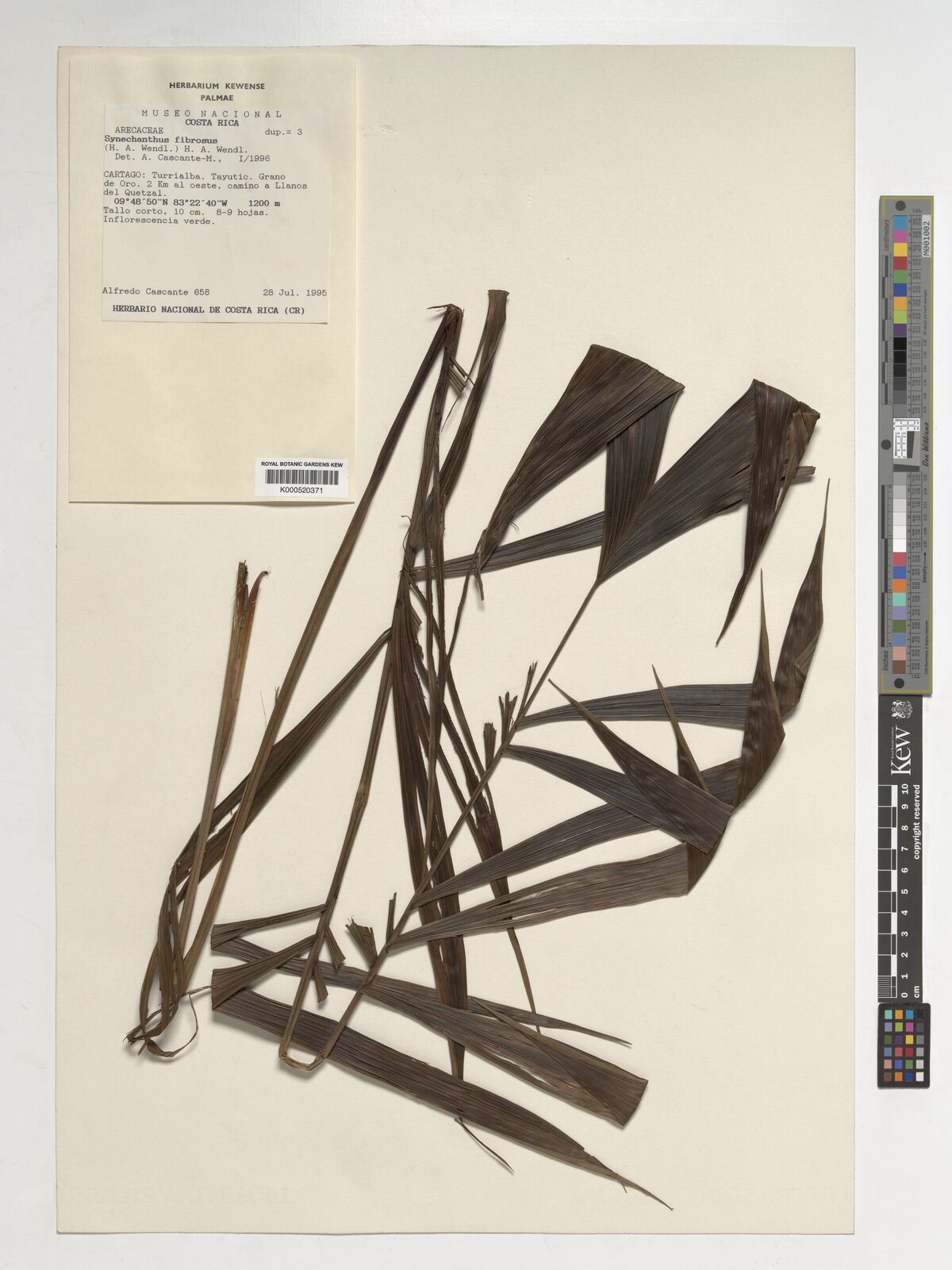
- Synechanthus fibrosus
- taxon common name
- 巧椰属
Sources (1)
via Wikidata · CC0
~3 min read
Encyclopedic overview
5 sectionsContents
- Description
- Distribution and habitat
- Cultivation
- References
- External links
Synechanthus is a monoecious genus of flowering plant in the palm family found in Mexico, Central and South America. Commonly called bola, palmilla, or jelly bean palm, they are closely related to members of Chamaedorea, only distinguished by their flower and fruit form. The Greek genus name is a combination of "united" and "flower".
==Description== Synechanthus fibrosus is solitary while S. warscewiczianus is clustering. The trunks of both are slender, rarely more than 2.5 cm wide, growing to 4.5 m tall; usually dark green, they are ringed by white leaf scars. S. warscewiczianus will usually have a dominant main stem with smaller clustering units surrounding it. The pinnate leaf is over a meter long, borne on a 30 cm petiole; the rachis is angled above and rounded below, the leaflets are slightly offset, occasionally twisting, the apical set being widest.
Excerpted from Wikipedia’s “Synechanthus” article, available under the CC BY-SA 4.0 licence.