File:Peptide_syn.svg · Wikimedia Commons · See Wikimedia Commons
transfer RNA
Sign in to saveAlso known as tRNA, sRNA, soluble RNA, transfer ribonucleic acid, soluble ribonucleic acid, RNA, Transfer
adaptor molecule composed of RNA, typically 76–90 nucleotides, that carries amino acids to the ribosome as directed by codons in mRNA
Transfer RNA is a small molecule made of RNA that acts like a messenger's assistant in your cells, picking up amino acids and delivering them to the ribosome based on instructions from messenger RNA. It matters because without it, your cells couldn't translate the genetic code into the proteins that your body needs to function.
AI-generated from the Wikipedia summary — may contain errors.
Research
65,063 papers- No stopping with a short-stem transfer RNA.Nature · 2023
- Regulatory RNAs derived from transfer RNA?RNA (New York, N.Y.) · 2010
- Transfer RNA in hepatomas.Advances in experimental medicine and biology · 1977
- Molecular dissection of a transfer RNA and the basis for its identity.Trends in biochemical sciences · 1989
- Total synthesis of transfer RNA genes.The ... Symposium. Society for Developmental Biology. Symposium · 1974
via PubMed
Wikidata facts
- Subclass of
- ribonucleic acid
- Image
- TRNA-Phe yeast 1ehz.png
Show 3 more facts
- Commons category
- TRNA
- Commons gallery
- TRNA
- exact match
- purl.obolibrary.org/obo/SO_0000253
Sources (3)
via Wikidata · CC0
~28 min read
Encyclopedic overview
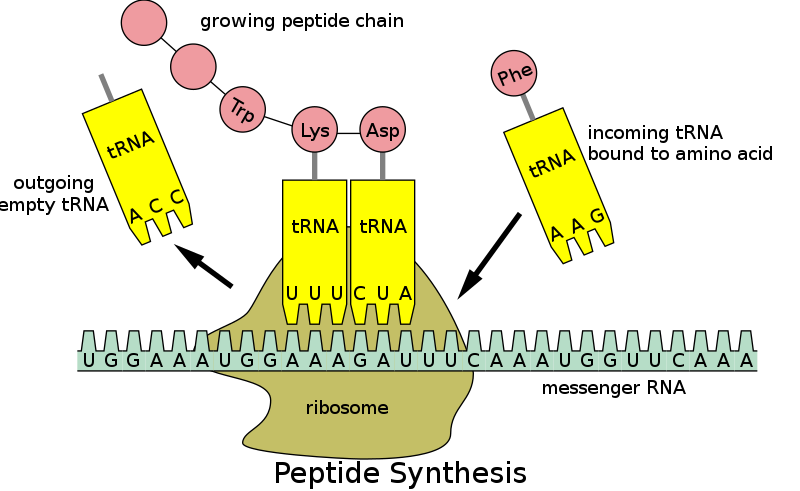
Transfer ribonucleic acid (tRNA), formerly referred to as soluble ribonucleic acid (sRNA), is an adaptor molecule composed of RNA, typically 76 to 90 nucleotides in length (in eukaryotes). In a cell, it provides the physical link between the genetic code in messenger RNA (mRNA) and the amino acid sequence of proteins, carrying the correct sequence of amino acids to be combined by the protein-synthesizing machinery, the ribosome. Each three-nucleotide codon in mRNA is complemented by a three-nucleotide anticodon in tRNA. As such, tRNAs are a necessary component of translation, the biological synthesis of new proteins in accordance with the genetic code.
Overview
Excerpted from Wikipedia’s “transfer RNA” article, available under the CC BY-SA 4.0 licence.