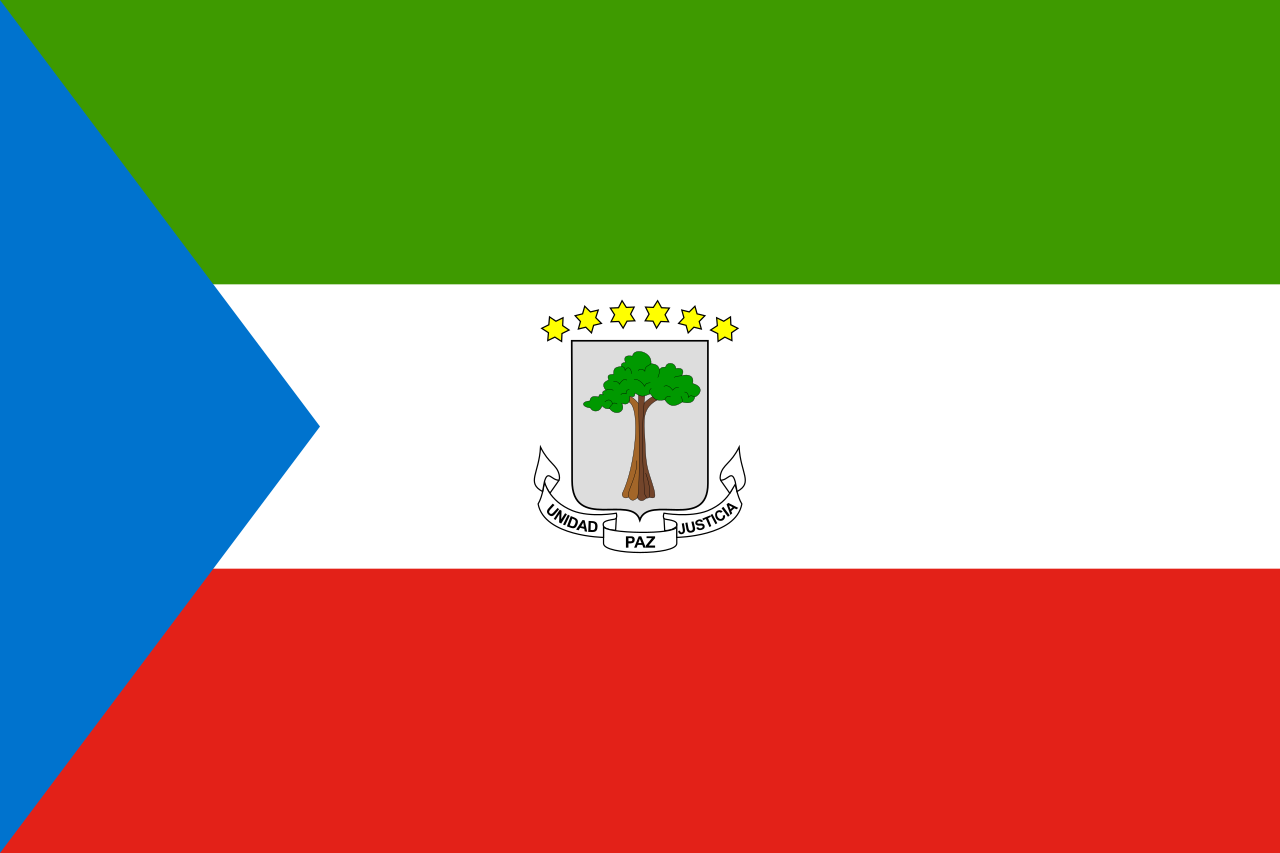
Equatorial Guinea
Sign in to saveAlso known as Republic of Equatorial Guinea, gq, GEQ
Equatorial Guinea, officially the Republic of Equatorial Guinea, is a country on the west coast of Central Africa. It has an area of 28,000 square kilometres (11,000 sq mi). Formerly the colony of Spanish Guinea, its post-independence name refers to its location both near the Equator and in the African region of Guinea. As of 2025, the country has a population of 1,853,559, over 85% of whom are members of the Fang people, the country's dominant ethnic group. The Bubi people, indigenous to Bioko, are the second largest group at approximately 6.5% of the population. Its capital is Ciudad de la Paz, replacing former capital Malabo in 2026, while its largest city is Bata.
OverviewAI-generated
Equatorial Guinea, officially the Republic of Equatorial Guinea, is a sovereign state located in Africa. Its capital is Ciudad de la Paz, and it shares borders with Cameroon and Gabon. The country includes the administrative territorial entities of Annobón Province, Bioko Norte, Bioko Sur, and Centro Sur. Its highest point is Pico Basilé.
The population is 1,668,768, with 71.3574028749806 percent living in urban areas. The land area covers 28,051 square kilometers. Forest area accounts for 86.3935828877005 percent of the total. The currency is the Central African CFA franc. The top-level Internet domain is .gq, and the telephone country code is +240.
Manuela Roka and Manuel Osa Nsue Nsue serve as heads of government. The national anthem is Caminemos pisando las sendas de nuestra inmensa felicidad. Equatorial Guinea is a member of the United Nations and the African Union. It is located in the UTC+01:00 time zone.
Synthesized by Vinony from 73 facts across 10 sources: Wikidata, Openweathermap, Open Meteo, World Bank, OpenStreetMap, Firecrawl, REST Countries, PubMed, Vinony graph, Geo. Generated from structured data (not the Wikipedia text) and checked against those facts — may still contain errors.
In the Vinony graph
Vinony catalogs Equatorial Guinea in its Countries collection (215 entries).
Within Vinony's link graph, Equatorial Guinea is referenced by 6,192 other articles, and connects out to African Union, Bioko and Francisco Macías Nguema Biyoko.
The entry is geolocated on the map in country, across 2 mapped points.
Vinony files it under 1968 establishments in Africa, Countries and territories where French is an official language and Countries and territories where Portuguese is an official language.
Weather now
cached 1h ago7-day forecast
via Open-Meteo
Country
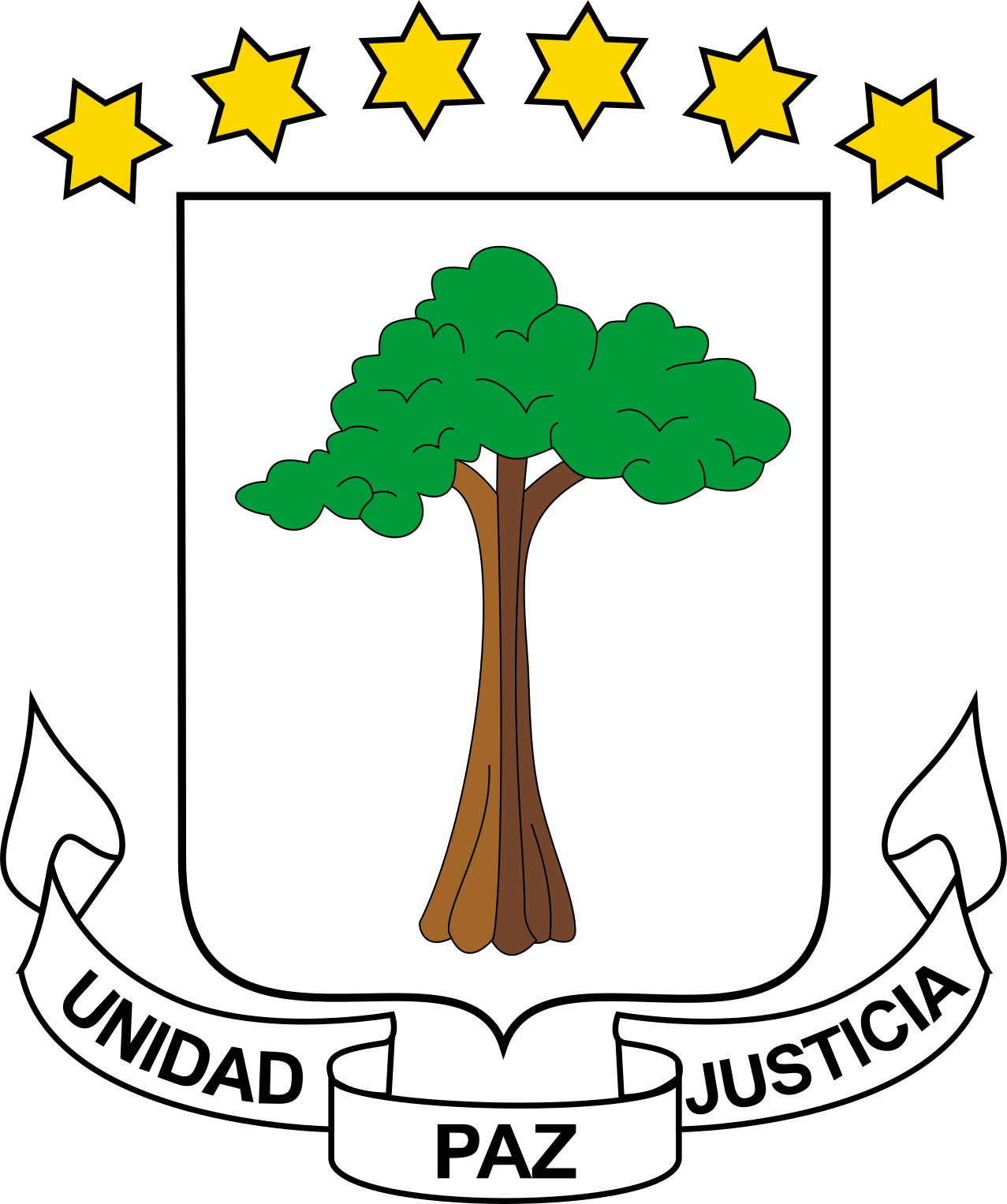
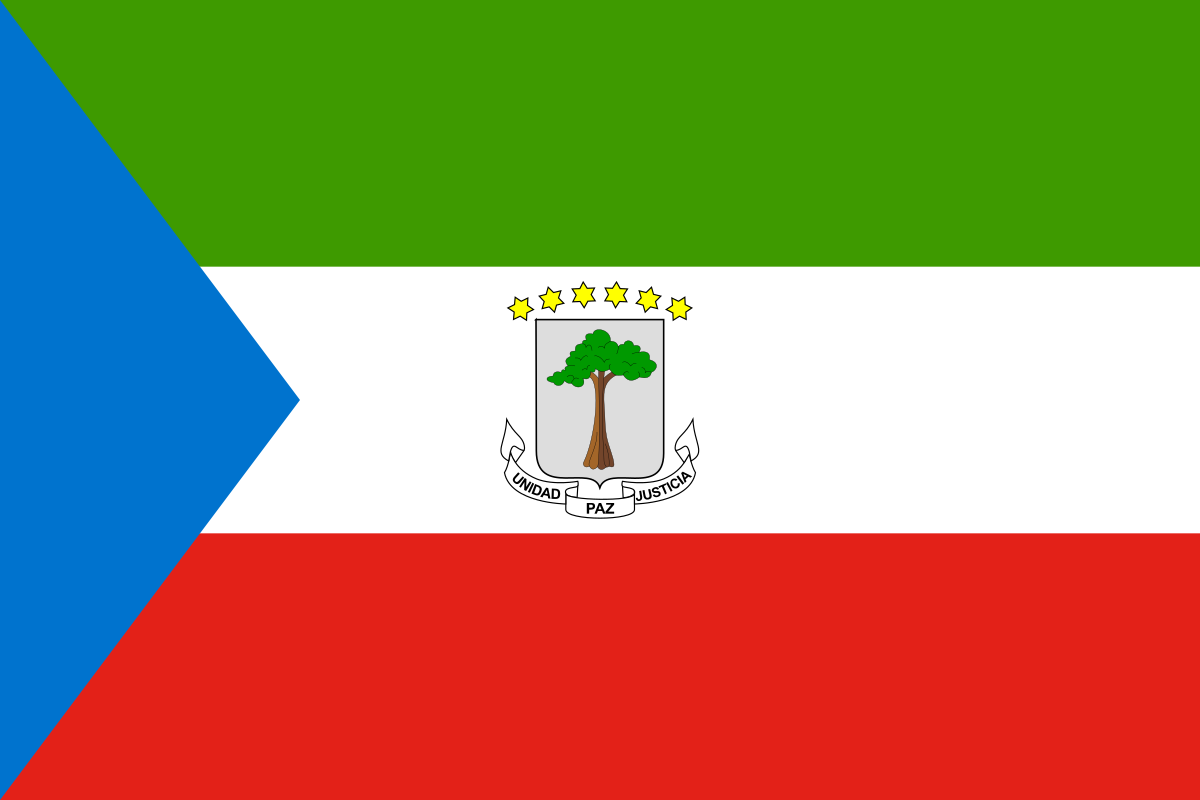
- Capital
- Ciudad de la Paz
- Population
- 1,668,768
- Region
- Africa · Middle Africa
- Demonym
- Equatorial Guinean
- Currencies
- XAF (Fr)
- Languages
- French, Portuguese, Spanish
- Calling code
- +240
- Drives on
- Right
- FIFA code
- EQG
- TLD
- .gq
- Timezones
- UTC+01:00
- Borders
- CMR, GAB
via REST Countries
Indicators · World Bank
- GDP
- $12.8B(2024)
- Population
- 1,892,516(2024)
- Life expectancy
- 63.9 yrs(2024)
- Unemployment
- 8.3 %(2025)
- Urban population
- 71.4 %(2024)
- Internet users
- 63.3 %(2024)
- Forest area
- 86.4 %(2023)
- Renewable energy
- 4.2 %(2022)
via World Bank Open Data · CC BY 4.0
Wikipedia views (30d)
84,982 totalvia Wikimedia Pageviews API
Research
853 papers- Equatorial Guinea intensifies its fight against tuberculosis.The Lancet. Infectious diseases · 2024Bagcchi SDOI: 10.1016/S1473-3099(24)00684-4
- Outbreak of Marburg Virus Disease, Equatorial Guinea, 2023.ReviewEmerging infectious diseases · 2025Ngai S, Evers ES, Seoane AKL et al.DOI: 10.3201/eid3105.241749
- A paradigm for Africa-centric vaccine development in Equatorial Guinea.ReviewTrends in parasitology · 2024Billingsley PF, Richie TL, Abdulla S et al.DOI: 10.1016/j.pt.2024.03.005
- Equatorial Guinea.Department of State publication. Background notes series · 1989United States. Department of State. Bureau of Public Affairs
- Equatorial Guinea.Department of State publication. Background notes series · 1984United States. Department of State. Bureau of Public Affairs
- WHO: Marburg Virus Outbreak Confirmed in Equatorial Guinea.JAMA · 2023Harris EDOI: 10.1001/jama.2023.3199
- Rural-Urban Inequities in Tuberculosis-Related Practices in Equatorial Guinea.Journal of epidemiology and global health · 2023Ayala A, Ncogo P, Eyene J et al.DOI: 10.1007/s44197-023-00162-9
- The SPIN framework to control and prevent the Marburg virus disease outbreak in Equatorial Guinea.ReviewThe Pan African medical journal · 2023Wirsiy FS, Nkfusai CN, Bain LEDOI: 10.11604/pamj.2023.44.110.39368
via PubMed
Official website

Página Oficial del Gobierno de la República de Guinea Ecuatorial
Web institucional del gobierno de Guinea Ecuatorial
guineaecuatorialpress.com →Link to the official site · 23,661 chars · not written by Vinony
Wikidata facts
- Instance of
- sovereign state
- Part of
- Spanish Empire
- Named after
- equator
- Official name
- Guinée équatoriale
- Demonym
- guineoecuatoriano
- Country
- Spanish Empire
- Contains
- Djibloho
- Continent
- Africa
- Capital
- Ciudad de la Paz
- Official language
- Portuguese
- Currency
- Equatorial Guinean peseta
- Population
- 1847549
- Area
- 28051
- Time zone
- UTC+01:00
- Body of water
- Atlantic Ocean
- Head of government
- Manuel Osa Nsue Nsua
- Head of state
- Teodoro Obiang
- Legislature
- Parliament of Equatorial Guinea
- Shares border with
- São Tomé and Príncipe
- Highest point
- Pico Basilé
- Official website
- www.guineaecuatorialpress.com
- Image
- Equatorialguinea w1 locator.svg
- Life expectancy
- 57.681
Show 60 more facts
- Nominal GDP
- 11813908448
- Unemployment rate
- 8
- Calling code
- +240
- Mains voltage
- 220
- Motto
- Unidade, Paz, Justiça
- Coat of arms
- coat of arms of Equatorial Guinea
- top-level Internet domain
- .gq
- Commons category
- Equatorial Guinea
- topic's main category
- Category:Equatorial Guinea
- category for people who died here
- Category:Deaths in Equatorial Guinea
- category for people born here
- Category:Births in Equatorial Guinea
- category for films shot at this location
- Category:Films shot in Equatorial Guinea
- category of associated people
- Category:Equatoguinean people
- diplomatic relation
- Taiwan
- topic's main Wikimedia portal
- Portal:Equatorial Guinea
- IPA transcription
- ɛkʋɑtuˈɾɪɑːlɡɪneːɑ
- Commons gallery
- Guinea Ecuatorial
- mobile country code
- 627
- lowest point
- Atlantic Ocean
- driving side
- right
- geography of topic
- Geography of Equatorial Guinea
- marriageable age
- 12
- short name
- 赤幾
- office held by head of government
- Prime Minister of Equatorial Guinea
- number of out-of-school children
- 50071
- located in/on physical feature
- Central Africa
- total fertility rate
- 4.835
- maritime identification digits
- 631
- inception
- 1968-10-12
- replaces
- Spanish Guinea
- Unicode character
- 🇬🇶
- language used
- Benga
- suicide rate
- 15.5
- native label
- República da Guiné Equatorial
- history of topic
- history of Equatorial Guinea
- culture
- culture of Equatorial Guinea
- VAT rate
- 15
- different from
- Guinea
- age of majority
- 18
- BTI Status Index
- 2.97
- BTI Governance Index
- 3.33
- economy of topic
- economy of Equatorial Guinea
- demographics of topic
- demographics of Equatorial Guinea
- Democracy Index
- 1.92
- Human Development Index
- 0.596
- P11012
- Rosenheim
- central bank
- Bank of Central African States
- hashtag
- EquatorialGuinea
- on focus list of Wikimedia project
- Wikipedia:Vital articles/Level/4
- P12749
- Freguesia de Pousade
- has cabinet
- Equatorial Guinea Council of Ministers
- birth rate
- 29.865
- male population
- 883926
- death rate
- 8.708
- rural population
- 435309
- female population
- 790982
- urban population
- 1239599
- P8168
- 641 BC
Sources (15)
via Wikidata · CC0
Travel guide
Understand
For visitors, Equatorial Guinea is infamous for its high prices and hard-to-get visas for most. This is nominally a police state, akin to Turkmenistan and North Korea (minus the minders and organized persecution of its inhabitants). As a result, tourist infrastructure is sparse and it is not a high priority for the government. You are likely to face harassment by police forces curious of what you are doing in the country as a "tourist". Since the oil companies operating here are mostly American, Americans may receive marginally better treatment compared to other nationalities (e.g. visa-free entry, less suspicion by police).
Since the discovery of oil, Equatorial Guinea has—at least on paper—one of the highest per-capita incomes on the planet. Despite this, income and day-to-day life for many Equatorial Guineans has improved little, due to the endemic corruption siphoning off oil revenue into the hands of a small wealthy elite. However, there has been progress, and new infrastructure and modernization projects are under construction or even finished, especially on Bioko and around Malabo. A new city called Ciudad de la Paz (City of Peace) has been built deep in the jungles of the mainland, officially becoming the capital in 2026. In spite of the impressive-looking new infrastructure, few Equatorial Guineans have access to it, and while the government throws billions of dollars at new construction, less than half the country's population (of fewer than 700,000) have access to…
Get in
thumb|375px|A map showing the visa requirements of Equatorial Guinea, with countries in dark green having visa-free access
Obtaining a visa for Equatorial Guinea has historically been notoriously expensive and difficult. Tourism is not a priority of the government, and visitors without obvious business or family reasons are viewed with grave suspicion.
See
thumb|Children enjoying nature
There are lots of beaches. Take the precautions listed in the 'Stay Safe' category.
Eat
There are several good places to eat, particularly in Malabo. The coffee shop at Hotel Sofitel (across from the Cathedral along the north coast) offers French cuisine. Hotel Bahia's main restaurant is also a favorite destination for locals and expats. For pizza and pasta, the Pizza Place is the best place in the city. For Asian cuisine, Restaurante Bantu offers Chinese cuisine. For Moroccan and European food, try La Luna. Try Equatorial Guinean cuisine such as smoked beef with a black pepper. There is also a roast duck with cheese and onion leaf.
Drink
thumb|213x213px|A bottle of Guineana in a bar in Bata
Ebebiyin is known for its many bars. Wine is available, and the locally produced beer, Guineana, is very good.
Sleep
Due to the influx of foreign workers and foreign investment in Malabo and on the continent, there is an ample choice of hotels.
Stay healthy
Food and water: There are no potable or clean water sources in Equatorial Guinea. Visitors should drink only bottled water. Take care when consuming any fruits or vegetables that may have been washed or drinks that may contain ice cubes or 'water' additives such as coffee, tea or lemonade.
Wear shoes: Beaches in Malabo and Bata are beautiful, however, due to discarded trash and unsafe sand bugs, it is a good idea to always wear shoes. This applies to walking on carpeted areas as well.
Malaria medicine: Malaria is a leading cause of death in this country. It is advised that visitors consult their doctor for malaria tablets. Plasmodium falciparum malaria is the most common strain in EG; it is resistant to the anti-malarial drug chloroquine.
According to the US embassy, the La Paz Hospitals in Bata and Malabo are the only two in the country with medical standards of a hospital in a developed country.
Respect
Local people are very hospitable and have a certain familiarity for everything related to Spain, as the country was a Spanish province until 1968. In addition, half of the country's population emigrated to Spain between 1966 and the 1990s.
Travel guide from Wikivoyage (CC BY-SA 4.0)
~40 min read
Encyclopedic overview
Equatorial Guinea, officially the Republic of Equatorial Guinea, is a country on the west coast of Central Africa. It has an area of 28,000 square kilometres (11,000 sq mi). Formerly the colony of Spanish Guinea, its post-independence name refers to its location both near the Equator and in the African region of Guinea. As of 2025, the country has a population of 1,853,559, over 85% of whom are members of the Fang people, the country's dominant ethnic group. The Bubi people, indigenous to Bioko, are the second largest group at approximately 6.5% of the population. Its capital is Ciudad de la Paz, while its largest city is Bata.
Despite its name, the Equator does not pass through the mainland of Equatorial Guinea. However, its southernmost territory, the Annobón island, lies about 1.4° south of the Equator, meaning the equator runs just north of the island and south of the mainland of the country and passes only through the country’s territorial waters.
Excerpted from Wikipedia’s “Equatorial Guinea” article, available under the CC BY-SA 4.0 licence.
Gallery (17)
On the map
2 mapped locations
Available in 241 languages
- Español
- Français
- Deutsch
- 中文
- 日本語
- Русский
- Português
- Italiano
- العربية
- हिन्दी
- Abkhazian
- Afrikaans
- Albanian
- Albanian
- Amharic
- ami
- Angika
- Aragonese
Show 222 more
- Armenian
- Arpitan
- Asturian
- azb
- Azerbaijani
- Bahasa Indonesia
- Balinese
- Bambara
- Bangla
- Banjar
- Bashkir
- Basque
- bat_smg
- Bavarian
- be_x_old
- Belarusian
- Betawi
- Bhojpuri
- Bikol
- Bishnupriya
- Bislama
- Bosnian
- Breton
- Bulgarian
- Buriat
- Burmese
- Catalan
- cbk_zam
- cdo
- Cebuano
- Central Kurdish
- Chechen
- Chuvash
- Cornish
- Corsican
- Crimean Tatar
- Croatian
- Czech
- dag
- Danish
- Divehi
- dty
- Dzongkha
- Egyptian Arabic
- Esperanto
- Estonian
- Ewe
- Extremaduran
- Faroese
- Fiji Hindi
- Filipino
- Finnish
- fiu_vro
- Fula
- Gagauz
- Galician
- Ganda
- gcr
- Georgian
- Gilaki
- gpe
- Greek
- Guarani
- Haitian Creole
- Hakka Chinese
- Hausa
- Hebrew
- Hungarian
- hyw
- Icelandic
- Ido
- Igbo
- Iloko
- Inari Sami
- Interlingua
- Interlingue
- Inupiaq
- Irish
- Jamaican Creole English
- Javanese
- Kabyle
- Kannada
- Kanuri
- Kara-Kalpak
- Karachay-Balkar
- Kazakh
- kbp
- Kinyarwanda
- Kongo
- Kotava
- Kurdish
- Kyrgyz
- Ladino
- Lao
- Latin
- Latvian
- Lezghian
- Ligurian
- Limburgish
- Lingala
- Lingua Franca Nova
- Lithuanian
- lld
- Lombard
- Low German
- Lower Sorbian
- Luxembourgish
- Macedonian
- Malagasy
- Malay
- Malayalam
- Maltese
- Manipuri
- Manx
- Māori
- map_bms
- Marathi
- Mazanderani
- Minangkabau
- Mingrelian
- Mirandese
- mnw
- Moksha
- Mongolian
- Moroccan Arabic
- Navajo
- nds_nl
- Nederlands
- Nepali
- Newari
- Northern Frisian
- Northern Sami
- Northern Sotho
- Norwegian
- Norwegian Nynorsk
- Novial
- Obolo
- Occitan
- Odia
- Old English
- olo
- Oromo
- Ossetic
- Pampanga
- Papiamento
- Pashto
- Piedmontese
- Polski
- Punjabi
- Quechua
- Romanian
- Samoan
- Sango
- Sardinian
- Saterland Frisian
- Scots
- Scottish Gaelic
- Serbian
- Serbian (Latin)
- Shan
- Shona
- Sicilian
- Silesian
- simple
- Sindhi
- Sinhala
- Slovak
- Slovenian
- Somali
- Southern Sotho
- Standard Moroccan Tamazight
- Sundanese
- Svenska
- Swahili
- szy
- Tachelhit
- Tajik
- Talysh
- Tamil
- Taroko
- Tatar
- tay
- Telugu
- Tibetan
- Tiếng Việt
- Toki Pona
- Tsonga
- Tswana
- Tumbuka
- Türkçe
- Turkmen
- Tyap
- Udmurt
- Ukrainian
- Upper Sorbian
- Urdu
- Uyghur
- Uzbek
- Venetian
- Veps
- Volapük
- Waray
- Welsh
- Western Frisian
- Western Mari
- Western Panjabi
- Wolof
- Wu Chinese
- Xhosa
- Yakut
- Yiddish
- Yoruba
- Zaza
- Zeelandic
- zh_classical
- zh_min_nan
- zh_yue
- Zhuang
- Zulu
- فارسی
- ไทย
- 한국어
via Wikidata sitelinks · CC0