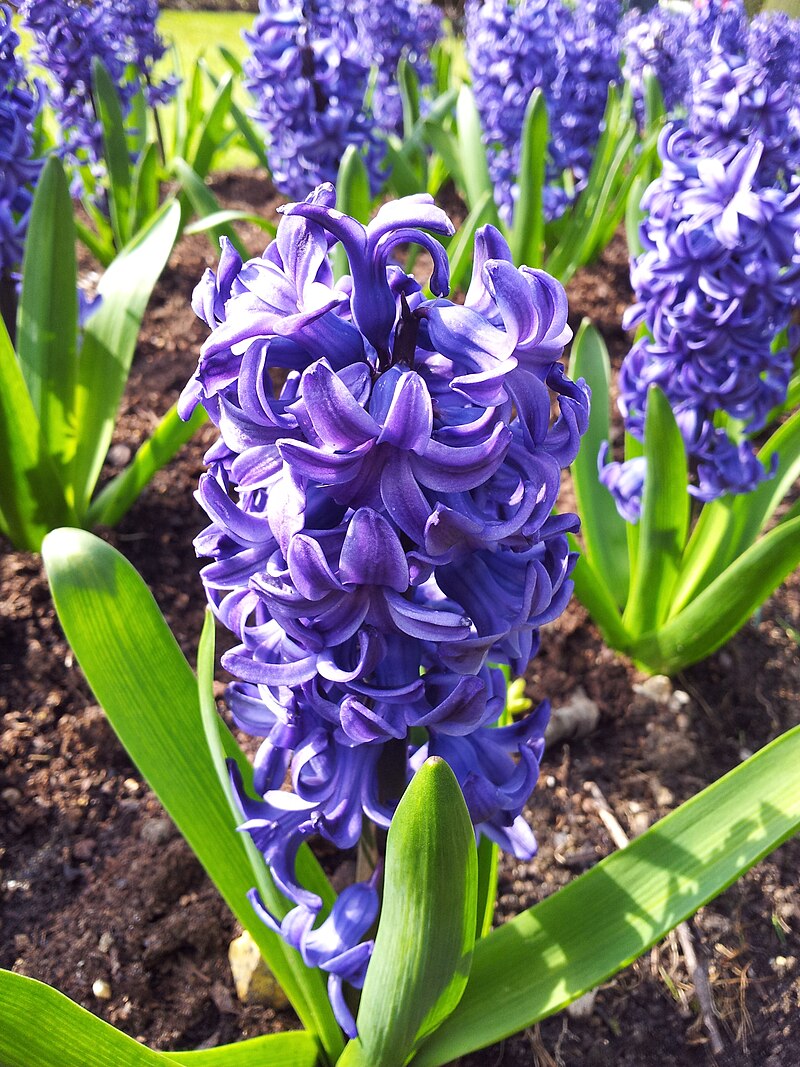
File:Hyacinth_-_Anglesey_Abbey.jpg · Wikimedia Commons · See Wikimedia Commons
hyacinth
Sign in to saveAlso known as Hyacinthus
Hyacinthus is a genus of bulbous herbs and spring-blooming perennials. They are fragrant flowering plants in the family Asparagaceae, subfamily Scilloideae and are commonly called hyacinths (). The genus is native predominantly to the Eastern Mediterranean region from the south of Turkey to the Palestine region, although naturalized more widely.
OverviewAI-generated
Hyacinthus is a taxon name associated with the family Hyacinthaceae. The Unicode character for this subject is 🪻. It is referenced by 174 other encyclopedia articles.
Cyrtorchis crassifolia is a species in the family Orchidaceae. Its flowers are white, fading to cream, and have a sweedy scent of hyacinths. This species is native to Angola, Burundi, DR Congo, Malawi, Rwanda, Tanzania, Zambia, and Zimbabwe.
A PubMed query for hyacinth returns a count of 1258.
Synthesized by Vinony from 12 facts across 4 sources: Wikidata, Plants of the World, PubMed, Vinony graph. Generated from structured data (not the Wikipedia text) and checked against those facts — may still contain errors.
Species
Flower: Flowers white, fading to cream, sweedy scented of hyacinths
via · Kew POWO
Research
1,258 papers- Water hyacinth: Prospects for biochar-based, nano-enabled biofertilizer development.ReviewHeliyon · 2024Irewale AT, Dimkpa CO, Elemike EE et al.DOI: 10.1016/j.heliyon.2024.e36966
- Water hyacinth for energy and environmental applications: A review.ReviewBioresource technology · 2021Li F, He X, Srishti A et al.DOI: 10.1016/j.biortech.2021.124809
- Water hyacinth a potential source for value addition: An overview.ReviewBioresource technology · 2017Sindhu R, Binod P, Pandey A et al.DOI: 10.1016/j.biortech.2017.01.035
- Global impact of water hyacinth (Eichhornia Crassipes) on rural communities and mitigation strategies: a systematic review.Environmental science and pollution research international · 2024Abba A, Sankarannair SDOI: 10.1007/s11356-024-33905-7
- The Multifaceted Function of Water Hyacinth in Maintaining Environmental Sustainability and the Underlying Mechanisms: A Mini Review.ReviewInternational journal of environmental research and public health · 2022Xu J, Li X, Gao TDOI: 10.3390/ijerph192416725
- An underutilized bean: hyacinth bean [Lablab purpureus (L.) sweet]: bioactive compounds, functional activity, and future food prospect and applications.ReviewJournal of the science of food and agriculture · 2025Zhou J, Wang W, Zhang Z et al.DOI: 10.1002/jsfa.13708
- Prospective of fungal pathogen-based bioherbicides for the control of water hyacinth: A review.ReviewJournal of basic microbiology · 2022Sharma S, Pandey LMDOI: 10.1002/jobm.202100381
- Remediation of potentially toxic elements -containing wastewaters using water hyacinth - a review.ReviewInternational journal of phytoremediation · 2023Galgali P, Palimkar S, Adhikari A et al.DOI: 10.1080/15226514.2022.2068501
via PubMed
Wikidata facts
- Instance of
- taxon
- Parent taxon
- Hyacinthinae
- Named after
- Hyacinth
- Image
- Hyacinth - Anglesey Abbey.jpg
Show 10 more facts
- Unicode character
- 🪻
- taxon name
- Hyacinthus
- taxon rank
- genus
- Commons category
- Hyacinthus (Hyacinthaceae)
- topic's main category
- Category:Hyacinthus (Hyacinthaceae)
- taxon common name
- hyacint
- has fruit type
- capsule
- taxonomic type
- Hyacinthus orientalis
- different from
- jacinth
via Wikidata · CC0
~6 min read
Encyclopedic overview
14 sectionsContents
- Description
- Taxonomy
- Species
- Distribution
- Cultivation
- Toxicity
- Culture
- Colour
- Unicode
- Gallery
- See also
- References
- Further reading
- External links
Hyacinthus is a genus of bulbous herbs and spring-blooming perennials. They are fragrant flowering plants in the family Asparagaceae, subfamily Scilloideae and are commonly called hyacinths (). The genus is native predominantly to the Eastern Mediterranean region from the south of Turkey to the Palestine region, although naturalized more widely.
The name comes from Greek mythology: Hyacinth was killed by Zephyrus, the god of the west wind, jealous of his love for Apollo. He then transformed the drops of Hyacinth's blood into flowers.
Excerpted from Wikipedia’s “hyacinth” article, available under the CC BY-SA 4.0 licence.
Gallery (15)
Available in 67 languages
- Español
- Français
- Deutsch
- 中文
- Русский
- Português
- Italiano
- العربية
- Afrikaans
- Albanian
- Armenian
- Azerbaijani
- Bahasa Indonesia
- Basque
- Bosnian
- Bulgarian
- Catalan
- Cebuano
Show 48 more
- Chuvash
- Croatian
- Czech
- Danish
- Egyptian Arabic
- Esperanto
- Estonian
- Filipino
- Finnish
- Galician
- Georgian
- Greek
- Hebrew
- Hungarian
- Icelandic
- Ido
- Ingush
- Irish
- Kashubian
- Kazakh
- Kurdish
- Kyrgyz
- Latin
- Lithuanian
- Luxembourgish
- Macedonian
- Malayalam
- Nederlands
- Norwegian
- Norwegian Nynorsk
- olo
- Ossetic
- Polski
- Serbian
- Serbian (Latin)
- Sindhi
- Slovak
- Tiếng Việt
- Türkçe
- Ukrainian
- Upper Sorbian
- Uzbek
- Waray
- Wu Chinese
- zh_yue
- فارسی
- ไทย
- 한국어
via Wikidata sitelinks · CC0