
hyperkalemia
Sign in to saveAlso known as Blood potassium increased
Hyperkalemia is an elevated level of potassium (K+) in the blood. Normal potassium levels are between 3.5 and 5.0mmol/L (3.5 and 5.0mEq/L) with levels above 5.5mmol/L defined as hyperkalemia. Typically hyperkalemia does not cause symptoms. Occasionally when severe it can cause palpitations, muscle pain, muscle weakness, or numbness. Hyperkalemia can cause an abnormal heart rhythm which can result in cardiac arrest and death.
OverviewAI-generated
Hyperkalemia is a medical condition characterized by high blood potassium levels. It is cataloged in the NCI Thesaurus under the identifier C37968 and is associated with the Human Phenotype Ontology term HP_0002153. The condition is documented in medical resources, including a specific entry on the Cleveland Clinic website.
The subject has been the focus of extensive academic research, with 13,535 related articles indexed in PubMed. Additionally, hyperkalemia is referenced by 288 other encyclopedia articles. A detailed overview of the condition, including its symptoms and treatment, is available under the title "Hyperkalemia (High Potassium): Symptoms & Treatment."
Synthesized by Vinony from 11 facts across 4 sources: Wikidata, PubMed, Firecrawl, Vinony graph. Generated from structured data (not the Wikipedia text) and checked against those facts — may still contain errors.
Key facts
- Medical condition (new).name
- Hyperkalemia
- Medical condition (new).synonyms
- Hyperkalaemia
- Medical condition (new).image
- ECG in hyperkalemia.svg
- Medical condition (new).caption
- Electrocardiography showing precordial leads in hyperkalemia.
- Medical condition (new).field
- Critical care medicine, nephrology
- Medical condition (new).symptoms
- Palpitations, muscle pain, muscle weakness, numbness
- Medical condition (new).complications
- Cardiac arrest
- Medical condition (new).causes
- Kidney failure, hypoaldosteronism, rhabdomyolysis, certain medications
- Medical condition (new).diagnosis
- Blood potassium > 5.5mmol/L, electrocardiogram
- Medical condition (new).differential
- Pseudohyperkalemia
- Medical condition (new).treatment
- Medications, low potassium diet, hemodialysis
- Medical condition (new).medication
- Calcium gluconate, dextrose with insulin, salbutamol, sodium bicarbonate
- Medical condition (new).frequency
- ~2% (people in hospital)
via Wikipedia infobox
Research
13,535 papers- New strategies for the treatment of hyperkalemia.European journal of internal medicine · 2025
- Consensus document on the management of hyperkalemia.Nefrologia · 2023
- Pharmacological interventions for the acute treatment of hyperkalaemia: A systematic review and meta-analysis.Resuscitation · 2025
- [Hyperkalemia treatment in chronic kidney disease patients: overview on new K binders and possible therapeutic approaches].Giornale italiano di nefrologia : organo ufficiale della Societa italiana di nefrologia · 2018
- Acute hyperkalaemia in emergency care: evidence-based approaches.Emergency medicine journal : EMJ · 2026
via PubMed
Described at
Hyperkalemia (High Potassium): Symptoms & Treatment
Hyperkalemia is high potassium levels in your blood. Symptoms may be mild or severe. Dietary changes and medications can lower potassium levels.
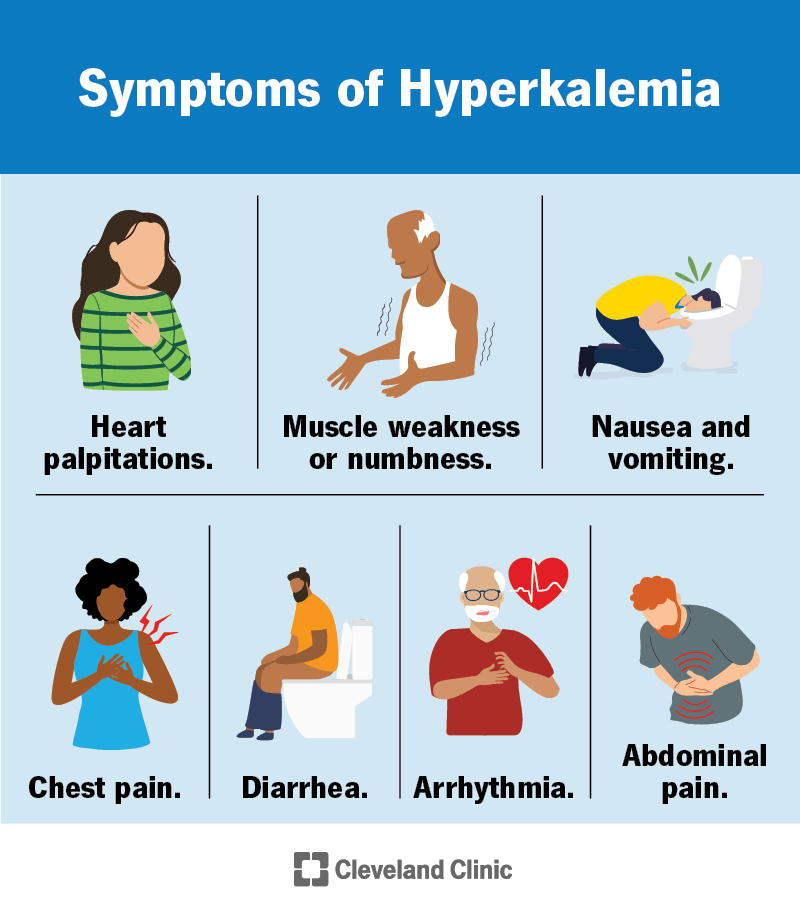
my.clevelandclinic.org →Hyperkalemia is a condition in which you have high potassium levels in your blood. You may not have any symptoms, or they may be easy to dismiss. Severe symptoms may cause muscle weakness or affect your heart. Treatment includes a low-potassium diet, medications that lower your potassium levels and, in severe cases, dialysis. Cleveland Clinic is a non-profit academic medical center. Advertising on our site helps support our mission. We do not endorse non-Cleveland Clinic products or services. Policy Hyperkalemia symptoms may be mild and easy to ignore. Severe hyperkalemia symptoms may affect your heart and muscles. Cleveland Clinic is a non-profit academic medical center. Advertising on our site helps support our mission. We do not endorse non-Cleveland Clinic products or services. Policy Potassium is a positively charged electrolyte . Electrolytes are minerals that have a natural positive or negative charge when they dissolve in water or other body fluids, such as blood. It helps carry an electric charge through your body, which helps your body function. Potassium helps: Muscles in your body expand and contract. Nerves send signals between your brain and the rest of your body. Move waste products out of your cells and nutrients into your cells. Offset sodium’s (salt’s) effects on your blood pressure. You get potassium through the foods and drinks you consume. Normally, your kidneys remove extra potassium, which leaves your body through your urine (pee). But if you have too much potassium in your body, your kidneys may not be able to remove all of it, and it can build up in your blood. Too much potassium in your blood can damage your heart , make you feel palpitations and even cause a heart attack . You can’t always tell when your potassium levels are high. A typical potassium level for adults is between 3.5 and 5.0 millimoles per liter (mmol/L). Hyperkalemia occurs when potassium levels go above 5.5 mmol/L. A potassium level above 6.5 mmol/L can cause heart problems that require immediate medical attention. In the general U.S. population, hyperkalemia is rare. Medical experts estimate 2% to 3% of people have high potassium levels. However, you’re up to three times more likely to have hyperkalemia if you have chronic kidney disease (CKD). Over half of those who have CKD but don’t need dialysis eventually develop high potassium levels. If you have mild hyperkalemia, you may not have any signs, or your signs might be easy to dismiss. Symptoms often come and go or may gradually develop over weeks or months. Mild hyperkalemia signs may include: Dangerously high potassium levels affect your heart and cause sudden, life-threatening problems. Severe hyperkalemia symptoms may include: Chest pain . Heart palpitations. Arrhythmia (irregular, fast or fluttering heartbeat). Muscle weakness or numbness in your limbs. The most common cause of hyperkalemia is kidney disease. Kidney disease damages your kidneys, which means they don’t filter wastes (including excess potassium) from your blood as well as they should. A high-potassium diet, including potassium supplements. Medications that block your kidneys’ ability to secrete potassium, including certain drugs that treat high blood pressure . In very rare cases, genetic disorders may cause high potassium levels. These include: Pseudohypoaldosteronism type 1 (PHA1) . A genetic mutation that helps your body regulate sodium causes PHA1. Pseudohypoaldosteronism type 2 (PHA2) . A genetic mutation that helps regulate your blood pressure causes PHA2. Another name for PHA2 is Gordon’s syndrome. Addison’s disease . Alcohol use disorder . Burns over a large part of your body. Congestive heart failure . Diabetes . Human immunodeficiency virus (HIV). Chronic kidney disease or a family history of CKD. Abnormal kidney structure. Severe hyperkalemia can come on suddenly. It can cause life-threatening changes to your heart that cause a heart attack. Without treatment, even mild hyperkalemia
Excerpt from a page describing this subject · 20,457 chars · not written by Vinony
Wikidata facts
- Instance of
- symptom or sign
- Subclass of
- electrolyte imbalance
- Image
- ECG in hyperkalemia.svg
Show 6 more facts
- health specialty
- endocrinology
- Commons category
- Hyperkalemia
- exact match
- purl.obolibrary.org/obo/HP_0002153
- NCI Thesaurus ID
- C37968
- opposite of
- hypokalemia
via Wikidata · CC0
~24 min read
Encyclopedic overview
21 sectionsContents
- Signs and symptoms
- Causes
- Ineffective elimination
- Excessive release from cells
- Excessive intake
- Pseudohyperkalemia
- Mechanism
- Physiology
- Elevated potassium
- Diagnosis
- Definitions
- ECG findings
- Prevention
- Treatment
- Myocardial excitability
- Temporary measures
- Elimination
- Epidemiology
- Society and culture
- References
- External links
Hyperkalemia is an elevated level of potassium (K+) in the blood. Normal potassium levels are between 3.5 and 5.0mmol/L (3.5 and 5.0mEq/L) with levels above 5.5mmol/L defined as hyperkalemia. Typically hyperkalemia does not cause symptoms. Occasionally when severe it can cause palpitations, muscle pain, muscle weakness, or numbness. Hyperkalemia can cause an abnormal heart rhythm which can result in cardiac arrest and death.
Common causes of hyperkalemia include kidney failure, hypoaldosteronism, and rhabdomyolysis. A number of medications can also cause high blood potassium including mineralocorticoid receptor antagonists (e.g., spironolactone, eplerenone and finerenone) NSAIDs, potassium-sparing diuretics (e.g., amiloride), angiotensin receptor blockers, and angiotensin converting enzyme inhibitors. The severity is divided into mild (5.5 – 5.9mmol/L), moderate (6.0 – 6.5 mmol/L), and severe (> 6.5mmol/L). High levels can be detected on an electrocardiogram (ECG), though the absence of ECG changes does not rule out hyperkalemia. The measurement properties of ECG changes in predicting hyperkalemia are not known. Pseudohyperkalemia, due to breakdown of cells during or after taking the blood sample, should be ruled out.
Excerpted from Wikipedia’s “hyperkalemia” article, available under the CC BY-SA 4.0 licence.