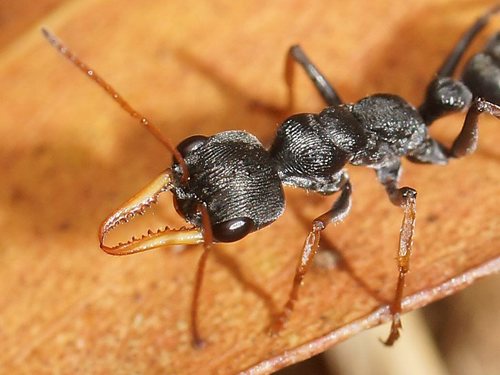
(c) Reiner Richter, some rights reserved (CC BY-NC-SA), uploaded by Reiner Richter · cc-by-nc-sa
In the Vinony graph
Vinony's link graph records 157 inbound references to Myrmecia, and connects out to Formicidae, Wikidata and anaphylaxis.
Vinony files it under Ant genera, Ants of Australia and Extant Early Cretaceous first appearances.
Vinony links it to 27 Wikipedia language editions.
Species
Jack Jumper Ant
Genus
- PhylumChlorophyta
- ClassTrebouxiophyceae
- OrderTrebouxiales
- FamilyTrebouxiaceae
鬥牛犬蟻屬(學名:Myrmecia)亦稱為牛蟻或鬥牛蟻,生活在澳大利亞和塔斯馬尼亞,身體能夠生長到5厘米,是體型較大的螞蟻之一,亦長有一根毒刺。
via
Museum specimens
- Specimen records
- 4,284
- With media
- 1
- Family
- Formicidae
- Collections
- NMV, CSIRO
- Recorded in
- Australia
Wikidata facts
- Instance of
- taxon
- Image
- Bullant apr07.jpg
Show 7 more facts
- taxon name
- Myrmecia
- taxon rank
- genus
- Commons category
- Myrmecia
- topic's main category
- Category:Myrmecia
- Commons gallery
- Myrmecia
- taxon common name
- Bulldog karıncası
- endemic to
- Australia
Sources (1)
via Wikidata · CC0
~40 min read
Encyclopedic overview
Myrmecia is a genus of ants first established by Danish zoologist Johan Christian Fabricius in 1804. The genus is a member of the subfamily Myrmeciinae of the family Formicidae. Myrmecia is a large genus of ants, comprising at least 93 species that are found throughout Australia and its coastal islands, while a single species is only known from New Caledonia. One species has been introduced out of its natural distribution and was found in New Zealand in 1940, but the ant was last seen in 1981. These ants are commonly known as bull ants, bulldog ants or jack jumper ants, and are also associated with many other common names. They are characterized by their extreme aggressiveness, ferocity, and painful stings. Some species are known for the jumping behavior they exhibit when agitated.
Species of this genus are also characterized by their elongated mandibles and large compound eyes that provide excellent vision. They vary in colour and size, ranging from 8 to 40 millimetres (0.31 to 1.57 in). While workers and queens are hard to distinguish from each other due to their similar appearance, males are identifiable by their perceptibly smaller mandibles. Almost all Myrmecia species are monomorphic, with little variation among workers of a given species. Some queens are ergatoid and have no wings, while others have either stubby or completely developed wings. Nests are mostly found in soil, but they can be found in rotten wood and under rocks. One species does not nest in the ground at all; its colonies can only be found in trees.
Excerpted from Wikipedia’s “Myrmecia” article, available under the CC BY-SA 4.0 licence.