File:Lamna_nasus_noaa.jpg · Wikimedia Commons · See Wikimedia Commons
porbeagle
Sign in to saveAlso known as Lamna nasus, porbeagle shark
The porbeagle or porbeagle shark (Lamna nasus) is a species of mackerel shark in the family Lamnidae, distributed widely in the cold and temperate marine waters of the North Atlantic and Southern Hemisphere. In the North Pacific, its ecological equivalent is the closely related salmon shark (L. ditropis). It typically reaches in length and a weight of ; North Atlantic sharks grow larger than Southern Hemisphere sharks and differ in coloration and aspects of life history. Grey above and white below, the porbeagle has a very stout midsection that tapers towards the long, pointed snout and t
OverviewAI-generated
The porbeagle, scientifically named *Lamna nasus*, is a species of shark belonging to the family Lamnidae. It is classified within the order Lamniformes, class Elasmobranchii, and phylum Chordata. The species has an accepted taxonomic status and is also referred to by common names such as the Atlantic mackerel shark, Sildehajen, Heringshai, and Tiburón cailón. Its parent taxon is *Lamna*.
This marine organism has a recorded range in Brazil. In the wild, its maximum longevity is 30 years. The porbeagle is listed as Vulnerable on the IUCN Red List, a status assigned in 2019. Additionally, it holds a regional conservation status of Critically Endangered.
Synthesized by Vinony from 24 facts across 5 sources: Wikidata, WoRMS, IUCN Red List, Encyclopedia of Life, Vinony graph. Generated from structured data (not the Wikipedia text) and checked against those facts — may still contain errors.
In the Vinony graph
Vinony catalogs porbeagle in its Vulnerable Species collection (16,386 entries).
Vinony's link graph records 331 inbound references to porbeagle, and connects out to fin, crocodile shark and geologic time scale.
Vinony files it under Cite IUCN maint, Cite IUCN without doi and Extant Miocene first appearances.
Vinony links it to 45 Wikipedia language editions.
Species
Vulnerable(common) Atlantic mackerel shark
Species
- PhylumChordata
- ClassElasmobranchii
- OrderLamniformes
- FamilyLamnidae
Maximum longevity: 30 years (wild)
via IUCN
Wikidata facts
Show 9 more facts
- taxon rank
- species
- IUCN conservation status
- Vulnerable
- Commons category
- Lamna nasus
- taxon name
- Lamna nasus
- Commons gallery
- Lamna nasus
- taxon common name
- marraxu buxu
- taxon range
- Brazil
- short name
- L. nasus
- regional conservation status
- Critically Endangered
Sources (2)
via Wikidata · CC0
~37 min read
Encyclopedic overview
16 sectionsContents
- Taxonomy
- Phylogeny and evolution
- Distribution and habitat
- Description
- Biology and ecology
- Feeding
- Life history
- Thermoregulation
- Human interactions
- Commercial fishing
- Conservation
- Southern Hemisphere
- Eastern North Atlantic and Mediterranean Sea
- Western North Atlantic
- References
- External links
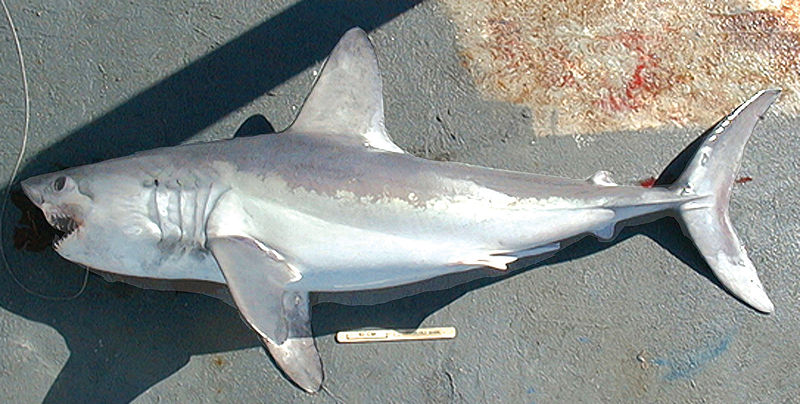
The porbeagle or porbeagle shark (Lamna nasus) is a species of mackerel shark in the family Lamnidae, distributed widely in the cold and temperate marine waters of the North Atlantic and Southern Hemisphere. In the North Pacific, its ecological equivalent is the closely related salmon shark (L. ditropis). It typically reaches in length and a weight of ; North Atlantic sharks grow larger than Southern Hemisphere sharks and differ in coloration and aspects of life history. Grey above and white below, the porbeagle has a very stout midsection that tapers towards the long, pointed snout and the narrow base of the tail. It has large pectoral and first dorsal fins, tiny pelvic, second dorsal, and anal fins, and a crescent-shaped caudal fin. The most distinctive features of this species are its three-cusped teeth, the white blotch at the aft base of its first dorsal fin, and the two pairs of lateral keels on its tail.
The porbeagle is an opportunistic hunter that preys mainly on bony fishes and cephalopods throughout the water column, including the bottom. Most commonly found over food-rich banks on the outer continental shelf, it makes occasional forays both close to shore and into the open ocean to a depth of . It also conducts long-distance seasonal migrations, generally shifting between shallower and deeper water. The porbeagle is fast and highly active, with physiological adaptations that enable it to maintain a higher body temperature than the surrounding water. It can be solitary or gregarious, and has been known to perform seemingly playful behavior. This shark is aplacental viviparous with oophagy, developing embryos being retained within the mother's uterus and subsisting on non-viable eggs. Females typically bear four pups every year.
Excerpted from Wikipedia’s “porbeagle” article, available under the CC BY-SA 4.0 licence.