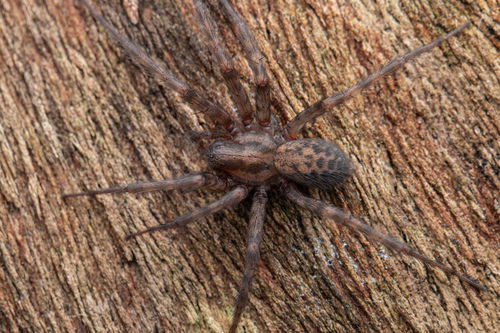
(c) Frederik Leck Fischer, all rights reserved, uploaded by Frederik Leck Fischer
Agelena
Sign in to saveAgelena is a genus of agelenid spiders first described by Charles Athanase Walckenaer in 1805. Sometimes referred to as Eurasian grass spiders, they trap their prey by weaving entangling non-sticky funnel webs. They are limited to the Old World, occurring from Africa to Japan. Many species have been moved to other genera, particularly to Allagelena, Benoitia and Mistaria.
Species
Barn Funnel Weaver
GENUS
- KingdomAnimalia
- PhylumArthropoda
- ClassArachnida
- OrderAraneae
- FamilyAgelenidae
Agelena es un género de arañas araneomorfas que tejen telarañas de una gran superficie, en forma de embudo, en el fondo del cual acecha la araña a la espera de atrapar a sus presas. El género está limitado al Viejo Mundo, apareciendo desde África y Europa hasta Japón. En la península ibérica las dos especies más representativas de este género son Agelena labyrinthica y Agelena gracilens. En las islas Canarias encontramos varios endemismos como Agelena canariensis, Agelena gomerensis, Agelena gonzalezi y Agelena tenerifensis. Especies Cuatro especies fueron transferidas al género Allagelena en 2006. Agelena agelenoides (Walckenaer, 1842) (Mediterráneo occidental) Agelena annulipedella Strand, 1913 (África central) Agelena atlantea Fage, 1938 (Marruecos) Agelena australis Simon, 1896 (Sur de África) Agelena babai Tanikawa, 2005 (Japón) Agelena barunae Tikader, 1970 (India) Agelena bifida Wang, 1997 (China) Agelena borbonica Vinson, 1863 (Reunión) Agelena canariensis Lucas, 1838 (Islas Canarias, Marruecos y Argelia) Agelena chayu Zhang, Zhu & Song, 2005 (China) Agelena choi Paik, 1965 (Corea) Agelena consociata Denis, 1965 (Gabón) Agelena cuspidata Zhang, Zhu & Song, 2005 (Chi
via GBIF
Museum specimens
- Specimen records
- 137
- With media
- 2
- Family
- Agelenidae
- Collections
- RBINS-SCIENTIFIC HERITAGE, ARC-PPRI, SAM
- Recorded in
- Turkey, Dr Congo, South Africa, Namibia
Wikidata facts
- Instance of
- taxon
- Parent taxon
- Agelenidae
- Image
- Agelena labyrinthica.jpg
Show 5 more facts
- Commons category
- Agelena
- taxon name
- Agelena
- taxon rank
- genus
- topic's main category
- Category:Agelena
- taxonomic type
- Agelena labyrinthica
Sources (1)
via Wikidata · CC0
~6 min read
Encyclopedic overview
6 sectionsContents
- Life style
- Description
- Species
- Former species
- References
- External links
Agelena is a genus of agelenid spiders first described by Charles Athanase Walckenaer in 1805. Sometimes referred to as Eurasian grass spiders, they trap their prey by weaving entangling non-sticky funnel webs. They are limited to the Old World, occurring from Africa to Japan. Many species have been moved to other genera, particularly to Allagelena, Benoitia and Mistaria.
==Life style== Agelena constructs a typical non-sticky funnel-web that features a flat open sheet-like area. The webs are usually positioned close to the soil surface within low vegetation. The capture web consists of a flat, slightly concave, non-adhesive silk sheet that measures 40-60 cm wide and is composed of a mesh of silken threads suspended by oblique and vertical threads. This sheet is laid over the ground or any horizontal area and is usually clearly visible in the early morning when it becomes covered with dewdrops. The web typically remains in the same location and is repaired and enlarged as the spider grows.
Excerpted from Wikipedia’s “Agelena” article, available under the CC BY-SA 4.0 licence.
Gallery (3)
Available in 22 languages
- Español
- Français
- 中文
- Русский
- Italiano
- Belarusian
- Catalan
- Cebuano
- Czech
- Egyptian Arabic
- Greek
- Limburgish
- Navajo
- Nederlands
- Polski
- Romanian
- Svenska
- Tiếng Việt
via Wikidata sitelinks · CC0