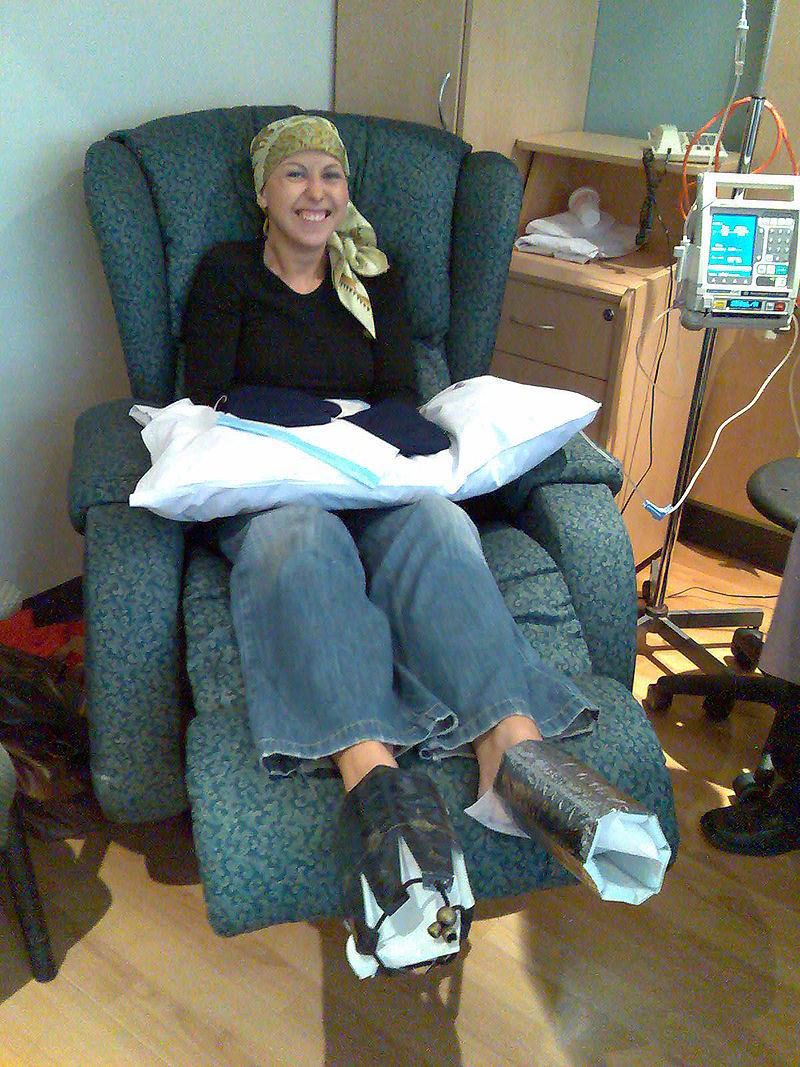
File:Chemotherapy_with_acral_cooling.jpg · Wikimedia Commons · See Wikimedia Commons
chemotherapy
Sign in to saveChemotherapy (often abbreviated chemo, sometimes CTX and CTx) is the type of cancer treatment that uses one or more anti-cancer drugs (chemotherapeutic agents or alkylating agents) in a standard regimen. Chemotherapy may be given with a curative intent (which almost always involves combinations of drugs), or it may aim only to prolong life or to reduce symptoms (palliative chemotherapy). Chemotherapy is one of the major categories of the medical discipline specifically devoted to pharmacotherapy for cancer, which is called medical oncology.
Chemotherapy is a cancer treatment that uses anti-cancer drugs given according to a standard treatment plan, either to cure cancer or to extend life and reduce symptoms. It is one of the main approaches doctors use in the medical field of oncology to treat cancer with medication.
AI-generated from the Wikipedia summary — may contain errors.
Key facts
- Medical intervention (new).name
- Chemotherapy
- Medical intervention (new).image
- Chemotherapy with acral cooling.jpg
- Medical intervention (new).caption
- A woman being treated with docetaxel chemotherapy for breast cancer. Cold mittens and booties are placed on her hands and feet to protect the nerves there, reducing the risk of neuropathy.
- Medical intervention (new).synonyms
- chemo, CTX, CTx
via Wikipedia infobox
Wikidata facts
- Subclass of
- chemotherapy
- Image
- Chemotherapy vials (4).jpg
Show 7 more facts
- described by source
- Armenian Soviet Encyclopedia
- topic's main category
- Category:Chemotherapy
- Commons category
- Chemotherapy
- has effect
- cancer pain
- different from
- chemotherapy
- on focus list of Wikimedia project
- Wikipedia:Vital articles/Level/4
via Wikidata · CC0
~80 min read
Encyclopedic overview
53 sectionsContents
- Treatment strategies
- Effectiveness
- Dosage
- Types
- Alkylating agents
- Antimetabolites
- Anti-microtubule agents
- Topoisomerase inhibitors
- Cytotoxic antibiotics
- Delivery
- Adverse effects
- Immunosuppression and myelosuppression
- Neutropenic enterocolitis
- Gastrointestinal distress
- Anemia
- Nausea and vomiting
- Hair loss
- Secondary neoplasm
- Infertility
- Teratogenicity
- Peripheral neuropathy
- Cognitive impairment
- Tumor lysis syndrome
- Organ damage
- Other side-effects
- Limitations
- Resistance
- Cytotoxics and targeted therapies
- Mechanism of action
- Other uses
- Occupational exposure and safe handling
- Routes of exposure
- Hazards
- Safe handling in health care settings
- Preparation
- Administration
- Employee training
- Housekeeping and waste disposal
- Spill control
- Occupational monitoring
- Available agents
- History
- The term ''chemotherapy''
- Research
- Targeted delivery vehicles
- Antibody-drug conjugates
- Nanoparticles
- Electrochemotherapy
- Hyperthermia therapy
- Other animals
- See also
- References
- External links
Chemotherapy (often abbreviated chemo, sometimes CTX and CTx) is the type of cancer treatment that uses one or more anti-cancer drugs (chemotherapeutic agents or alkylating agents) in a standard regimen. Chemotherapy may be given with a curative intent (which almost always involves combinations of drugs), or it may aim only to prolong life or to reduce symptoms (palliative chemotherapy). Chemotherapy is one of the major categories of the medical discipline specifically devoted to pharmacotherapy for cancer, which is called medical oncology.
The term chemotherapy now means the non-specific use of intracellular poisons to inhibit mitosis (cell division) or to induce DNA damage (so that DNA repair can augment chemotherapy). This meaning excludes the more-selective agents that block extracellular signals (signal transduction). Therapies with specific molecular or genetic targets, which inhibit growth-promoting signals from classic endocrine hormones (primarily estrogens for breast cancer and androgens for prostate cancer), are now called hormonal therapies. Other inhibitions of growth-signals, such as those associated with receptor tyrosine kinases, are targeted therapy.
Excerpted from Wikipedia’s “chemotherapy” article, available under the CC BY-SA 4.0 licence.
Gallery (38)
Available in 84 languages
- Español
- Français
- Deutsch
- 中文
- 日本語
- Русский
- Português
- Italiano
- العربية
- हिन्दी
- Afrikaans
- Albanian
- Aragonese
- Armenian
- Asturian
- Azerbaijani
- Bahasa Indonesia
- Bangla
Show 65 more
- Basque
- be_x_old
- Belarusian
- Bosnian
- Bulgarian
- Catalan
- Central Kurdish
- Croatian
- Czech
- Danish
- Esperanto
- Estonian
- Filipino
- Finnish
- Galician
- Greek
- Haitian Creole
- Hausa
- Hebrew
- Hungarian
- Ido
- Igbo
- Irish
- Javanese
- Kannada
- Kazakh
- Kikuyu
- Kyrgyz
- Latin
- Latvian
- Lithuanian
- Luxembourgish
- Macedonian
- Malay
- Malayalam
- Marathi
- Nederlands
- Norwegian
- Pashto
- Polski
- Punjabi
- Romanian
- Serbian
- Serbian (Latin)
- simple
- Sindhi
- Sinhala
- Slovak
- Slovenian
- Svenska
- Tamil
- Tatar
- Tiếng Việt
- Türkçe
- Ukrainian
- Urdu
- Uzbek
- Waray
- Welsh
- Wu Chinese
- Zaza
- zh_yue
- فارسی
- ไทย
- 한국어
via Wikidata sitelinks · CC0