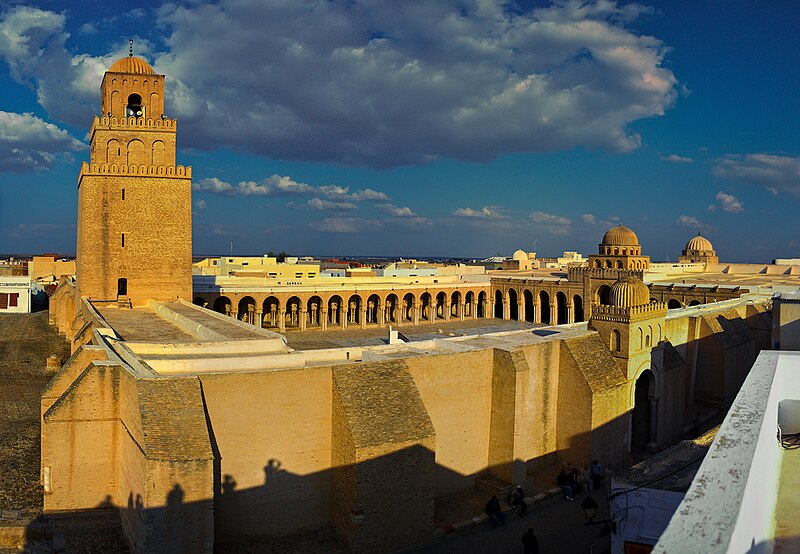
File:Great_Mosque_of_Kairouan_Panorama_-_Grande_Mosquée_de_Kairouan_Panorama.jpg · Wikimedia Commons · See Wikimedia Commons
Great Mosque of Kairouan
Also known as Mosque of Uqba, Sidi Ukbe Camii
Tunisian religious building and site of Islamic worship
Key facts
- Affiliation
- Islam
- Status
- Active
- Location
- Kairouan , Tunisia
- Style
- Aghlabid
- Completed
- 9th century (current building, with later restorations)
via Wikipedia infobox
Wikidata facts
- Image
- Grande Mosquée de Kairouan, vue d'ensemble.jpg
Show 2 more facts
- Commons category
- Great Mosque of Kairouan
- Commons gallery
- Grande Mosquée de Kairouan
Sources (3)
~37 min read
Article
The Great Mosque of Kairouan (Arabic: جامع القيروان الأكبر), also known as the Mosque of Uqba (جامع عقبة بن نافع), is a mosque situated in the UNESCO World Heritage town of Kairouan, Tunisia and is one of the largest Islamic monuments in North Africa.
Established by the Arab general Uqba ibn Nafi in 50 AH (670/671 CE) at the founding of the city of Kairouan, the mosque occupies an area of over 9,000 square metres (97,000 sq ft). It is one of the oldest places of worship in the Islamic world, and is a model for all later mosques in the Maghreb. Its perimeter, of about 405 metres (1,329 ft), contains a hypostyle prayer hall, a marble-paved courtyard and a square minaret. In addition to its spiritual prestige, the Mosque of Uqba is one of the masterpieces of Islamic architecture, notable among other things for the first Islamic use of the horseshoe arch.